Why was ‘incredible’ giant cedar cut down, despite B.C.’s big-tree protection law?
Advertisement
Read this article for free:
or
Already have an account? Log in here »
To continue reading, please subscribe:

Digital Subscription
One year of digital access for only $205*
- Enjoy unlimited reading on winnipegfreepress.com
- Read the E-Edition, our digital replica newspaper
- Access News Break, our award-winning app
- Play interactive puzzles
*First annual payment billed as $205.00 + GST for one year. This annual subscription will automatically renew at $233.00 + GST every 52 weeks (10% off the regular annual price of $259.35). Offer available to new and qualified returning subscribers only. Cancel any time.
To continue reading, please subscribe:
Add Free Press access to your Brandon Sun subscription for only an additional
$1 for the first 4 weeks*
- Enjoy unlimited reading on winnipegfreepress.com
- Read the E-Edition, our digital replica newspaper
- Access News Break, our award-winning app
- Play interactive puzzles
*Your next Brandon Sun subscription payment will increase by $1.00 and you will be charged $17.95 plus GST for four weeks. After four weeks, your payment will increase to $24.95 plus GST every four weeks.
Read unlimited articles for free today:
or
Already have an account? Log in here »
Hey there, time traveller!
This article was published 04/12/2025 (289 days ago), so information in it may no longer be current.
Joshua Wright says a yellow cedar tree he photographed last year was “incredible,” the largest he’d ever seen in a decade of hiking around Vancouver Island.
The monumental cedar stood in what was one of the few intact or nearly intact old-growth valleys left on the island, says Wright, an advocate who also recorded the sounds of marbled murrelets — a threatened species under federal law — within the same forest.
Wright measured the cedar’s diameter at 2.79 metres, a size that should have ensured protection for the tree, along with a one-hectare buffer under provincial law.
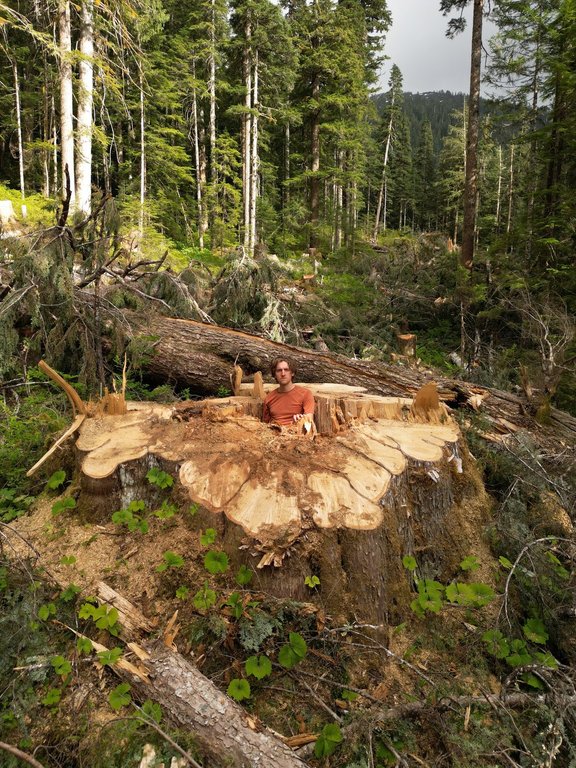
But when he returned to the area south of Gold River in June, Wright says the tree had been felled as part of a logging operation approved by the province.
“It was clearly above the threshold for what the government is supposed to be protecting and what industry is supposed to be protecting,” he said in an interview.
The tree was cut down under a system that partly relies on logging operators to report the existence of trees large enough to warrant protection. When Wright saw the yellow cedar standing, it had already been marked with spray paint. But the apparent marking did not save the tree from being cut sometime in the last year.
The Forests Ministry said it was investigating the felling after Wright’s complaint. It would not confirm whether officials were aware of the tree before the complaint.
Rachel Holt, an independent ecologist who has advised the British Columbia government, said it is “very disturbing to see example after example” of forests with the oldest, biggest trees continue to be logged, especially those identified as containing the most at-risk and irreplaceable old-growth left in the province.
“This is off the charts, globally rare stuff,” Holt said.
“We’ve lost sight of that in British Columbia. We’ve never had sight of that, and that’s what needs to change,” she said in an interview.
Provincial mapping shows the area where Wright documented the yellow cedar overlaps significantly with a category of old-growth representing the largest trees left standing.
Holt served on a provincial advisory panel that identified much of the area as “big-treed” old growth and recommended it be set aside from logging in 2021.
Yet the deferrals required support from First Nations to go ahead, and at the time, there was no significant funding to help communities offset foregone revenues.
A notice posted on B.C.’s Forest Operations Map website shows the yellow cedar was felled in an area where Matchlee Ltd. Partnership, majority owned by Mowachaht/Muchalaht First Nation, holds a non-renewable forest licence.
The province announced a $300-million conservation financing fund in the fall 2023, saying it was aimed at “accelerating protection of B.C.’s oldest and rarest trees.”
But Holt said forests identified as priority for deferral continue to be logged, with no meaningful financial alternatives readily available to First Nations.
“The process has failed because that conservation financing hasn’t come to the table to make sure no First Nation loses out by choosing not to log ancient forest.”
Representatives of Mowachaht/Muchalaht First Nation did not respond to requests for comment on the logging operation.
Asked how much money from the B.C. Conservation Fund has gone to First Nations in support of old-growth logging deferrals, the province said there are “instances” of that happening when deferrals overlap with conservation interests.
Forests Minister Ravi Parmar said people he engages with in every corner of B.C. “care deeply about forests, care deeply about forestry and old-growth.”
Old forests carry social value, including “for me as an Islander,” said Parmar, who represents the riding of Langford-Highlands, west of Victoria.
“The Ministry of Forests has and will continue working with First Nations throughout British Columbia to collaboratively steward our forests on their traditional lands and protect old-growth and protect our forest biodiversity.”
Parmar acknowledged the province is facing “fibre supply constraints,” or a lack of timber that’s both mature enough and economically viable to harvest, as it works to bolster the industry that’s been hard hit by mill closures and U.S. tariffs.
The minister pointed to forest losses from wildfires and the mountain pine beetle epidemic, which has subsided since a peak around 2005.
“It has nothing to do with government policy, it has nothing to do with reconciliation,” Parmar said of the dearth of merchantable timber.
“It has everything to do with the fact that the trees aren’t there. They will come back, they will grow back. But they are not here right now.”
‘WE HAVE A FAILED SYSTEM’
Parmar said rates of old-growth logging have declined in recent years under the New Democrat government, though it will “always be a part of (B.C.’s) forest sector.”
But a recent analysis by two other former members of B.C.’s old-growth advisory panel found logging rates since 2021 have been higher in big-treed old growth than in old-growth forests with smaller trees at lower risk of irreversible biodiversity loss.
The report by independent ecologist Karen Price and registered professional forester Dave Daust found logging had disturbed 2.1 per cent of the panel’s recommended deferral areas, compared with 0.5 per cent of other old-growth, making logging four times as likely in forests with the biggest and oldest trees.
Wright took a series of photos of the giant yellow cedar before and after it was cut.
One taken in June 2024 shows him standing at the moss-covered base of its towering, silvery trunk. Another, taken a year later, shows him sitting inside the hollow centre of the tree’s splintered stump.
The forest also contained western red cedar trees Wright called “massive.”
He said the yellow cedar, at least, should have been left standing under the special tree protection regulation, which came into force in 2020.
The province set out to protect 1,500 exceptionally large trees with certain diameters; for yellow cedars, the threshold is 2.65 metres.
Wright’s measurement of 2.79 metres for the Gold River tree should have afforded it protection, along with a buffer radius around the tree.
When those responsible for forestry operations become aware of a tree that meets the threshold for protection, they must report it within 30 days and preserve it.
The forests minister has the power to grant an exception under certain conditions.
Wright said he filed a complaint about the felling of the yellow cedar. The Forests Ministry said it couldn’t comment beyond confirming its investigation was ongoing.
Parmar said the province has mechanisms in place to ensure the regulation is followed and applies penalties in the event of a violation.
But Holt said there is little oversight in B.C.’s forests.
“I’m literally spending my morning looking at old-growth management areas that don’t have old-growth in them, and looking at the adjacent old-growth that does exist that’s not protected,” she said. “We have a failed system here.”
Holt said she recently told a senior staff member at the Forests Ministry that she was standing atop the stump of what had been a roughly 1,000-year-old tree.
“And they said, ‘Oh, wow.’ Like they didn’t seem to know that we do that on a day-to-day basis here in British Columbia,” she recalled.
Holt said trees that qualify under the special tree protection regulation are “extremely rare” and special, but sparing them won’t save the broader ecosystem.
The way B.C. has set the thresholds means “almost no trees” qualify, she added.

“The idea that if a tree qualified and was still cut, I mean, that just shows how far wrong our forest management system is,” Holt said.
Wright, too, said he appreciates the regulations to save some of B.C.’s biggest trees, but they also amount to “greenwashing” by the B.C. government as it continues to approve the logging of ancient forests while pledging to protect them.
“I think the issue isn’t why are trees like this being cut down, it’s why are places like this being destroyed? That’s the bigger question,” he said.
“When a tree dies, it’s sad … But ecosystems shouldn’t die, like that’s horrible.”
This report by The Canadian Press was first published Dec. 4, 2025.