In Senegal, climate change is adding to historic tension between farmers and herders
Advertisement
Read this article for free:
or
Already have an account? Log in here »
To continue reading, please subscribe:

Digital Subscription
One year of digital access for only $205*
- Enjoy unlimited reading on winnipegfreepress.com
- Read the E-Edition, our digital replica newspaper
- Access News Break, our award-winning app
- Play interactive puzzles
*First annual payment billed as $205.00 + GST for one year. This annual subscription will automatically renew at $233.00 + GST every 52 weeks (10% off the regular annual price of $259.35). Offer available to new and qualified returning subscribers only. Cancel any time.
To continue reading, please subscribe:
Add Free Press access to your Brandon Sun subscription for only an additional
$1 for the first 4 weeks*
- Enjoy unlimited reading on winnipegfreepress.com
- Read the E-Edition, our digital replica newspaper
- Access News Break, our award-winning app
- Play interactive puzzles
*Your next Brandon Sun subscription payment will increase by $1.00 and you will be charged $17.95 plus GST for four weeks. After four weeks, your payment will increase to $24.95 plus GST every four weeks.
Read unlimited articles for free today:
or
Already have an account? Log in here »
Hey there, time traveller!
This article was published 16/12/2025 (299 days ago), so information in it may no longer be current.
DAKAR, Senegal (AP) — Cheikh Diouf and his father had just delivered a load of manure to the family’s fields near their village in January when Diouf, returning home for a second load, got an urgent phone call from his sister-in-law: His father, she said, was arguing with a group of herders. By the time Diouf raced to the field, his father was dead, struck down by machete blows.
There was no trace of the attackers, but Diouf and his family blame herders whose animals had grazed into the cassava fields that Moussa Diouf was cultivating. The elder Diouf, in his 60s, spent most of his time in the fields or at a mosque where he served as muezzin, performing the daily call to prayer.
“It hurts so much,” Diouf, 18, said. “If only I had been there, he wouldn’t have died. Either I or the herder would have died — but not my father. If I ever meet that herder, I will avenge him, that’s for sure.”

Tension between farmers and herders has long been a fact of life in West Africa, but climate change is ramping it up. Declining rainfall and rising temperatures have dried up pasture land at the same time agricultural use has expanded. And that’s meant more frequent conflict as nomadic herders, and their cattle, sheep and goats, range through the region searching for grazing.
Changing weather patterns in Senegal breed conflict
Senegal has averaged about 27% less annual rainfall in the past 30 years than it did from 1951 to 1980, according to data from the Copernicus Climate Change Service. Meanwhile, farmers also complain that it’s become impossible to determine when the rains will begin and end — sometimes delaying seeding or damaging crops.
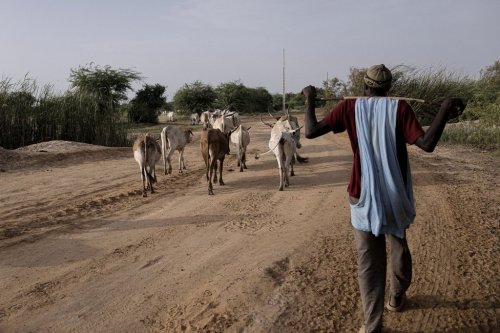
The Peul, or Fulani, are herders who have traditionally raised animals across a vast territory from Senegal to Nigeria. Their nomadic movements are essential in a region that doesn’t produce enough vegetation to feed a large number of animals in one place all year long. They also supply two-thirds or more of the meat and milk sold in the region’s markets, according to a United Nations study.
In Senegal, the approach of the dry season in October and November typically sees them moving their herds southward from the semi-desert northern region along centuries-old routes. But in recent decades, that southward journey has become longer as they’ve had to search for more favorable land, and it’s during this migration — which overlaps with harvest — when disputes between the two groups are worst.
Animals can struggle to find grazing because grass has often been cut to sell as forage. That can lead shepherds to cut branches from trees to feed their animals, contributing to deforestation and desertification. And when the animals pass near crops, which typically aren’t fenced or monitored, they are attracted to the food.
It’s difficult to get accurate data on violent incidents because Senegal doesn’t have a specific investigation system in place and most aren’t officially recorded. They’re often mediated locally with village chiefs overseeing. But Senegalese media have reported numerous instances since 2024, including a death in Amdalah and serious injuries in Diounto, both in January 2025.
Everyday tools become weapons
Both shepherds and farmers use cutting tools in their daily work and in disputes they can easily be weapons. That’s the case with the diassi, a small machete that can cut tall grass or wood to build a hut, cut branches to feed an animal or serve as protection against wild animals or cattle thieves.
Dr. Yawma Fall, deputy head of the Ndofane medical center in the Kaolack region, said in the past 18 months she has seen wounds from clashes between farmers and herders. She described a shepherd about 12 years old struck in the shoulder with an ax by a man apparently angered because the boy’s livestock entered his field. She described another shepherd who lost fingers when he was struck with a blade.
In the Saint-Louis region, near the Mauritanian border, an ordinary day in the fields in 2022 turned into a confrontation that cost Mamadou Gueye, a 39-year-old farmer, his left hand. He described a fight with a herder over cattle that included a motorbike chase.
“As soon as they saw us coming, they drew their machetes to scare us. That’s when I was struck — I saw my blood flowing fast,” he said. He added: “The relationship between us and the herders is very tense; we mistrust each other. There’s no friendship between them and me.”
What farmers and herders say
On the outskirts of the village of Ndofane, 45-year-old Fode Diome sits beneath a tree where he spends most of his days watching over his fields.
Problems between herders and farmers have existed for a long time, he said.
“It’s normal that animals need to eat, I agree, but there are specific times when transhumance is allowed,” he said, using the term for moving livestock to new grazing areas.
“Unfortunately, most herders don’t respect this rule, and that causes damage. They’re allowed to come only after the harvest, when all fieldwork is done, usually in January and not before. Sometimes the nomads stay here until the next rains, and we ask them to leave because we need to prepare the fields for the new season.”
For herders, finding pasture is a major concern, complicated by the gradual expansion of land under cultivation. They also have the burden of nurturing their animals through winter, as well as costs of veterinary care and feed that are difficult for the average herder.
“There’s no grass left for the livestock. Everywhere you go, there are fields. It has become very difficult,” says Alioune Sow, a 61-year-old herder from Linguere. “Especially after the rainy season: if you don’t move with your animals in search of pasture, you’re forced to buy feed. There are no cattle paths. Since fields are almost everywhere, the animals wander into them and sometimes they get poisoned.”
Sitting on a worn wooden platform in the shade of a large, low canopy, he keeps watch over his goats, gathered inside a small enclosure within Dakar’s sprawling livestock market. He said he hasn’t had major disputes with farmers, but some of his relatives have.
He said one possible solution would be to designate land specifically for farmers and other areas reserved for herders.
What’s being done to manage the problem
Senegal doesn’t have a national entity that manages conflict between agriculture and herding. Mediation falls mainly to local communities, helped out by associations and other nongovernmental bodies.
Labgar, a village in the Louga region, has managed to defuse some of the tensions between farmers and herders, said Papa Khokhane Seydou Faye, the village’s agricultural and rural adviser since 2017. Many longtime nomadic routes pass through the village.
With help from NGO workers, the village organizes periodic meetings with members of both groups on sensitive issues such as fires, deforestation and grazing conflict, to talk about possible solutions. In one workshop, the solutions discussed for grazing conflict included more clearly marking grazing trails as well as field boundaries.
___
Associated Press data journalist M.K. Wildeman contributed from Hartford, Connecticut.
___
The Associated Press’ climate and environmental coverage receives financial support from multiple private foundations. For global health and development coverage in Africa, the AP receives financial support from the Gates Foundation. AP is solely responsible for all content. Find AP’s standards for working with philanthropies, a list of supporters and funded coverage areas at AP.org.