Fast shipping is increasing emissions. Here’s why delivery has become more polluting
Advertisement
Read this article for free:
or
Already have an account? Log in here »
To continue reading, please subscribe:

Digital Subscription
One year of digital access for only $205*
- Enjoy unlimited reading on winnipegfreepress.com
- Read the E-Edition, our digital replica newspaper
- Access News Break, our award-winning app
- Play interactive puzzles
*First annual payment billed as $205.00 + GST for one year. This annual subscription will automatically renew at $233.00 + GST every 52 weeks (10% off the regular annual price of $259.35). Offer available to new and qualified returning subscribers only. Cancel any time.
To continue reading, please subscribe:
Add Free Press access to your Brandon Sun subscription for only an additional
$1 for the first 4 weeks*
- Enjoy unlimited reading on winnipegfreepress.com
- Read the E-Edition, our digital replica newspaper
- Access News Break, our award-winning app
- Play interactive puzzles
*Your next Brandon Sun subscription payment will increase by $1.00 and you will be charged $17.95 plus GST for four weeks. After four weeks, your payment will increase to $24.95 plus GST every four weeks.
Read unlimited articles for free today:
or
Already have an account? Log in here »
Hey there, time traveller!
This article was published 23/12/2025 (266 days ago), so information in it may no longer be current.
It feels simple: You shop, find something you want and click to buy. It shows up today, overnight or tomorrow. We’ve gotten used to that speed. But that convenience comes with a climate cost.
Multiple factors shape the environmental toll of a delivery. These include the distance from a fulfillment center, whether the shipment rides in a half-empty truck, how many trips a driver makes in the same area and the type of transportation used to move the package.
When customers choose faster shipping and earlier delivery dates, the system shifts from optimized routing to whatever gets the package out fastest, and that means higher emissions, said Sreedevi Rajagopalan, a research scientist at MIT’s Center for Transportation and Logistics. For example, trucks may leave warehouses before they’re full and drivers might loop the same neighborhood multiple times a day, she said.
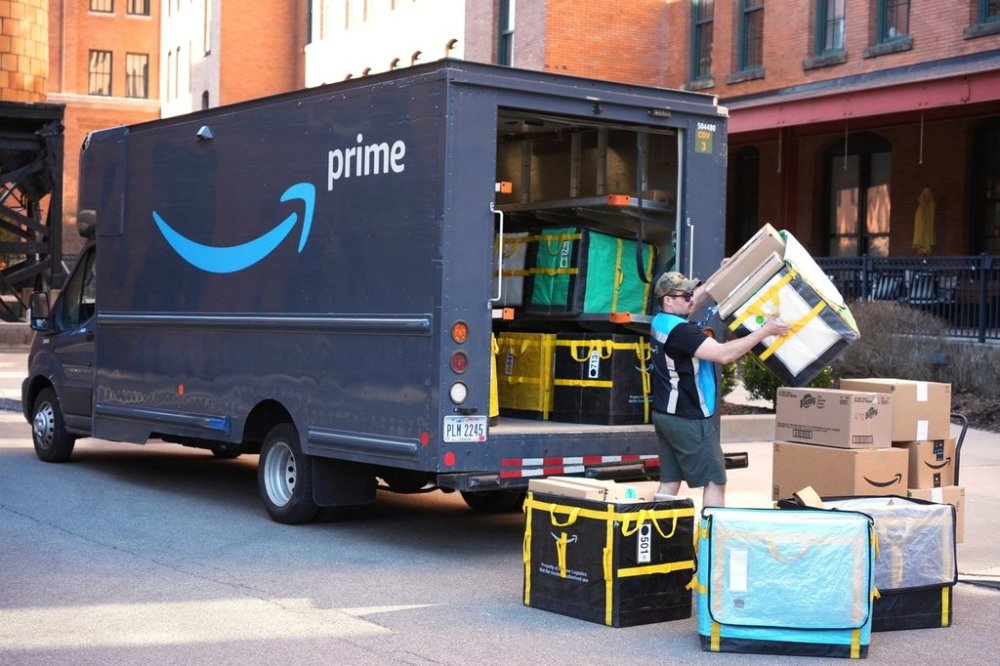
“For the same demand, fast shipping definitely increases emissions 10 to 12%,” she said.
To meet tight delivery windows, retailers may rely on air freight, which produces far more emissions than other options such as trains, making it the most carbon-intensive.
“Given that companies want to be competitive in terms of speed, it comes at the cost of your efficiency,” Sreedevi said. “Vans are half full, and you make multiple rounds, multiple trips to the same location … your fuel consumption goes up, and you’re not able to consolidate.”
One way companies like Amazon try to minimize that is by placing their supply chain closer to customers to reduce mileage and improve speed for the customer. Their goal is to make the journey fast and effective, but reduce its emissions at the same time.
“By really leveraging our supply chain efficiencies that we have at scale, we’re able to both offer better speed and sustainability outcomes at the same time,” said Chris Atkins, director of Worldwide Operations Sustainability at Amazon.
The last mile
Getting items to customers’ doors from a fulfillment center — referred to as the “last mile” or “last kilometer” of shipping — is one of the hardest stages to make less polluting, Sreedevi said.
Emissions rise even more when customers place multiple small orders throughout the week.
“If I place an order this morning and then I place an order this evening and choose fast shipping, the company might have already processed my morning order and wouldn’t wait for my evening order to consolidate,” she said.
And sending more half-full trucks out on the road means more trips overall.
“Imagine you’re not only sending a half-full truck, you’re also bringing back that truck empty. … Emissions are going to go up,” Sreedevi said.
Reducing emissions
Consumers can lower emissions if they’re willing to wait even a tiny bit, and they’ll save money at the same time, said Christopher Faires, assistant professor of logistics and supply chain management at Georgia Southern University.
Delaying delivery by one to two days can result in a 36% reduction in carbon dioxide emissions, and three to four days pushes that reduction to 56%, so opting for standard or delayed shipping instead of next-day or two-day shipping helps, according to Sreedevi.
Amazon’s Atkins said changes to their network are cutting emissions linked to fast delivery. The company has expanded the use of electric delivery vans and shifted more packages to rail and to delivering by foot or bicycle in dense cities.
“Aviation is very carbon-intensive relative to ground shipping,” said Atkins. “One of the other things that Amazon and other logistics companies are looking at doing is: How do we mode-shift to less carbon intensive forms of transportation?”
Amazon says providing shipping options that encourage customers to consolidate orders have also helped. Data for the first nine months of 2025 shows that when customers chose a single delivery day for all items, it reduced more than 300 million delivery stops and avoided 100,000 tons (90,718 metric tons) of carbon emissions, according to Atkins.
Consumers change behavior when they know the impact

People are more likely to delay or consolidate orders once they understand the environmental impact of fast shipping, according to Sreedevi, who co-authored a 2024 study of delivery customers in Mexico.
“A significant number of consumers decided to wait for longer delivery or delayed their shipping when we showed them the environmental impact information in the form of trees,” said Sreedevi. “So it’s important that they are educated.”
While fast shipping isn’t likely to go away, experts say its climate impacts can be meaningfully reduced through small behavior shifts, both from shoppers and companies. Bundling orders, skipping the overnight option and choosing a single weekly delivery can all make a difference.
___
The Associated Press’ climate and environmental coverage receives financial support from multiple private foundations. AP is solely responsible for all content. Find AP’s standards for working with philanthropies, a list of supporters and funded coverage areas at AP.org.