Out of the shadows
Adaptation of Gabrielle Roy’s nostalgic tale subtle and sweet

Advertisement
Read this article for free:
or
Already have an account? Log in here »
To continue reading, please subscribe:

Digital Subscription
One year of digital access for only $205*
- Enjoy unlimited reading on winnipegfreepress.com
- Read the E-Edition, our digital replica newspaper
- Access News Break, our award-winning app
- Play interactive puzzles
*First annual payment billed as $205.00 + GST for one year. This annual subscription will automatically renew at $233.00 + GST every 52 weeks (10% off the regular annual price of $259.35). Offer available to new and qualified returning subscribers only. Cancel any time.
To continue reading, please subscribe:
Add Free Press access to your Brandon Sun subscription for only an additional
$1 for the first 4 weeks*
- Enjoy unlimited reading on winnipegfreepress.com
- Read the E-Edition, our digital replica newspaper
- Access News Break, our award-winning app
- Play interactive puzzles
*Your next Brandon Sun subscription payment will increase by $1.00 and you will be charged $17.95 plus GST for four weeks. After four weeks, your payment will increase to $24.95 plus GST every four weeks.
Read unlimited articles for free today:
or
Already have an account? Log in here »
Hey there, time traveller!
This article was published 16/01/2026 (220 days ago), so information in it may no longer be current.
When summer returns to Petite-Rivière-Saint-François, so does Gabrielle Roy (Marie-Ève Fontaine), who finds everything exactly as she left it.
When Roy — the trailblazing Franco-Manitoban author — pushes through the door to her seasonal writing retreat, the drop-leaf writing table is blanketed by a dust cover and the curtains are drawn, waiting to be reanimated by the keen observations of a cyclical guest.
But in Cet été qui chantait, the idea that the world stops moving as soon as we make our exit is revealed as a misinterpretation: the raven still caws, the cow still grazes, the weeds still grow and the frog still croaks its orotund melodies.
JONATHAN LORANGE PHOTO
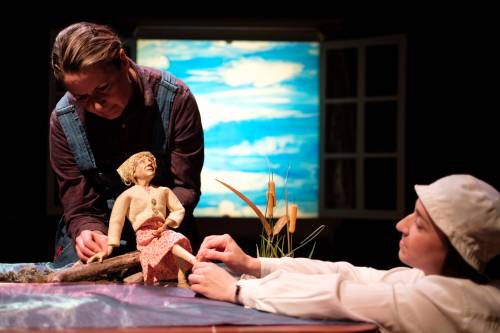
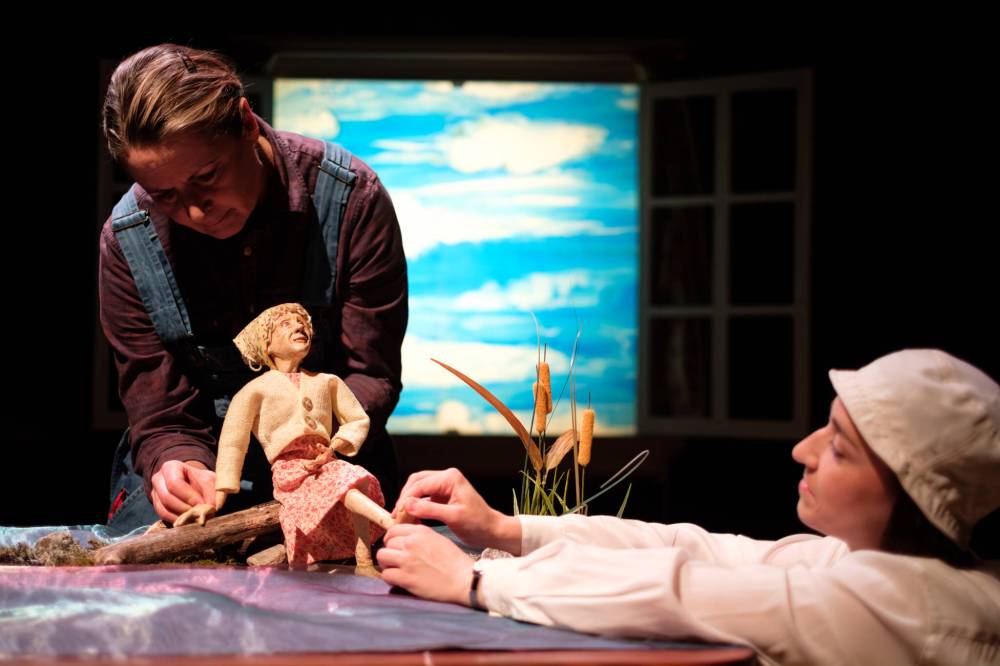
Natalie Labossière (left) and Marie-Ève Fontaine both manipulate marionette Bernadette.
Indeed, in Théâtre Cercle Molière’s and Flammèche Théâtre’s collaborative ode to spatial memory, the sound of the natural world is as pronounced as it is propulsive.
Long before Roy, who visited the cabin on an annual basis in the later stages of her writer’s life, speaks her first word, and long after she shares her last in this 75-minute production, that soundscape remains.
No birds or frogs or cud-chewing ungulates were recorded by sound designer Gérald Laroche. Instead of relying on digital files, Laroche uses various flutes, whistles, harmonicas and his elastic cheeks to recreate, live on stage, the edenic soundscape at Théâtre Cercle Molière, the century-old company where the drama-loving Roy cut her teeth as an aspiring theatre artist in the institution’s first decades.
Among the first sounds Laroche recreates are the chug-a-lugs of an incoming train carrying Fontaine’s Roy back to her happy place, a community 90 kilometres from Québec City.
Once she arrives, Roy assesses the space in silence, perhaps already anticipating the end of the season on its very first day. From the table, Fontaine’s Roy removes the dust cover, folding it swiftly and precisely in practiced motion: she has been here before, but as she nears her mid-60s, she understands a return is no longer guaranteed.
She opens the dining room window, and the world she sees resembles a picture book and a living theatre. Brilliantly using an overhead projector and transparencies to create an infinite scroll of naturalistic imagery, the production team illustrates the wonders of analogue storytelling techniques.
Those vibrantly filled transparencies are reminiscent of the work of visual artist Louise Pomminville, who provided the barnyard illustrations for Roy’s 1976 children’s book Ma Vache Bossie.
Placed at the centre of the stage, the window serves as a focal point for the audience’s attention, with Fontaine and fellow performer Natalie Labossière engaging in witty, emotional shadowplay in the overhead projector’s light path. (Lighting designer Emilio Sebastiao wisely presents the window as the production’s key light source, supporting the projector’s glow with sparingly used overhead lighting and a number of lamps.) Scored by Laroche, these moving pictures roll by gently, the imagery synched to the designer’s sound.
At the cabin, Roy reunites with her neighbour, Mr. Émile (Labossière), always happy to pop by with a futzy story or a made-up word.
She also keenly awaits the arrival of her sister, Bernadette, who is portrayed by a marionette. Manipulated by Fontaine and Labossière — sometimes together, other times individually — Bernadette’s presence has a rejuvenating effect on Gabrielle, who sees her surroundings through her sister’s ailing eyes.

JONATHAN LORANGE PHOTO
Marie-Ève Fontaine (left) performs as Gabrielle Roy while Gérald Laroche provides live sound effects.
Among the performance’s most touching sequences is a visit by the sisters to the nearby river, with Gabrielle carefully removing Bernadette’s shoes so she can feel the rush of the water on her toes once more. This scene plays out atop the drop-leaf table, the surface of which is cloaked by a shimmering blue sheet.

The tabletop setting echoes the large-scale scenic design, which divides the performers from the audience with plant and stone. Though this is effective at creating a performative boundary, the production would benefit from moving the border several feet back; beyond the first three rows, all that scenic work is nearly impossible to fully appreciate, owing to the escalating seating.
The shadow work is at its strongest when the sisters interact in silhouette as the periwinkle sky turns royal blue: appearing in profile, equalized by perspective, Fontaine’s Roy and Bernadette appear to be in deep conversation; the performer and the puppet look like siblings. They even share clothing: Gabrielle’s kerchief — part of Janelle Tougas’s elemental costume design — becomes her sister’s evening blanket.
In engaging so playfully with scale and shade, the projected shadow-work calls to mind the dreamlike, handcut animation of German filmmaker Lotte Reiniger (1899-1981), whose output reimagined fairy tales through silhouette, anonymizing the characters and allowing viewers to imagine themselves in the projected scenarios.
A gentle, subtle and sweet exploration of memory, familial connection, and above all, the necessity of connection to the natural world, Cet été qui chantait functions as a bedtime story and a wake-up call: we have one world to live in, and we’re lucky to share it.
winnipegfreepress.com/benwaldman
If you value coverage of Manitoba’s arts scene, help us do more.
Your contribution of $10, $25 or more will allow the Free Press to deepen our reporting on theatre, dance, music and galleries while also ensuring the broadest possible audience can access our arts journalism.
BECOME AN ARTS JOURNALISM SUPPORTER
Click here to learn more about the project.
Ben Waldman is a National Newspaper Award-nominated reporter on the Arts & Life desk at the Free Press. Born and raised in Winnipeg, Ben completed three internships with the Free Press while earning his degree at Ryerson University’s (now Toronto Metropolitan University’s) School of Journalism before joining the newsroom full-time in 2019. Read more about Ben.
Every piece of reporting Ben produces is reviewed by an editing team before it is posted online or published in print — part of the Free Press‘s tradition, since 1872, of producing reliable independent journalism. Read more about Free Press’s history and mandate, and learn how our newsroom operates.
Our newsroom depends on a growing audience of readers to power our journalism. If you are not a paid reader, please consider becoming a subscriber.
Our newsroom depends on its audience of readers to power our journalism. Thank you for your support.
Theatre Review
Cet été qui chantait
● Théâtre Cercle Molière, 340 Provencher Blvd.
● To Jan. 24
● Tickets $10-$40 at cerclemoliere.com
★★★★ out of five
If you value coverage of Manitoba’s arts scene, help us do more.
Your contribution of $10, $25 or more will allow the Free Press to deepen our reporting on theatre, dance, music and galleries while also ensuring the broadest possible audience can access our arts journalism.
BECOME AN ARTS JOURNALISM SUPPORTER
Click here to learn more about the project.
Ben Waldman is a National Newspaper Award-nominated reporter on the Arts & Life desk at the Free Press. Born and raised in Winnipeg, Ben completed three internships with the Free Press while earning his degree at Ryerson University’s (now Toronto Metropolitan University’s) School of Journalism before joining the newsroom full-time in 2019. Read more about Ben.
Every piece of reporting Ben produces is reviewed by an editing team before it is posted online or published in print — part of the Free Press‘s tradition, since 1872, of producing reliable independent journalism. Read more about Free Press’s history and mandate, and learn how our newsroom operates.
Our newsroom depends on a growing audience of readers to power our journalism. If you are not a paid reader, please consider becoming a subscriber.
Our newsroom depends on its audience of readers to power our journalism. Thank you for your support.

Advertisement Advertise With Us
Advertisement Advertise With Us