Irving’s New England return feels like disjointed parody

Advertisement
Read this article for free:
or
Already have an account? Log in here »
To continue reading, please subscribe:

Digital Subscription
One year of digital access for only $205*
- Enjoy unlimited reading on winnipegfreepress.com
- Read the E-Edition, our digital replica newspaper
- Access News Break, our award-winning app
- Play interactive puzzles
*First annual payment billed as $205.00 + GST for one year. This annual subscription will automatically renew at $233.00 + GST every 52 weeks (10% off the regular annual price of $259.35). Offer available to new and qualified returning subscribers only. Cancel any time.
To continue reading, please subscribe:
Add Free Press access to your Brandon Sun subscription for only an additional
$1 for the first 4 weeks*
- Enjoy unlimited reading on winnipegfreepress.com
- Read the E-Edition, our digital replica newspaper
- Access News Break, our award-winning app
- Play interactive puzzles
*Your next Brandon Sun subscription payment will increase by $1.00 and you will be charged $17.95 plus GST for four weeks. After four weeks, your payment will increase to $24.95 plus GST every four weeks.
Read unlimited articles for free today:
or
Already have an account? Log in here »
Hey there, time traveller!
This article was published 17/01/2026 (267 days ago), so information in it may no longer be current.
You can’t go home again, Thomas Wolfe said.
Apparently, you also can’t go back to St. Cloud’s Orphanage, the setting of John Irving’s beloved 1985 novel The Cider House Rules — at least not in any satisfying way.
Queen Esther, the American-Canadian author’s latest book, has a tantalizing connection to that storied locale in Maine, home of orphan Homer Wells and Dr. Wilbur Larch, an ether-addicted, abortion-providing physician. (The Cider House Rules was made into a 1999 movie, starring Tobey Maguire and Michael Caine.)

Chris Young / Canadian Press files
John Irving’s latest cries out for an editor to give its narrative more shape.
St. Cloud’s is where the Esther of the title was dropped off as an infant by two antisemitic townspeople after her mother — a Jewish immigrant from Vienna — was murdered. The child grows up there, beloved by all the orphaned boys and girls, as well as the staff.
Sadly, however, we only visit Dr. Larch for a chapter before Irving meanders his way off in all directions, to paraphrase Stephen Leacock.
Adopted as a teen to serve as a nanny by the book-loving Winslows, Constance and Thomas, Esther grows up with the family in New Hampshire and forms a tight bond with her charge, the couple’s youngest daughter, Honor.
So tight, in fact, that she will later take a break from her mysterious life in Israel — Esther has embraced her Jewish roots with secular fever but made it her private business — to give birth to a baby for the asexual Honor, who wants nothing to do with penises. (This latter fact is talked about at length, no pun intended, by her sisters in a way that doesn’t feel in any way realistic, especially for the 1920s, the time period in which this portion of the book is set.)
The boy, Jimmy, grows up to be a writer, following his birth mother’s journey back to Austria; Esther essentially drops out of the story for much of the middle section. This isn’t much of a loss, because despite Irving’s attempts to make her a figure of mythical proportions, he gives the reader no insight into her inner life whatsoever.
All the Irving touchstones are here: Vienna, wrestling, New England, abortion, chosen families.
But the way the 83-year-old novelist employs his well-worn tricks this time is all wrong: Queen Esther often reads like a John Irving parody. The final third is almost unreadable, owing to its disjointed construction and repetitive nature.
At 400-plus pages, the novel cries out for an editor to give the raggedy narrative some shape, to cull to the unnecessary, unseemly digressions — including those into the pros and cons of circumcision and bras (don’t ask) — to trim the endless, maddening repetition of first names, to work in the historical detail in a way that doesn’t read like a Wikipedia entry plunked down in the middle of the narrative.
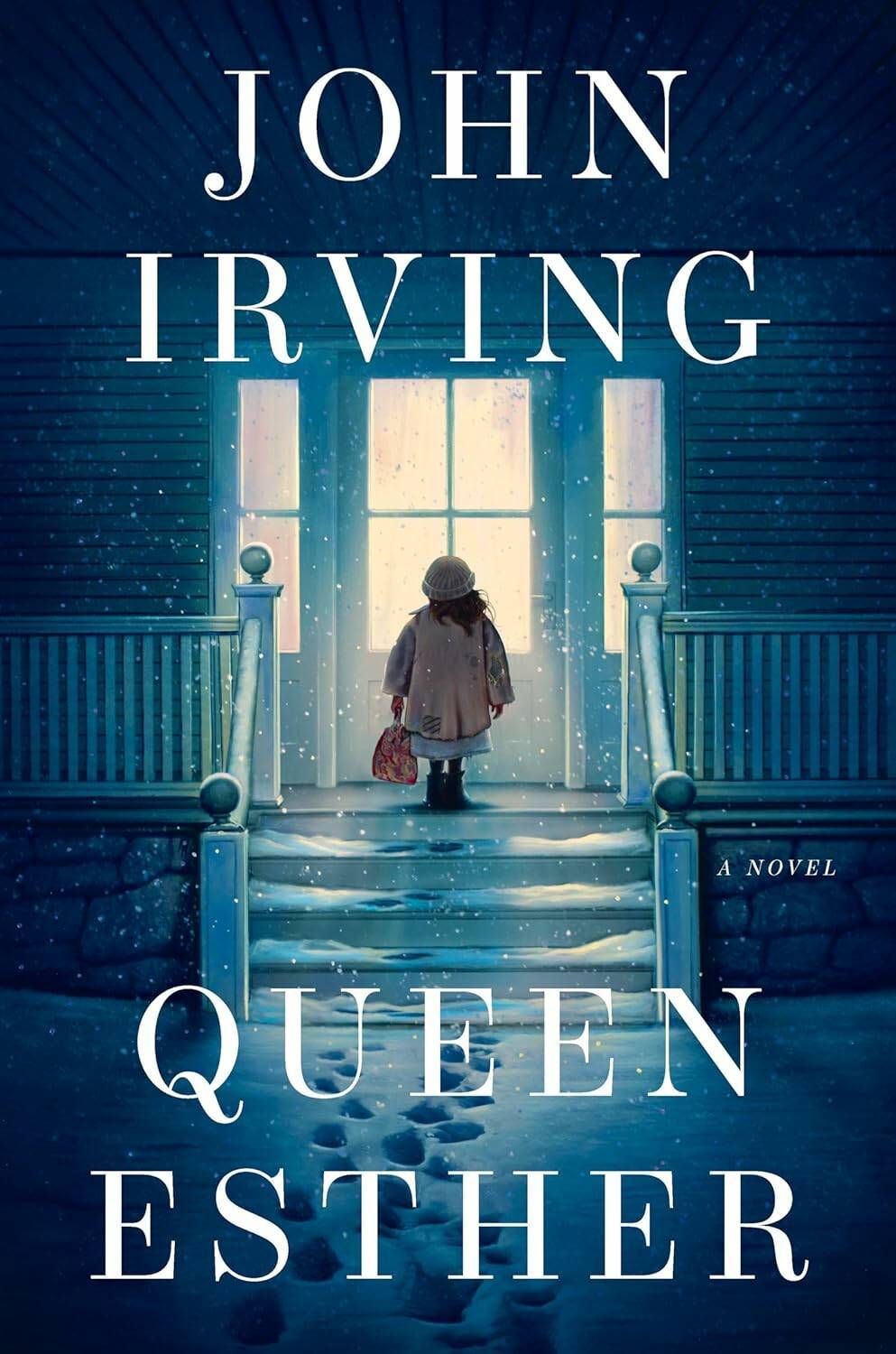
Queen Esther

Irving is known for what some might call heavy-handed foreshadowing (think “the Shot” in 1989’s A Prayer for Owen Meany) but it’s usually a signature part of his style — an enjoyable motif of catchphrases and winks at what’s to come.
Here, however, most of the first third of the book merely comes off as a collection of possible hints at a future climactic event, without much of a plot to tie them together. It’s very difficult to stay invested in these flimsy characters.
And although it’s certainly not meant to be, the way Irving constantly refers to Esther’s heritage — and Jewishness in general — feels weirdly fetishized and awkward, like someone at great pains to point out how many of his good friends are Jewish; it’s deeply uncomfortable.
Unlike The Cider House Rules, Queen Esther is not destined to be anyone’s favourite John Irving novel.
Jill Wilson is the Free Press arts and life editor.
Jill Wilson is the editor of the Arts & Life section. A born and bred Winnipegger, she graduated from the University of Winnipeg and worked at Stylus magazine, the Winnipeg Sun and Uptown before joining the Free Press in 2003. Read more about Jill.
Jill oversees the team that publishes news and analysis about art, entertainment and culture in Manitoba. It’s part of the Free Press‘s tradition, since 1872, of producing reliable independent journalism. Read more about Free Press’s history and mandate, and learn how our newsroom operates.
Our newsroom depends on a growing audience of readers to power our journalism. If you are not a paid reader, please consider becoming a subscriber.
Our newsroom depends on its audience of readers to power our journalism. Thank you for your support.
Queen Esther: A Novel
By John Irving
Simon & Schuster, 432 pages, $40
Jill Wilson is the editor of the Arts & Life section. A born and bred Winnipegger, she graduated from the University of Winnipeg and worked at Stylus magazine, the Winnipeg Sun and Uptown before joining the Free Press in 2003. Read more about Jill.
Jill oversees the team that publishes news and analysis about art, entertainment and culture in Manitoba. It’s part of the Free Press‘s tradition, since 1872, of producing reliable independent journalism. Read more about Free Press’s history and mandate, and learn how our newsroom operates.
Our newsroom depends on a growing audience of readers to power our journalism. If you are not a paid reader, please consider becoming a subscriber.
Our newsroom depends on its audience of readers to power our journalism. Thank you for your support.
Advertisement Advertise With Us
Advertisement Advertise With Us