China’s population falls again as births drop to lowest rate since 1949 communist revolution
Advertisement
Read this article for free:
or
Already have an account? Log in here »
To continue reading, please subscribe:

Digital Subscription
One year of digital access for only $205*
- Enjoy unlimited reading on winnipegfreepress.com
- Read the E-Edition, our digital replica newspaper
- Access News Break, our award-winning app
- Play interactive puzzles
*First annual payment billed as $205.00 + GST for one year. This annual subscription will automatically renew at $233.00 + GST every 52 weeks (10% off the regular annual price of $259.35). Offer available to new and qualified returning subscribers only. Cancel any time.
To continue reading, please subscribe:
Add Free Press access to your Brandon Sun subscription for only an additional
$1 for the first 4 weeks*
- Enjoy unlimited reading on winnipegfreepress.com
- Read the E-Edition, our digital replica newspaper
- Access News Break, our award-winning app
- Play interactive puzzles
*Your next Brandon Sun subscription payment will increase by $1.00 and you will be charged $17.95 plus GST for four weeks. After four weeks, your payment will increase to $24.95 plus GST every four weeks.
Read unlimited articles for free today:
or
Already have an account? Log in here »
Hey there, time traveller!
This article was published 19/01/2026 (230 days ago), so information in it may no longer be current.
BANGKOK (AP) — How do you persuade a population to have more babies after generations of limiting families to just one?
A decade after ending China’s longtime one-child policy, the country’s authorities are pushing a range of ideas and policies to try to encourage more births — tactics that range from cash subsidies to taxing condoms to eliminating a tax on matchmakers and day care centers.
The efforts haven’t paid off yet. At least, that’s what population figures released Monday show for what is now the world’s second-most populous nation. China’s population of 1.4 billion continued to shrink, marking the fourth straight year of decrease, new government statistics show. The total population in 2025 stood at 1.404 billion, which was 3 million less than the previous year.
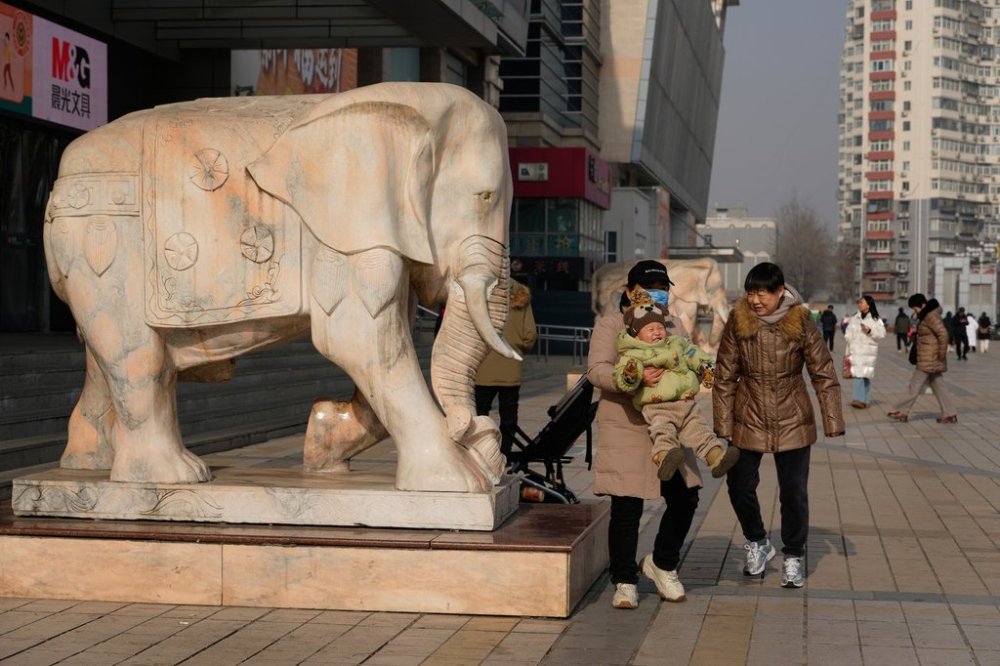
Measured another way, the birth rate in 2025 — 5.63 per 1,000 people — is the lowest on record since 1949, the year that Mao Zedong’s Communists overthrew the Nationalists and began running China. Figures before that, under the previous Nationalist government, were not available.
China was long the world’s most populous nation until 2023, when it was surpassed by regional neighbor and sometime rival India. Monday’s statistics illustrate the stark demographic pressures faced by the country as it tries to pivot from a problem it is working hard to overcome: status as a nation with a growing but transitional economy that, as is often said, is “getting old before it gets rich.”
Is a snake involved?
The number of new babies born was just 7.92 million in 2025, a decline of 1.62 million, or 17%, from the previous year. The latest birth numbers show that the slight tick upward in 2024 was not a lasting trend. Births declined for seven years in a row through 2023.
Most families cite the costs and pressure of raising a child in a highly competitive society as significant hurdles that now loom larger in the face of an economic downturn that has impacted households struggling to meet their living costs.
Across the region, “it’s these big structural issues which are much harder to tackle, whether it’s housing, and work and getting a job and getting started in life and expectations around education…,” said Stuart Gietel-Basten, director of the Center for Aging Science at the Hong Kong University of Science and Technology. “It’s gonna be difficult to make a major change in those number of births until those are addressed.”
Another potential factor in the numbers, at least for 2025: Last year in China was the year of the snake, considered one of the least favored years for having a child under the Chinese zodiac. The government’s official Xinhua News Agency, however, did say early last year — perhaps optimistically — that the snake “is shaking off its negative connotations.”
Like many other countries in Asia, China has faced a declining fertility rate, or the average number of babies a woman is expected to have in her lifetime. While the government does not regularly publish a fertility rate, last saying it was 1.3 in 2020, experts have estimated it is now around 1. Both figures are far below the 2.1 rate that would maintain the size of China’s population.
For decades, the Chinese government barred people from having more than one baby and often sanctioned those who did — a policy that produced more than two generations of only children. In 2015, the government raised the permitted amount of offspring to two and then, facing demographic pressure, further revised the limit to three in 2021.
Economics are behind the decision
The push for more births is about the economy. China now has 323 million people over 60, or 23% of the entire population. That number has continued to rise, while the working-age population is shrinking, meaning there are fewer workers to support the older population.
This demographic shift is happening while China is in the process of trying to transition away from labor-intensive industries like farming and manufacturing into a consumer-driven economy built with high-tech manufacturing.

While China’s rapid development in manufacturing with high-tech and robotics can reduce the impact of a shrinking labor force, “the bigger concern is whether economic growth can stay afloat with a shrinking population,” said Gary Ng, senior economist for Asia Pacific at French investment bank Natixis.
China reported a 5% annual economic growth for 2025 on Monday, based on official data. But some analysts expect growth to slow over the next few years.
To cope with these massive changes, China will eventually need to reform its pension system, Ng said, as well as broaden the tax base to cope with the higher government expenditure.
Officials have had limited success with policy changes to incentivize families to have more children. In July, the government announced cash subsidies of 3,600 yuan ($500) per child to families.

Coupling incentives with other attempts to mold behavior, the government also has started taxing condoms. China removed contraceptives, including condoms, from a value-added tax exemption list in 2025, meaning condoms are now being hit with a 13% tax that kicked into effect Jan. 1.
To further promote child-rearing, kindergartens and daycares have been added to the tax-exemption list, along with matchmaking services.
Researchers like Gietel-Basten say that young women want policies, especially in the workplace, that ensure they are not penalized for taking time off to have children, and that this is up to private companies to change. “It shouldn’t be this massive penalty,” he said.
___
Shihuan Chen in Beijing, Chan Ho-him in Hong Kong and Fu Ting in Washington contributed to this report.