

Microgreens farm Fresh Forage goes dark
‘Gap’ opens in Manitoba market as owner turns focus to scaling up freshwater phosphorus-capture tech firm

Advertisement
Read this article for free:
or
Already have an account? Log in here »
To continue reading, please subscribe:

Digital Subscription
One year of digital access for only $205*
- Enjoy unlimited reading on winnipegfreepress.com
- Read the E-Edition, our digital replica newspaper
- Access News Break, our award-winning app
- Play interactive puzzles
*First annual payment billed as $205.00 + GST for one year. This annual subscription will automatically renew at $233.00 + GST every 52 weeks (10% off the regular annual price of $259.35). Offer available to new and qualified returning subscribers only. Cancel any time.
To continue reading, please subscribe:
Add Free Press access to your Brandon Sun subscription for only an additional
$1 for the first 4 weeks*
- Enjoy unlimited reading on winnipegfreepress.com
- Read the E-Edition, our digital replica newspaper
- Access News Break, our award-winning app
- Play interactive puzzles
*Your next Brandon Sun subscription payment will increase by $1.00 and you will be charged $17.95 plus GST for four weeks. After four weeks, your payment will increase to $24.95 plus GST every four weeks.
Read unlimited articles for free today:
or
Already have an account? Log in here »
Hey there, time traveller!
This article was published 20/01/2026 (224 days ago), so information in it may no longer be current.
One of Manitoba’s largest microgreen farmers is hanging up his vertical shelves.
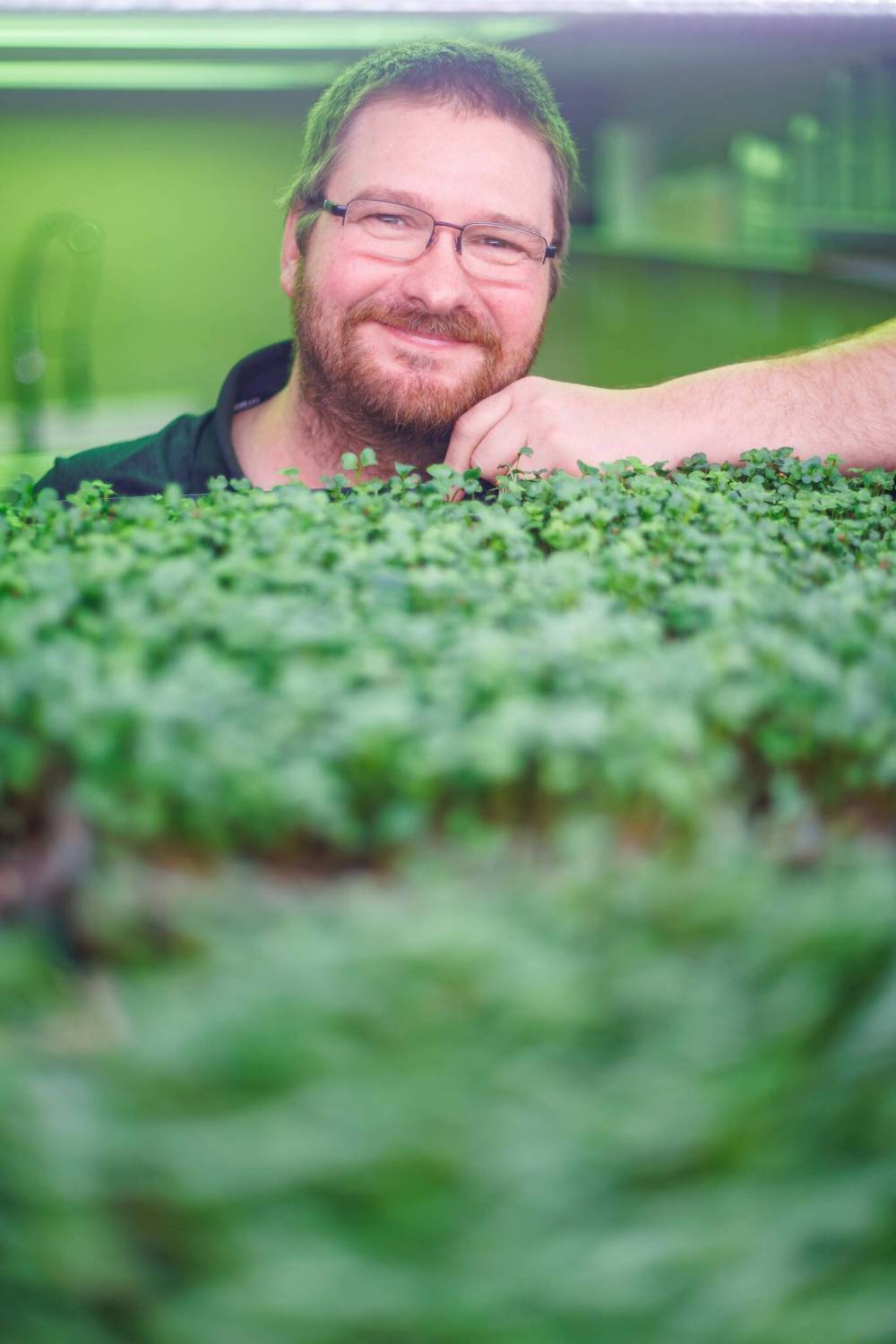
Fresh Forage — which produces microgreens, herbs, wheatgrass and flowers out of an indoor farm on Waverley Street in Winnipeg — is closing on Jan. 30 after nearly a decade. Company owner Joel Weber said the long hours of maintaining a vertical farm are no longer sustainable and he’s focusing on another aspect of creating a greener city: mitigating the growing amount of phosphorus entering Lake Winnipeg.
“To many, it seems like a sad moment in time. To me, it’s more of a stepping stone to a much larger problem that needs to be solved,” he said.
MIKE DEAL / FREE PRESS
Fresh Forage owner Joel Weber says the industry is currently a niche market with tough margins. He will shutter his indoor farm Jan. 30.
He founded Lakewater Nutrient Capture, which uses shipping containers with filters to capture phosphorus, in 2024, but is now scaling up operations.
Weber said he has worked on bodies of water in the Stonewall and East St. Paul areas and wants to tackle the issue in Lake Winnipeg, where high phosphorus levels caused by agricultural and urban run-off can create toxic algae blooms.
“It’s a major, major problem, and as you scale up, a lot of the existing technologies do not scale,” he said.
Weber acknowledges closing his farm is going to leave a gap in the local microgreens market. He said Fresh Forage is the largest microgreen grower in the province, with as many as 700 shelves in circulation and stock in multiple grocery stores.
Weber called the industry a niche market with tough margins. “There’s a lot of vertical farms that have gone bankrupt or have gone under, there’s a lot of different realities that people just don’t understand, unfortunately.”
Weber said he had been working more than 80 hours a week when he decided to shutter Fresh Forage.
“A grocery store has variable demand, but an indoor farm has to sell out 100 per cent every week, based on the business models,” he said.
“It is just not sustainable, purchasing container farms or setting up big, massive indoor grows. The business model itself quickly falls apart when you apply practical realities of the business and sales culture to it.”
Weber will sell the company’s materials, but plans to hold on to the Fresh Forage brand.
If you’ve had a dish peppered with microgreens at Passero, Oxbow, Nola or a number of casual fine-dining restaurants in Winnipeg, there’s a good chance they came from Alex Kohut at Winnipeg-based vertical farm Cal’s Crops.
Kohut said Weber’s experience running a vertical farm rung true, and the growing interest in organic local produce is outpacing the few vertical farms in Manitoba.
“Even if we were to fill the gap that Joel was providing, there’s still so much more room for other businesses and other providers, home-based or otherwise,” he said.
Kohut said all of Cal’s Crops seed lots come from Canada-based farms. Interest in vertical farming could grow as tariffs imposed by the U.S. contribute to the rising cost of groceries and a renewed interest in local produce.

“This industry has a lot of potential to fill the need, especially with growing tensions in U.S.-Canadian trade relations,” he said. “I do think that a lot of folks are looking for different opportunities to build more Canadian independence in the market.”
Vertical farming has been the subject of several projects at the University of Manitoba.
A research team working with Opaskwayak Cree Nation built “smart vertical farming” in the community some 600 kilometres by highway northwest of Winnipeg, which uses computer-monitored light and climate controls to grow fruits and vegetables year-round.
A test farm at the U of M’s Fort Garry campus is testing an artificial intelligence system that could adjust growing conditions to optimize growth yield and reflect market prices.
malak.abas@freepress.mb.ca
Malak Abas is a city reporter at the Free Press. Born and raised in Winnipeg’s North End, she led the campus paper at the University of Manitoba before joining the Free Press in 2020. Read more about Malak.
Every piece of reporting Malak produces is reviewed by an editing team before it is posted online or published in print — part of the Free Press‘s tradition, since 1872, of producing reliable independent journalism. Read more about Free Press’s history and mandate, and learn how our newsroom operates.
Our newsroom depends on a growing audience of readers to power our journalism. If you are not a paid reader, please consider becoming a subscriber.
Our newsroom depends on its audience of readers to power our journalism. Thank you for your support.
Malak Abas is a city reporter at the Free Press. Born and raised in Winnipeg’s North End, she led the campus paper at the University of Manitoba before joining the Free Press in 2020. Read more about Malak.
Every piece of reporting Malak produces is reviewed by an editing team before it is posted online or published in print — part of the Free Press‘s tradition, since 1872, of producing reliable independent journalism. Read more about Free Press’s history and mandate, and learn how our newsroom operates.
Our newsroom depends on a growing audience of readers to power our journalism. If you are not a paid reader, please consider becoming a subscriber.
Our newsroom depends on its audience of readers to power our journalism. Thank you for your support.
Related Articles
Microgreens gaining macro reach

Advertisement Advertise With Us
Advertisement Advertise With Us
History
Updated on Wednesday, January 21, 2026 8:10 AM CST: Replaces tile photo