

Farmers face new role in multipolar world
Advertisement
Read this article for free:
or
Already have an account? Log in here »
To continue reading, please subscribe:
Digital Subscription
One year of digital access for only $1.44 a week*
- Enjoy unlimited reading on winnipegfreepress.com
- Read the E-Edition, our digital replica newspaper
- Access News Break, our award-winning app
- Play interactive puzzles
*Billed as $5.77 plus GST every four weeks. After 52 weeks, price increases to the regular rate of $19.95 plus GST every four weeks. Offer available to new and qualified returning subscribers only. Cancel any time.
To continue reading, please subscribe:
Add Free Press access to your Brandon Sun subscription for only an additional
$1 for the first 4 weeks*
- Enjoy unlimited reading on winnipegfreepress.com
- Read the E-Edition, our digital replica newspaper
- Access News Break, our award-winning app
- Play interactive puzzles
*Your next Brandon Sun subscription payment will increase by $1.00 and you will be charged $17.95 plus GST for four weeks. After four weeks, your payment will increase to $24.95 plus GST every four weeks.
Read unlimited articles for free today:
or
Already have an account? Log in here »
Hey there, time traveller!
This article was published 24/01/2026 (266 days ago), so information in it may no longer be current.
BRANDON — Farmers escaping the cold drudgery of winter to sneak a peek at shiny new equipment at Manitoba Ag Days this week might have hoped they could leave the world’s problems outside for a few hours.
However, geopolitics followed them inside the sprawling Keystone Centre like a foggy draft, cloaking speaker sessions and conversations alike in a blanket of uncertainty.
Farmers knew going in the outlook for markets will put the profitability required to support new machinery purchases out of reach for many this year, but it never hurts just to look.
Laura Rance
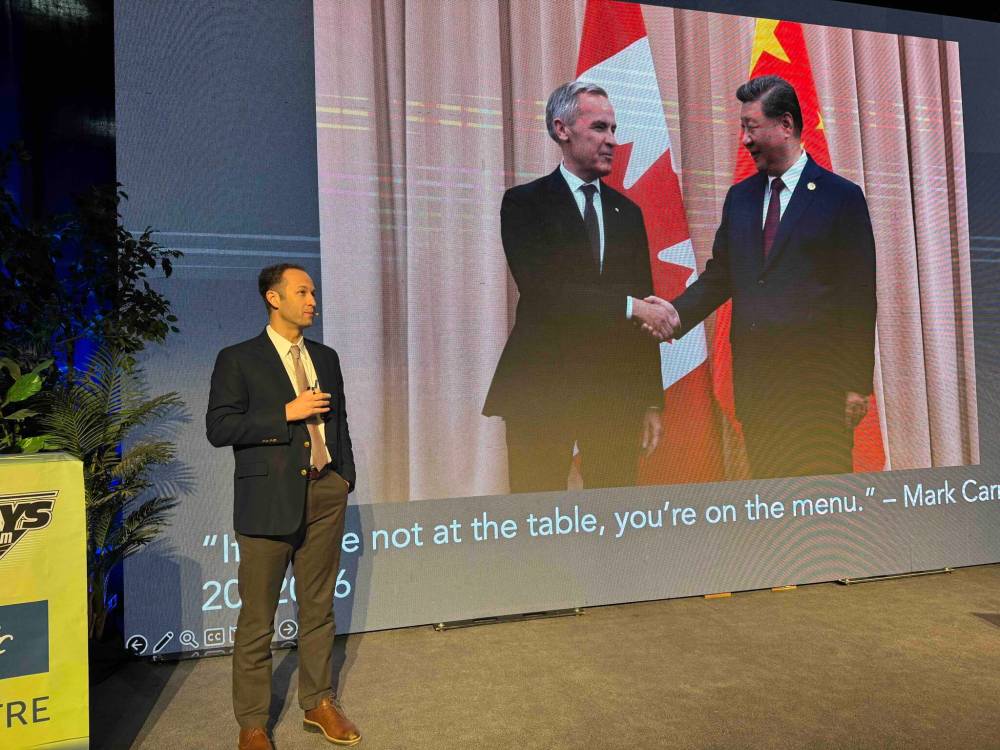
China will always be a fickle buyer for Canadian farm goods, U.S.-based analyst Jacob Shapiro told a gathering at Manitoba Ag Days in Brandon.
And even though the “what-if” scenarios emerging from U.S. President Donald Trump’s ever-more-ominous ramblings dampened the optimism surrounding Canada’s new deal with China to restore trade in key agricultural commodities, some hopeful undercurrents emerged.
A day after Prime Minister Mark Carney made global headlines with his speech before the World Economic Forum, farmers at the Brandon event heard from a U.S.-based political consultant specializing in global geopolitics who reinforced many of Carney’s main points.
Whereas Carney laid out the imperative for moving beyond a world order where the big players such as the U.S., China and Russia use their might to force smaller countries to tow their line, Jacob Shapiro went further.
The founder and chief strategist for New Orleans-based Perch Perspectives said strategic realignments between small and middle powers are already taking place — and food security is one of the drivers.
Shapiro said the U.S.’s dominance as a global power broker is fading. “If you want to understand why the world feels so disjointed, it’s because the United States is applying imperial foreign policy to a world that is fundamentally multipolar,” Shapiro said.
“Ironically, truly multipolar worlds are actually relatively stable, because truly multipolar worlds are worlds in which countries don’t think they can achieve all their aims at the point of a gun or with a tariff. So, they have to learn to compromise and balance against each other.”
This is already affecting trade in food commodities. Countries that were once content to import food from exporters who could produce it cheaper are now focused on either producing it themselves or buying from suppliers who won’t weaponize a trade relationship.
“They don’t care how much it costs to grow it themselves. They care to source it from a country that will not try and tell them what to do or raise tariffs on them or kidnap their leaders or threaten them or cajole them in all sorts of ways if they won’t do what is asked,” Shapiro said.
The impact on markets is more than a cyclical downturn. It’s a pivot away from outsourcing to the lowest-cost suppliers to premium-quality and reliable trading partners.
“I think we are in a fundamental structural reorganization for global agricultural markets, full stop. I think the way that things have worked for the past 200 years is not going to work going forward,” he said.
He warned farmers to expect continued trade volatility with China because it remains committed to food self-sufficiency. “They are not a viable source of economic growth and export growth for farmers in North America, period.”

Likewise, there is no sugar-coating the economic hurt that would follow if the Canada-U.S. trading relationship collapses. “It will suck for Canada the most. But I think that Canadians will deal with economic pain much better than the folks in Michigan and Wisconsin and North Dakota who are also going to deal with economic pain.”
He suggested farmers ask themselves why they remain focused on doing a better job of supplying grain and oilseed markets that are already habitually oversupplied when the world is chronically short of protein, vegetables and fruit.
“Farmers are the only profession I know in the world where the better you do your job, the better crops you grow and the more that you grow, the worse you actually get paid,” Shapiro said.
“Turn off the social media, turn off the news, stop listening to whoever is the president of the United States and start figuring out what markets need, what can I grow for them and how much can I charge them.”
Laura Rance is executive editor, production content lead for Glacier FarmMedia. She can be reached at lrance@farmmedia.com.