

Bank of Canada expected to keep key rate steady this week — and maybe all year long
Advertisement
Read this article for free:
or
Already have an account? Log in here »
To continue reading, please subscribe:

Digital Subscription
One year of digital access for only $205*
- Enjoy unlimited reading on winnipegfreepress.com
- Read the E-Edition, our digital replica newspaper
- Access News Break, our award-winning app
- Play interactive puzzles
*First annual payment billed as $205.00 + GST for one year. This annual subscription will automatically renew at $233.00 + GST every 52 weeks (10% off the regular annual price of $259.35). Offer available to new and qualified returning subscribers only. Cancel any time.
To continue reading, please subscribe:
Add Free Press access to your Brandon Sun subscription for only an additional
$1 for the first 4 weeks*
- Enjoy unlimited reading on winnipegfreepress.com
- Read the E-Edition, our digital replica newspaper
- Access News Break, our award-winning app
- Play interactive puzzles
*Your next Brandon Sun subscription payment will increase by $1.00 and you will be charged $17.95 plus GST for four weeks. After four weeks, your payment will increase to $24.95 plus GST every four weeks.
Read unlimited articles for free today:
or
Already have an account? Log in here »
Hey there, time traveller!
This article was published 26/01/2026 (223 days ago), so information in it may no longer be current.
OTTAWA – Many economists expect no change in the Bank of Canada’s benchmark interest rate later this week — and, possibly, for the rest of the year.
The central bank will make its first interest rate decision of 2026 on Wednesday.
Financial market odds for a rate hold this week stood at nearly 90 per cent as of Monday morning, according to LSEG Data & Analytics.
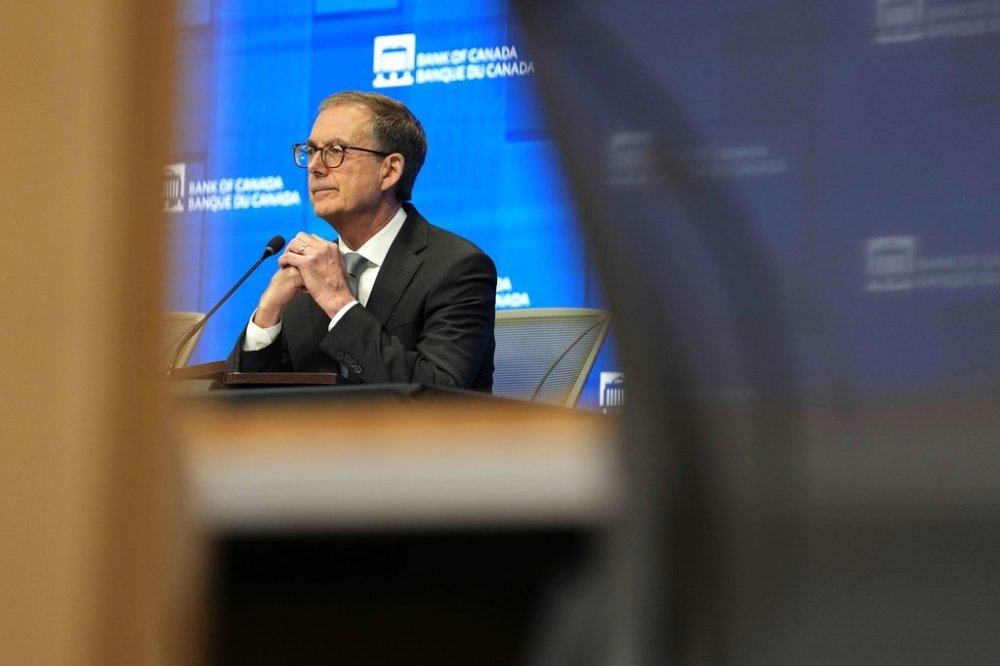
The Bank of Canada held its policy rate steady at 2.25 per cent in December, coming off two consecutive quarter-point cuts in the second half of 2025.
At that decision, governor Tiff Macklem said the central bank believes monetary policy is at “about the right level” to balance a turbulent economy and lingering inflationary pressures.
TD Bank economist Rishi Sondhi said in a note Friday that forecasters ought to take the Bank of Canada at its word when it comes to rate expectations.
“The Bank has repeatedly said that they are happy with the current policy stance, provided the economy evolves broadly in line with expectations,” he said.
“It would take a significant undershooting of economic growth or meaningful softening in the labour market to force policymakers off the sidelines.”
Macklem said Bank of Canada officials believe inflation is likely to hold at around its target of two per cent for the coming year, but if the outlook changes, the central bank is “prepared to respond.”
Avery Shenfeld, chief economist at CIBC, said none of the incoming economic data since the Bank of Canada’s December decision was surprising enough to knock it off its holding stance.
The annual rate of inflation was hotter than expected at 2.4 per cent in December, but the unemployment rate jumped to 6.8 per cent in the month. Early data is also suggesting growth slowed in the fourth quarter of the year.
“It looks like the economy seems to have decelerated again in the fourth quarter, inflation is not materially diverging from the Bank of Canada’s objectives, and the unemployment rate is still too high for comfort,” Shenfeld said.
The central bank will also release updated projections for the economy and inflation alongside Wednesday’s rate decision.
CIBC is among the forecasters expecting the Bank of Canada will neither raise nor lower interest rates in 2026.
The past few years since the onset of the COVID-19 pandemic and its recovery have been marked by relatively rapid easing and tightening cycles.
Shenfeld said that when a central bank reaches the end of its interest rate path, it’s more typical for the policy rate to hold there for a year or more as the economy adjusts to the new borrowing rate.
While Shenfeld expects no change in the central bank’s stance on Wednesday, he said Macklem might soften his tone toward further easing in monetary policy — if only to push back against any expectations in the market for a rate hike this year.
“When markets hear from a central bank that they’re done easing, they start to say, ‘Well, the next move must be a hike and let’s start to put in some probability of it,'” he said.
Expectations for a change in interest rates can be as impactful as a cut or hike itself. For instance, long-term policy rate expectations are baked into prices in the bond market, which lenders use to set interest rates on mortgages and other loans.
Shenfeld said that while mortgage rates aren’t particularly low, suggestions from the Bank of Canada that rate cuts are done could lure some homebuyers off the sidelines this spring, rather than the recent trend of waiting longer in hopes of a cheaper rate.

Businesses also watch for signals from the Bank of Canada when they’re making investment and other planning decisions, but Shenfeld noted that the central bank’s interest rate has not been the biggest source of uncertainty for firms over the past year.
The outlook for key Canadian industries facing tariffs from the United States is still in question with the scheduled review of the Canada-U.S.-Mexico trade agreement coming up later this year.
Shenfeld said the Bank of Canada could see its rate hold disturbed if another serious shock like a sudden stock market downturn hits the economy this year, but the fate of U.S. tariffs so far appears to be the clearest risk in 2026.
“Trade by far is still the biggest cloud on the horizon, and the one that might end up compelling the Bank of Canada to get off of its stand-pat stance and actually ease more if the trade barriers worsen,” he said.
This report by The Canadian Press was first published Jan. 26, 2026.