

Another strike sends 31,000 Kaiser Permanente health care workers to picket lines
Advertisement
Read this article for free:
or
Already have an account? Log in here »
To continue reading, please subscribe:
Monthly Digital Subscription
$1 per week for 24 weeks*
- Enjoy unlimited reading on winnipegfreepress.com
- Read the E-Edition, our digital replica newspaper
- Access News Break, our award-winning app
- Play interactive puzzles
*Billed as $4.00 plus GST every four weeks. After 24 weeks, price increases to the regular rate of $19.95 plus GST every four weeks. Offer available to new and qualified returning subscribers only. Cancel any time.
Monthly Digital Subscription
$4.99/week*
- Enjoy unlimited reading on winnipegfreepress.com
- Read the E-Edition, our digital replica newspaper
- Access News Break, our award-winning app
- Play interactive puzzles
*Billed as $19.95 plus GST every four weeks. Cancel any time.
To continue reading, please subscribe:
Add Free Press access to your Brandon Sun subscription for only an additional
$1 for the first 4 weeks*
*Your next subscription payment will increase by $1.00 and you will be charged $16.99 plus GST for four weeks. After four weeks, your payment will increase to $23.99 plus GST every four weeks.
Read unlimited articles for free today:
or
Already have an account? Log in here »
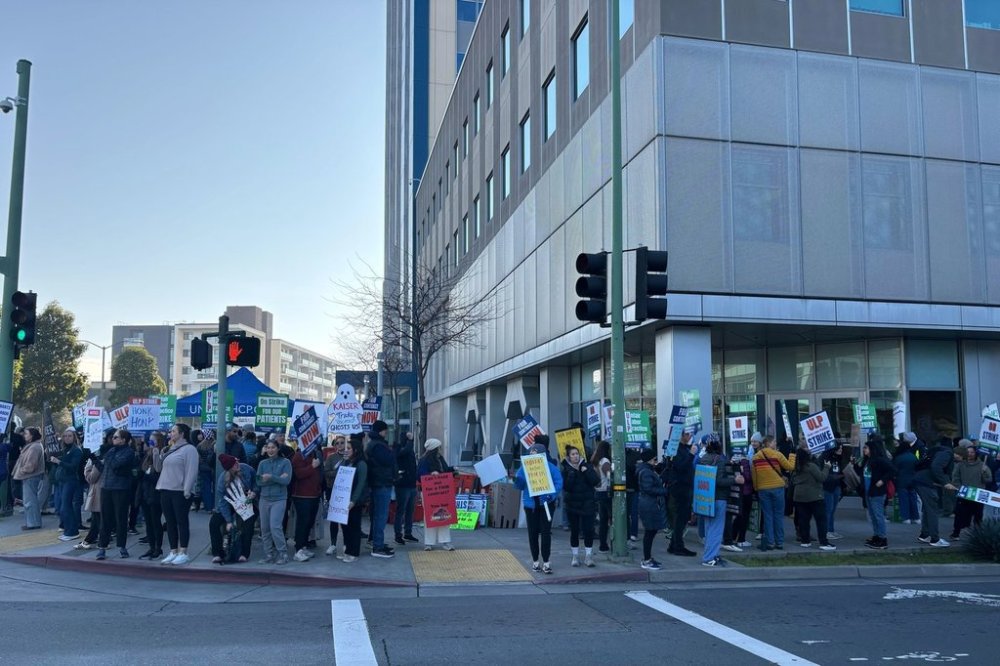
OAKLAND, Calif. (AP) — An estimated 31,000 registered nurses and other front-line Kaiser Permanente health care workers launched an open-ended strike this week in California and Hawaii to demand better wages and staffing from the health care giant.
The picketing that began Monday marked the second major walkout in recent months by employees represented by the United Nurses Associations of California/Union of Health Care Professionals. A five-day strike in October ended with negotiations resuming, but talks broke down in December.
This week the union accused Kaiser of refusing to return to national bargaining discussions.
“We will continue to push Kaiser to stop their egregious unfair labor practices against the frontline workers who deliver the best care for their patients and billions in profit to do the right thing, and come back to the table to bargain in good faith,” the union bargaining committee said in a statement.
Kaiser said Sunday that the union had agreed to return to local bargaining, even as workers moved forward with the strike. The company said it paused national bargaining last month after what it described as a threatening incident involving a union official.
“Illegal threats are a line that cannot be crossed,” Greg Holmes, Kaiser’s chief human resources officer, said in a statement. “This union official’s actions have compromised the national bargaining process and undermined both parties’ ability to continue good-faith bargaining.”
Those on strike, including pharmacists, midwives and rehab therapists, say wages have not kept pace with inflation and there is not enough staffing to keep up with patient demand.
They are asking for a 25% wage increase over four years to make up for wages they say are at least 7% behind their peers.
Kaiser Permanente had countered with a 21.5% increase over four years. The company says that represented employees earn, on average, 16% more than their peers, and it would have to charge customers more to meet strikers’ pay demand.
Arezou Mansourian, a physician assistant on the bargaining team, told the San Francisco Chronicle that Kaiser has been unable to retain and recruit providers, which is impacting patient care. Medical staff have been leaving Kaiser for higher-paying jobs at other local hospitals, Mansourian said.

She said the union’s fight for better working conditions will ultimately help patients as well.
“We know it’s a pain right now, but it’s so that we can take care of you better in the future,” Mansourian told the Chronicle.
The company said health clinics and hospitals will remain open during the strike, with some in-person appointments shifted to virtual appointments, and some elective surgeries and procedures being rescheduled.
Kaiser Permanente is one of the nation’s largest not-for-profit health plans, serving 12.6 million members at 600 medical offices and 40 hospitals in largely western U.S. states. It is based in Oakland, California.
In New York City, about 15,000 nurses who walked off the job headed back to the bargaining table earlier this month. The New York State Nurses Association said contract negotiations resumed with officials at the three private hospital systems impacted by the strike: Montefiore, Mount Sinai and New York-Presbyterian.