‘Creeping snow drought’: Canadian research shows less snowpack a concern

Advertisement

Advertise with us

New research shows less snowpack in certain regions of Canada can have wide-ranging effects on everything from farms and wildlife to the broader economy. 

Read this article for free:

or

Already have an account? Log in here »

To continue reading, please subscribe:

Subscribe and receive a limited-edition Free Press branded hat or tote.

Digital Subscription

One year of digital access for only $205*

  • Enjoy unlimited reading on winnipegfreepress.com
  • Read the E-Edition, our digital replica newspaper
  • Access News Break, our award-winning app
  • Play interactive puzzles

*First annual payment billed as $205.00 + GST for one year. This annual subscription will automatically renew at $233.00 + GST every 52 weeks (10% off the regular annual price of $259.35). Offer available to new and qualified returning subscribers only. Cancel any time.

To continue reading, please subscribe:

Add Free Press access to your Brandon Sun subscription for only an additional

$1 for the first 4 weeks*

  • Enjoy unlimited reading on winnipegfreepress.com
  • Read the E-Edition, our digital replica newspaper
  • Access News Break, our award-winning app
  • Play interactive puzzles
Start now

*Your next Brandon Sun subscription payment will increase by $1.00 and you will be charged $17.95 plus GST for four weeks. After four weeks, your payment will increase to $24.95 plus GST every four weeks.

Hey there, time traveller!
This article was published 29/01/2026 (189 days ago), so information in it may no longer be current.

New research shows less snowpack in certain regions of Canada can have wide-ranging effects on everything from farms and wildlife to the broader economy. 

The Concordia University study, published in the Nature journal “Communications Earth and Environment,” says the usable water from snowpacks has dropped sharply in areas of the Canadian Rockies.

The mountainous region is the headwaters of major rivers in British Columbia and the Prairies, feeding communities and habitats. 
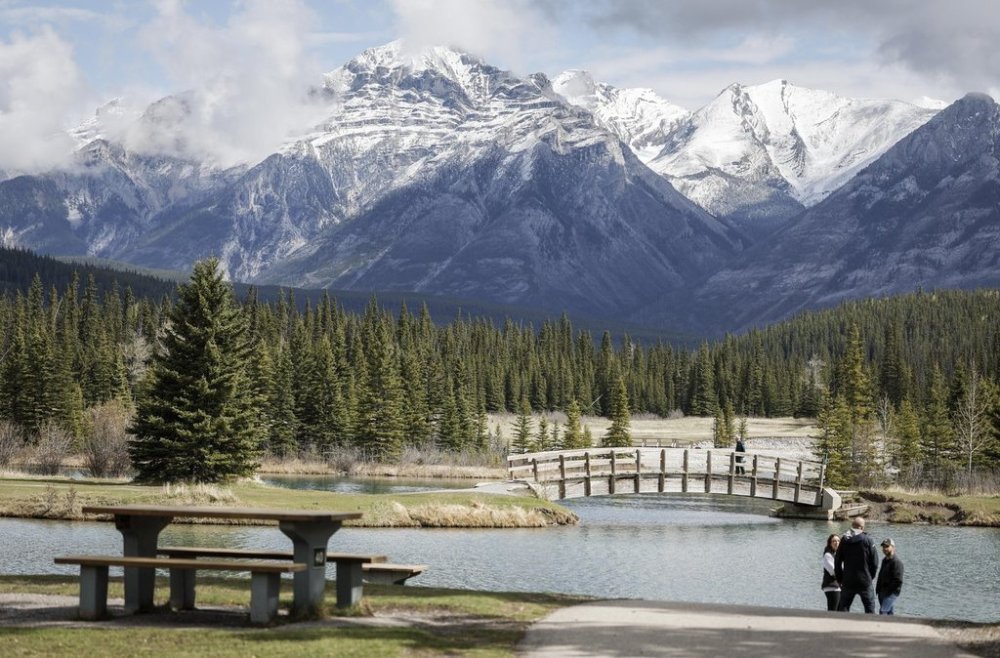
Visitors explore Cascade Ponds in Banff National Park, Alta., Thursday, May 15, 2025.THE CANADIAN PRESS/Jeff McIntosh

Ali Nazemi, an associate professor at the university and an author of the study, has called the finding “creeping snow drought,” which he says threatens Canada’s water supply. 

“You don’t really realize it up to the time that you are in the middle of a crisis,” Nazemi said in an interview.

The researchers analyzed snowpack data from 2000 to 2019, finding three per cent of Canada’s land mass — areas of the Canadian Rockies — saw declines. 

To determine losses, they measured the amount of water available in snowpack using satellite data and climate reanalysis techniques, Nazemi said. 

He said while three per cent may seem small, the losses are situated in critical headwaters that downstream users heavily rely upon.

“(There) are a lot of social and economic activities blended there,” Nazemi said. 

The paper cites past Canadian climate events that suggest were a result of snowpack issues. 

It says during a drought in 2015, low snowpack contributed to water shortages in British Columbia’s Okanagan region where sockeye salmon populations collapsed. A lack of cooler water from mountain runoff caused warmer stream temperatures the fish couldn’t survive in, the paper says.

The drought that year also reached the Prairies, causing less inflows into Saskatchewan’s Lake Diefenbaker, a major reservoir. It resulted in strains to hydroelectric power generation and agricultural irrigation. 

The paper also says a lack of snow more than 10 years ago in parts of Ontario and Quebec had affected the shipping industry. 

It says due to little snow in 2011, there wasn’t much meltwater to replenish the Great Lakes. It triggered an emergency situation, where harbours were dredged and ships lightened their loads.

In Quebec, dams were released so ships could come and go at the Port of Montreal, Nazemi said.

“We showed that St. Lawrence River might be one of the vulnerable places due to this,” he said. “Perhaps we cannot take hydropower anymore (for) granted.”

Despite declines in the Rockies, snowpack has increased in other areas, the research shows.

Nazemi said Canada’s north is seeing more snow due to warming ice in the Arctic Ocean. As the ice melts, it releases more moisture into the atmosphere. 

“This global warming is basically corresponding with both increasing snow water availability in the north … and also decreasing in the south in the mountains,” he said.

“There are some other factors, like atmospheric and oceanic factors playing in that. So, we can say it’s a combination of climate change and natural climate variability.” 

Nazemi said it would be alarming if the trends continue.

“We need to really think again about how we are managing our water and how we are developing around that new reality of water,”  he said. “We have a lot of people talking about the fact that the water future might actually be different from what we have now.”

He said the Canada Water Agency, along with the Global Institute for Water Security in Saskatchewan, are working to address future scarcity issues.

But there needs to be better ways to assess problems at local levels, he added.

“What is actually happening in a neighbourhood, in a community, in a farm, in a wetland?” he said. “In part of this paper, we showed that when we go to the smaller scale … the uncertainties can actually be skyrocketing.” 

The research received funding from the Canadian government through grant programs.

This report by The Canadian Press was first published Jan. 29, 2026.

Report Error Submit a Tip

More Stories

Homegrown grub: Resto turns to the Leaf for freshest ingredients

AV Kitching 4 minute read Preview

Homegrown grub: Resto turns to the Leaf for freshest ingredients

AV Kitching 4 minute read Tuesday, Aug. 4, 2026

The term “eat local” has taken on a whole new meaning at Gather Craft Kitchen and Bar, where the journey from plot to plate is measured in footsteps rather than miles.

Head chef Mike Licharson has expanded the restaurant’s focus on local sourcing by incorporating fruit and vegetables grown in The Leaf’s biomes and outdoor kitchen garden into his menu.

Bananas from the tropical biomes star in his banana-bread French toast and accompanying banana compote. Leeks, braised slowly and paired with Manitoba-grown beluga lentils, and Swiss chard — which takes the place of grape leaves in Licharson’s play on classic meze dolmades, a nod to the chef’s Greek-Ukrainian-Irish heritage — are both grown in the outdoor kitchen garden.

The park’s produce complements the restaurant’s other locally sourced ingredients, Licharson says.

Read
Tuesday, Aug. 4, 2026

Mattress upgrade sure to support camp romps

Maureen Scurfield 4 minute read Yesterday at 2:00 AM CDT

DEAR MISS LONELYHEARTS: Help us. We simply can’t go camping again and have the kind of wild sex we want if we don’t make some changes.

Our cheap older air mattress rolled us both to the middle on our last trip — and not in a romantic way. And it squeaked for anybody nearby to hear. We need an upgrade. Any suggestions?

— Camping Lovers, Whiteshell

Dear Camping Lovers: Hybrid air and foam self-inflating camp mattresses are the way to go for you two. The best camping mattress for sex offers a supportive surface and minimal squeaking.

‘Catastrophic’ ending to eventful Manitoba Derby

Mike McIntyre 6 minute read Preview

‘Catastrophic’ ending to eventful Manitoba Derby

Mike McIntyre 6 minute read Tuesday, Aug. 4, 2026

It had everything you could have wanted for the signature racing event of the season, including plenty of drama and excitement in front of a packed crowd at Assiniboia Downs.

Unfortunately, Monday night’s Manitoba Derby also served up another painful reminder of the potential perils of “The Sport of Kings” and what can occasionally happen when these magnificent animals are pushed to their limits.

Forty Twenty, a three-year-old bay colt who was one of the morning line favourites, looked to be in great shape as he approached the final turn and was near the lead in the nine-horse race.

But disaster struck as he approached the final turn and suddenly pulled up as the rest of the packed passed him.

Read
Tuesday, Aug. 4, 2026

Goldeyes catcher Pelletier moonlights as team barber

Taylor Allen 6 minute read Preview

Goldeyes catcher Pelletier moonlights as team barber

Taylor Allen 6 minute read Updated: Yesterday at 10:06 PM CDT

Tucked inside the Winnipeg Goldeyes’ clubhouse is a no-frills washroom with a urinal, a pair of toilets and a trio of sinks beneath matching mirrors.

But when rookie catcher Raphael Pelletier drags in a well-worn black leather salon chair with cracked upholstery and lays out his clippers, trimmers and shears, the space transforms into something else: a barbershop.

While far from luxurious, it’s the type of haircutting experience that could only exist inside the wacky world of independent baseball.

“He keeps everyone looking good on the field, honestly. We needed this,” said third-year Goldeyes pitcher Derrick Cherry, while getting a trim on Wednesday ahead of the team’s game against the Chicago Dogs.

Read
Updated: Yesterday at 10:06 PM CDT

Federal government to build $267-M emergency research lab in Winnipeg

Chris Kitching 6 minute read Preview

Federal government to build $267-M emergency research lab in Winnipeg

Chris Kitching 6 minute read Updated: Yesterday at 4:42 PM CDT

The federal government says it will build a $267-million medical countermeasures laboratory in Winnipeg with the goal of preparing Canada for future pandemics or outbreaks.

Expected to open in 2033, the national site will help the country develop vaccines, therapeutics and diagnostic tools, Winnipeg Liberal MP Terry Duguid said.

“This is a big deal for our city and for our province, a big deal for life sciences in Canada,” he told reporters Wednesday. “This facility is going to help protect the nation and help protect the world.”

Ottawa said the site — to be located next to the National Microbiology Laboratory’s Canadian Science Centre for Human and Animal Health on Arlington Street, just north of William Avenue — draws on lessons learned during the COVID-19 pandemic.

Read
Updated: Yesterday at 4:42 PM CDT

Storm left $840M of insured losses across Manitoba, Saskatchewan

Gabrielle Piché 3 minute read Preview

Storm left $840M of insured losses across Manitoba, Saskatchewan

Gabrielle Piché 3 minute read Yesterday at 6:41 PM CDT

Severe weather spanning two days in June — hitting both Manitoba and Saskatchewan — has led to at least $840 million in insured losses.

The June 9 and 10 weather is the latest in an increasing number of “catastrophic” events with major insurance payouts, said Rob de Pruis, the Insurance Bureau of Canada’s national director of consumer and industry relations.

The Insurance Bureau didn’t share a breakdown of insured losses by province. Most of the claims cover hail and flood damage, including sewer backups, de Pruis said.

At the time of the storm, Manitoba saw grapefruit-sized hail, torrential downpours and at least one tornado.

Read
Yesterday at 6:41 PM CDT