

Tariffs take $350M bite out of CN Rail revenues, with uncertainty now ‘biggest risk’
Advertisement
Read this article for free:
or
Already have an account? Log in here »
To continue reading, please subscribe:

Digital Subscription
One year of digital access for only $205*
- Enjoy unlimited reading on winnipegfreepress.com
- Read the E-Edition, our digital replica newspaper
- Access News Break, our award-winning app
- Play interactive puzzles
*First annual payment billed as $205.00 + GST for one year. This annual subscription will automatically renew at $233.00 + GST every 52 weeks (10% off the regular annual price of $259.35). Offer available to new and qualified returning subscribers only. Cancel any time.
To continue reading, please subscribe:
Add Free Press access to your Brandon Sun subscription for only an additional
$1 for the first 4 weeks*
- Enjoy unlimited reading on winnipegfreepress.com
- Read the E-Edition, our digital replica newspaper
- Access News Break, our award-winning app
- Play interactive puzzles
*Your next Brandon Sun subscription payment will increase by $1.00 and you will be charged $17.95 plus GST for four weeks. After four weeks, your payment will increase to $24.95 plus GST every four weeks.
Read unlimited articles for free today:
or
Already have an account? Log in here »
Hey there, time traveller!
This article was published 30/01/2026 (254 days ago), so information in it may no longer be current.
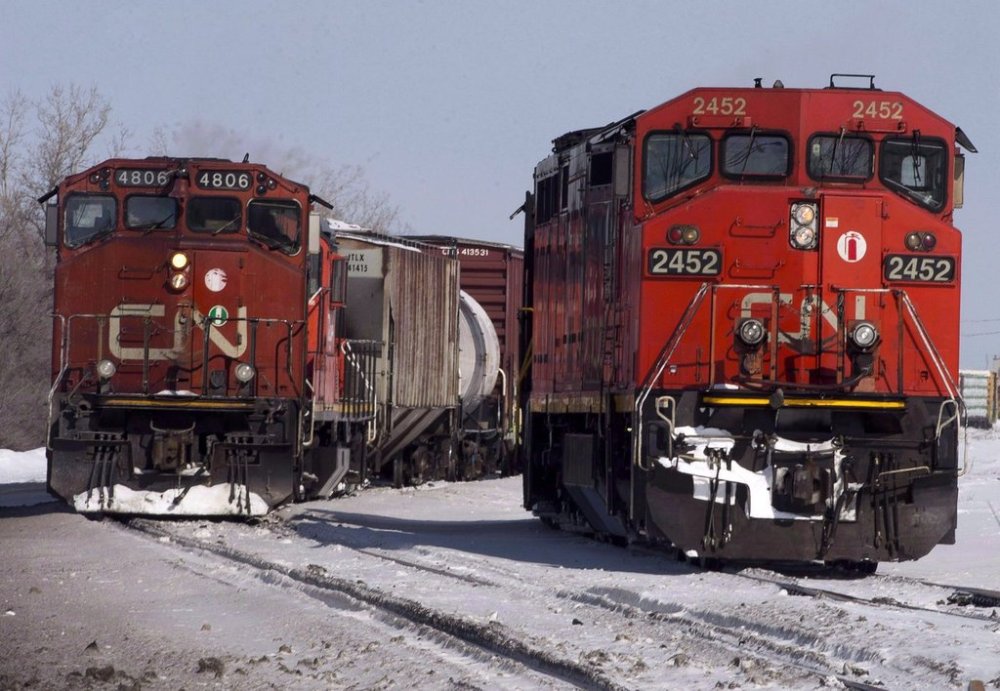
MONTREAL – Tariffs and economic angst delivered a significant blow to Canadian National Railway Co. last year, as the question mark hanging over North American free trade continues to threaten profits in 2026.
“Tariffs, trade uncertainty and volatility impacted our full-year 2025 revenues by over $350 million,” chief commercial officer Janet Drysdale told analysts on a conference call Friday.
Forest products and metals took the biggest bruising, she said, with the two segments seeing a year-over-year revenue drop of eight and four per cent, respectively, in the latest quarter.
The precarious state of the United States-Mexico-Canada Agreement, up for review this year, raises further questions about cross-border trade.
“The biggest risk around the USMCA is uncertainty. There’s investment that’s sitting on the sidelines, and our customers included are wondering under what rules they’ll be investing in the future and whether they should do that,” said CEO Tracy Robinson.
“It’s very difficult to say how this will work out,” she said. “I read the papers every day. I expect it’s going to be bumpy.”
Some 32 per cent of CN freight volumes were tied to Canada-U.S. shipments, including cargo arriving at Canadian ports and bound for American warehouses, according to an arbitration ruling last April.
For the coming year, Robinson predicted rail volumes would be “flattish,” assuming that tariffs stay where they are.
CN forecast that adjusted diluted earnings per share will slightly outpace any volume growth. The Montreal-based company also said it plans to put about $2.8 billion toward capital investment.
On top of trade uncertainty, a less publicized source of angst has rippled through the rail industry since last summer.
Union Pacific Corp., the second-largest railway operator in the United States, announced in July it wants to buy Norfolk Southern Corp. in a US$85-billion deal that would create that country’s first transcontinental railway, and potentially trigger a final wave of rail mergers across North America.
The proposed merger would marry Union Pacific’s vast rail network in the Western U.S. with Norfolk’s rails that snake across the country’s eastern half. The combined railroad would include more than 80,000 kilometres of track in 43 states with connections to major ports on both coasts.
Canadian railways have warned that without major conditions the acquisition would damage competition, cost customers and place unprecedented market power in the hands of a single railway, which would handle some 40 per cent of American freight traffic.
“The impact on CN would be less than that of the other railroad,” said Robinson, referring to Canadian Pacific Kansas City Ltd., “but it won’t be zero.”
If the deal proceeds — a revised application is underway after U.S. regulators rejected it as incomplete — Robinson aims to carve out concessions and conditions.
“We believe there’s opportunities if this is done properly,” she said.
Also Friday, CN reported that net income rose nine per cent year-over-year to $1.25 billion in the three months ended Dec. 31 compared to the same period a year earlier.
Fourth-quarter revenue increased two per cent to $4.46 billion from $4.36 billion the year before.
On an adjusted basis, CN said it earned $2.08 per diluted share in its latest quarter, up from an adjusted profit of $1.82 per diluted share a year earlier and beating analysts’ expectations of $1.98 per share, according to financial markets firm LSEG Data & Analytics.

CN’s operating ratio — a key measure of efficiency and profitability for a railway — for the quarter was 61.2 per cent, an improvement from 62.6 per cent a year earlier.
For the full year, CN boosted profits by six per cent to $4.72 billion and revenue by 1.5 per cent to $17.30 billion.
The Montreal-based company also raised its quarterly dividend on Friday, saying it will now pay 91.5 cents per share, up from 88.75 cents per share.
This report by The Canadian Press was first published Jan. 30, 2026.
Companies in this story: (TSX:CNR)