

Father turns sorrow from unimaginable loss into powerful, safe space for community

Advertisement
Read this article for free:
or
Already have an account? Log in here »
To continue reading, please subscribe:

Digital Subscription
One year of digital access for only $205*
- Enjoy unlimited reading on winnipegfreepress.com
- Read the E-Edition, our digital replica newspaper
- Access News Break, our award-winning app
- Play interactive puzzles
*First annual payment billed as $205.00 + GST for one year. This annual subscription will automatically renew at $233.00 + GST every 52 weeks (10% off the regular annual price of $259.35). Offer available to new and qualified returning subscribers only. Cancel any time.
To continue reading, please subscribe:
Add Free Press access to your Brandon Sun subscription for only an additional
$1 for the first 4 weeks*
- Enjoy unlimited reading on winnipegfreepress.com
- Read the E-Edition, our digital replica newspaper
- Access News Break, our award-winning app
- Play interactive puzzles
*Your next Brandon Sun subscription payment will increase by $1.00 and you will be charged $17.95 plus GST for four weeks. After four weeks, your payment will increase to $24.95 plus GST every four weeks.
Read unlimited articles for free today:
or
Already have an account? Log in here »
Hey there, time traveller!
This article was published 30/01/2026 (236 days ago), so information in it may no longer be current.
Born from tragedy, a new office for an organization dedicated to warning youths about the dangers of recreational drug use will offer a safe, judgment-free space for families coping with their own loss.
The Singing Red Bear Foundation cut the ribbon Friday on its new space in the Skywalk at 350 Portage Ave.
“This has been 3 1/2 years in the making… to get a place where we could work out of and share the message of, ‘No thanks, I’m good,’” said founder Joseph Fourre, whose son, Harlan, died of fentanyl poisoning in 2023 after ingesting MDMA (ecstasy) that had been laced with the opioid.
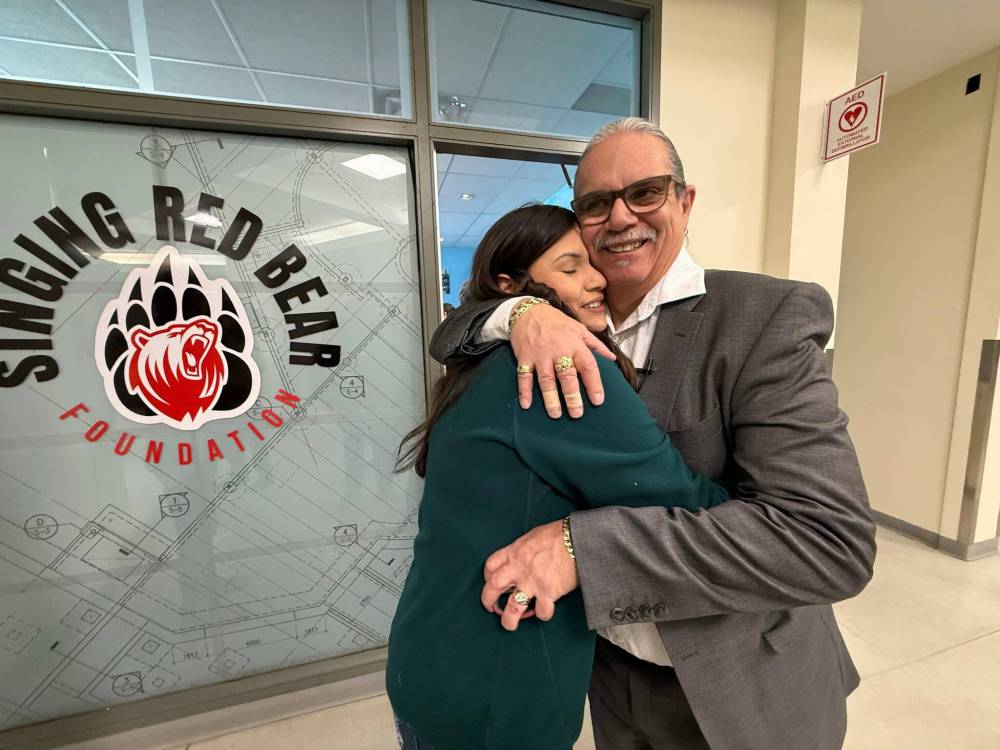
SCOTT BILLECK / FREE PRESS
Joseph Fourre and his daughter Nicole Labossiere embrace after a ribbon cutting ceremony for the Singing Red Bear Foundation, which opened its new office downtown Friday.
“More importantly, (it is) a space for the community to come that may be experiencing grief from the loss of loved ones.”
The foundation, created in the weeks following Harlan’s death, carries his traditional Indigenous name. Its logo is drawn from a tattoo Harlan chose to symbolize it.
Fourre started a campaign called “No thanks, I’m good” — a phrase Harlan often used when offered illicit substances. The campaign is aimed at encouraging youths and others not to take street drugs that could be tainted with fentanyl.
Fourre began organizing the Fentanyl Awareness Day Walk each year on Sept. 13, his son’s birthday.
“This came to light when we had one of the walks, and family was saying, ‘Thank you,’” he said. “‘Thank you for creating a safe space for us to grieve without shame.’
“The more that we have these conversations about fentanyl and fentanyl poisoning, we want to alleviate that shame…. This place that we open today will be a safe place for people to come.”
The office features a Forever Wall, where families are invited, if they feel comfortable, to hang a photo of a loved one in remembrance.
Fourre said it was during a visit to a school in Cross Lake that he knew his work was making a difference.
After giving a PowerPoint presentation to about 600 students, one approached him, tears in his eyes, and said, ‘Sorry for your loss.’
“But thank you,” the student told Fourre. “Thank you for trying to save our lives and giving us this information, because we didn’t know.”
Fourre said society has inadvertently lulled the recreational or the one-time user into a false sense of security about the drugs they take.
“My son made one bad choice, and it cost him his life,” he said. He wasn’t an addict. But for whatever reason, he made that choice. And so, when we approach young people in schools, we tell them flat out, ‘Someday you’re gonna have to make a choice.’”
And while he can’t control the supply that some First Nations communities see, he can try to help control the demand.
“And that demand is the next generation of potential drug users,” he said. “We can give them the education that they need, and the support that they need to say, ‘No thanks, I’m good.’ Then we can eliminate that supply.”
Fourre is in recovery after years of an addiction to heroin and methamphetamine that eventually led him to living on the streets of Edmonton.
His daughter, Nicole Labossiere, helped him back on his feet ahead of her wedding, telling her father that no matter what he looked like, she wanted him to walk her down the aisle.
“My dad was at his lowest when I asked him to come home,” Labossiere said. “His struggle with addiction, that was the absolute lowest that I’ve ever seen him. And to see him where he is is such a powerful truth that this is good and good change is good, and you know, it’s possible. It’s extremely powerful.
“I feel like if we had heard a message like (Singing Bear Foundation’s) before our tragedies had happened, we could have made different decisions. It’s difficult to talk about what-ifs and could-haves. But it’s so powerful and uplifting to talk about now, and what we can do to help.”

Fourre hopes that the space can also be used to develop programs needed in the community.
Community leaders, including Assembly of Manitoba Chiefs Grand Chief Kyra Wilson and Manitoba Keewatinowi Okimakanak Grand Chief Garrison Settee, were on hand for the opening.
“This is a testimony of how we can turn tragedy into something powerful,” Settee said. “This will change lives. This will transform lives. It will bring hope.”
Added an emotional Wilson: “I want to say thank you. Thank you for doing this.”
scott.billeck@freepress.mb.ca
Scott Billeck is a general assignment reporter for the Free Press. A Creative Communications graduate from Red River College, Scott has more than a decade’s worth of experience covering hockey, football and global pandemics. He joined the Free Press in 2024. Read more about Scott.
Every piece of reporting Scott produces is reviewed by an editing team before it is posted online or published in print — part of the Free Press‘s tradition, since 1872, of producing reliable independent journalism. Read more about Free Press’s history and mandate, and learn how our newsroom operates.
Our newsroom depends on a growing audience of readers to power our journalism. If you are not a paid reader, please consider becoming a subscriber.
Our newsroom depends on its audience of readers to power our journalism. Thank you for your support.
Scott Billeck is a general assignment reporter for the Free Press. A Creative Communications graduate from Red River College, Scott has more than a decade’s worth of experience covering hockey, football and global pandemics. He joined the Free Press in 2024. Read more about Scott.
Every piece of reporting Scott produces is reviewed by an editing team before it is posted online or published in print — part of the Free Press‘s tradition, since 1872, of producing reliable independent journalism. Read more about Free Press’s history and mandate, and learn how our newsroom operates.
Our newsroom depends on a growing audience of readers to power our journalism. If you are not a paid reader, please consider becoming a subscriber.
Our newsroom depends on its audience of readers to power our journalism. Thank you for your support.
Advertisement Advertise With Us
Advertisement Advertise With Us