How bomb cyclones form and create dangerous conditions

Advertisement

Advertise with us

When turbulent weather with whipping winds and heavy snow is in the forecast, meteorologists sometimes warn that a storm could “bomb out” or become a bomb cyclone. But what exactly does this mean?

Read this article for free:


or

Already have an account? Log in here »

To continue reading, please subscribe:

Subscribe and receive a limited-edition Free Press branded hat or tote.

Digital Subscription

One year of digital access for only $205*

  • Enjoy unlimited reading on winnipegfreepress.com
  • Read the E-Edition, our digital replica newspaper
  • Access News Break, our award-winning app
  • Play interactive puzzles

*First annual payment billed as $205.00 + GST for one year. This annual subscription will automatically renew at $233.00 + GST every 52 weeks (10% off the regular annual price of $259.35). Offer available to new and qualified returning subscribers only. Cancel any time.

To continue reading, please subscribe:

Add Free Press access to your Brandon Sun subscription for only an additional

$1 for the first 4 weeks*

  • Enjoy unlimited reading on winnipegfreepress.com
  • Read the E-Edition, our digital replica newspaper
  • Access News Break, our award-winning app
  • Play interactive puzzles
Start now

*Your next Brandon Sun subscription payment will increase by $1.00 and you will be charged $17.95 plus GST for four weeks. After four weeks, your payment will increase to $24.95 plus GST every four weeks.

Hey there, time traveller!
This article was published 31/01/2026 (223 days ago), so information in it may no longer be current.

When turbulent weather with whipping winds and heavy snow is in the forecast, meteorologists sometimes warn that a storm could “bomb out” or become a bomb cyclone. But what exactly does this mean?

According to the U.S. National Oceanic and Atmospheric Administration, certain storms undergo bombogenesis, which happens when a storm’s central pressure drops at least 24 millibars in 24 hours. These storms are sometimes called bomb cyclones. Storm intensity is measured by central pressure, so the lower the pressure, the stronger the storm.

Such rapidly strengthening storms are capable of producing heavy rain, blizzard conditions and intense winds that can create dangerous conditions such as downed trees and power outages.
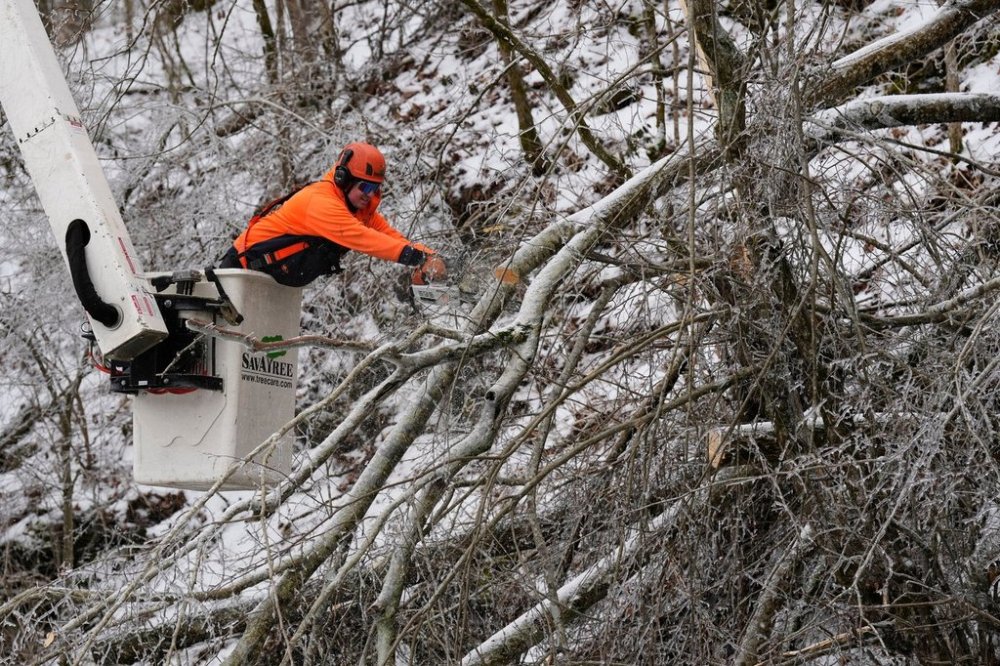
Austin Bradbury uses a chainsaw to remove a tree above a road Friday, Jan. 30, 2026, in Nashville, Tenn. (AP Photo/George Walker IV)

“If you’re watching TV at night and the weather report comes on and you’re hearing ‘bomb cyclone’ being used, that usually means there’s quite a bit of active weather going on,” said Andrew Orrison, a meteorologist with the National Weather Service in College Park, Maryland.

Bomb cyclones can happen in any season, but mainly occur during fall and winter when frigid air from the Arctic can creep south and clash with warmer air masses.

“It’s really the clash of those air masses that really kind of helps to generate the areas of low pressure in the first place,” said Orrison.

Regions in North America that are prone to seeing bomb cyclones include Alaska, the Pacific Northwest and the Great Lakes region.

___

The Associated Press’ climate and environmental coverage receives financial support from multiple private foundations. AP is solely responsible for all content. Find AP’s standards for working with philanthropies, a list of supporters and funded coverage areas at AP.org.

Report Error Submit a Tip

More Stories

Assisted living could alleviate ‘bed block’

Jesse Hajer and Tom Simms 5 minute read 2:00 AM CDT

There is a severe shortage of public and non-profit rent-geared-to-income/services-geared-to-income assisted-living housing for older adults in Manitoba. Seniors assisted living is a form of housing that includes rent, food, laundry and cleaning services.

Presently, the provincial government almost exclusively relies on the private market to provide assisted-living housing for seniors. Monthly private-market assisted-living housing rent for seniors ranges from $3,000 to $6,000 per month. The total income for an individual older adult receiving old age security (OAS) and guaranteed income supplement (GIS) pensions is less than $2,000 per month.

It is clear that low- and fixed-income seniors are not able to afford private-market assisted-living housing, resulting in the premature entry of these older adults into long-term care homes because seniors assisted-living housing is not publicly subsidized, whereas long-term care facilities do provide income-based subsidies.

Low- and fixed-income seniors are also experiencing a food affordability crisis which is negatively impacting their health and well-being. An enhanced assisted-living housing program that includes congregate meals would play an important role in addressing this growing affordability problem, along with reducing social isolation and loneliness.

The plane truth about a dangerous president

Editorial 4 minute read Preview

The plane truth about a dangerous president

Editorial 4 minute read Yesterday at 2:01 AM CDT

U.S. President Donald Trump has crossed firmly into cutting-off-your-nose-to-spite-your-face territory.

Read
Yesterday at 2:01 AM CDT

Letters, Sept. 11

7 minute read 2:01 AM CDT

25 years of remembering

There are days and events in one’s life that simply cannot be erased, nor should they. Such was that day, 25 years ago on Sept. 11, 2001.

The world remembered in silence at 9:46 AM (CST) in homage to the victims of that tragic event. Sadly many thousands would lose their lives in the wars that followed as a result of 9/11, including no less than 165 Canadians in Afghanistan. We shall remember them.

Following that solemn silence, attention in Canada and the United States will be drawn to Gander, Newfoundland and Labrador, and understandably so.

Time to revamp Hydro’s water licence

Will Braun 5 minute read Preview

Time to revamp Hydro’s water licence

Will Braun 5 minute read 2:00 AM CDT

On Sept. 1, Manitoba Hydro’s 50-year licence to divert 85 per cent of the flow of the second largest river in the province and flood the fourth largest lake expired. How different will the next 50 years of the Churchill River Diversion look?

The northern project is a cornerstone of the engineering wonder that provides Manitoba with inexpensive and reliable electricity.

Using control structures and a nine-kilometre channel blasted through granite, the project backs up the Churchill River — which carries five times more water than the Red — as it flows through Southern Indian Lake, a lake 50 times larger than West Hawk and Falcon lakes combined, causing it to overflow southward toward the huge dams on the distant Nelson River.

After touring Southern Indian Lake in 2022, Wab Kinew — then opposition leader — referred in a statement to witnessing “islands disappearing into the lake, shorelines eroding quickly, a landscape covered with debris, (and) fish spawning grounds lost….”

Read
2:00 AM CDT

‘We feel lucky — and a bit traumatized’: Tornado confirmed in River Heights Sunday

Malak Abas 6 minute read Preview

‘We feel lucky — and a bit traumatized’: Tornado confirmed in River Heights Sunday

Malak Abas 6 minute read Updated: Yesterday at 6:10 PM CDT

Tanner Lemieux wasn’t surprised to learn the violent winds that tore through River Heights and reached their peak near his home Sunday night have been classified as a tornado.

While driving back to his Lindsay Street home from a shopping trip with his wife Sunday, it became clear they were not in the middle of an ordinary thunderstorm when rain and wind started coming from every direction and hit every side of their truck.

The forceful wind made it impossible for him to open his door after they had parked. He climbed through the window, over the top of his vehicle, and the couple struggled to fight the whipping winds to make it into the house.

“As we were running in, the wind started pulling me backwards out of the door,” he told the Free Press while cleaning debris from his yard Thursday.

Read
Updated: Yesterday at 6:10 PM CDT

Supportive housing operator sued after man with dementia walks away

Erik Pindera 4 minute read Preview

Supportive housing operator sued after man with dementia walks away

Erik Pindera 4 minute read Yesterday at 6:00 AM CDT

The Public Guardian and Trustee of Manitoba is suing a health services company after a man with dementia under its care allegedly wandered away from an apartment it operates for vulnerable people and was later found face down in a puddle — unresponsive, hypothermic and severely injured.

The public trustee — a provincial government agency that, among other duties, makes financial and personal care decisions for vulnerable adults who cannot do so themselves — filed the lawsuit against Cambridge Health Inc. and a related numbered company in the Court of King’s Bench earlier this month.

The agency did so on behalf of a now-38-year-old man, who has been under its care since 2018, as a result of his frontotemporal dementia. The disease often starts in mid-life, rather than old age, as is the case with most other forms of dementia.

The lawsuit alleges the man, who resided at a Henderson Highway apartment complex where Cambridge Health operated a supportive residence for people with complex behavioural health issues, was in a common area of the home at about 4:30 p.m. on April 3 last year.

Read
Yesterday at 6:00 AM CDT