From southern India to Canada’s far north: New archbishop serves Indigenous Catholics
Advertisement
Read this article for free:
or
Already have an account? Log in here »
To continue reading, please subscribe:

Digital Subscription
One year of digital access for only $205*
- Enjoy unlimited reading on winnipegfreepress.com
- Read the E-Edition, our digital replica newspaper
- Access News Break, our award-winning app
- Play interactive puzzles
*First annual payment billed as $205.00 + GST for one year. This annual subscription will automatically renew at $233.00 + GST every 52 weeks (10% off the regular annual price of $259.35). Offer available to new and qualified returning subscribers only. Cancel any time.
To continue reading, please subscribe:
Add Free Press access to your Brandon Sun subscription for only an additional
$1 for the first 4 weeks*
- Enjoy unlimited reading on winnipegfreepress.com
- Read the E-Edition, our digital replica newspaper
- Access News Break, our award-winning app
- Play interactive puzzles
*Your next Brandon Sun subscription payment will increase by $1.00 and you will be charged $17.95 plus GST for four weeks. After four weeks, your payment will increase to $24.95 plus GST every four weeks.
Read unlimited articles for free today:
or
Already have an account? Log in here »
Hey there, time traveller!
This article was published 02/02/2026 (232 days ago), so information in it may no longer be current.
As a teenager in southern India, Susai Jesu led 4:30 a.m. prayer services in his small Catholic village before the farmers went into the fields. He directed the choir, helped at mass and soon began training for the priesthood.
Little did he know that this dedication would take him halfway around the world on a vast cross-cultural journey — ministering among Canada’s Indigenous Catholics, learning their language, culture and historical traumas.
Jesu became the first India-born Roman Catholic archbishop in Canada when he was ordained and installed in the Archdiocese of Keewatin-Le Pas on Jan. 26. He oversees ministry in northern Manitoba and Saskatchewan to about 49,000 Catholics, mostly Indigenous, across 725,000 square kilometres.
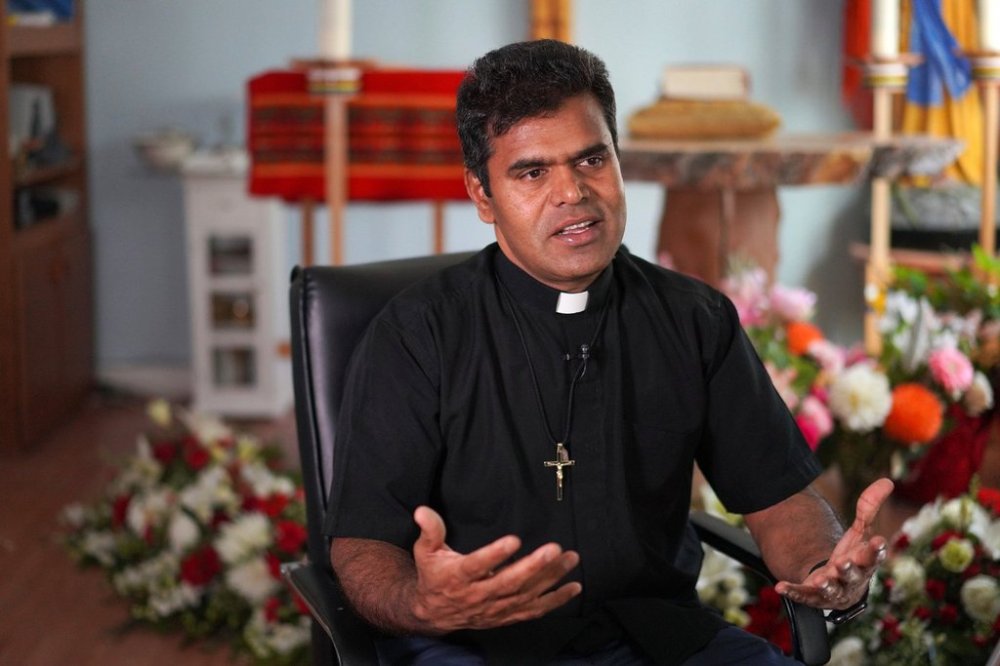
Jesu’s installation ceremony included traditional drumming, as well as songs and prayers in Cree, Dene, English, French, Oji-Cree and his native Tamil.
Jesu’s first order of business is simply to spend time with the people.
At each of the far-flung parishes he visits, he plans not only to preside at worship but to be “physically present with them,” he said. He hopes to build trust over time in a population that includes many loyal Catholics but also many who remain wounded and alienated from the church.
“For the first year, let us build a relationship,” said Jesu, 54, who was appointed archbishop by Pope Leo in November. “With all those residential schools (and their legacy), what kind of Jesus are we giving today?”
When he got the call from the Papal Nuncio in Ottawa about being called to Keewatin-Le Pas, Jesu’s first thought was that it was a scam.
“The area code was 613, and I knew that was Ottawa, so I didn’t answer it,” Jesu said.
The Nuncio left a message informing him of the news. After calling back, Jesu spent time in prayer before sending a note to the Pope that said ‘yes.’
“I was glad to be going back to this diocese,” he said, noting he first served the area after he moved to Canada in 2007. “I know it well and know so many people from my time here. I knew it was a calling of God to come back and serve these people. It was like coming home.”
His goal is to listen.
“When I was young in India, the priest would come to our town, say mass and then leave right away,” he said. “I told myself, if I ever become a priest I will stay longer.”
That will include learning how he and the church can assist with healing and reconciliation.
Murray Chatlain, Archbishop of Winnipeg, served with Jesu during his first stint in Keewatin-Le Pas. Chatlain, the area’s archbishop at the time, called
Jesu compassionate, culturally sensitive and dedicated to reconciliation and community building.
“He is very gifted and genuine,” Chatlain said, adding he is very comfortable speaking the Cree language. “It is rare for a foreign-born priest to learn an Indigenous language.”
Fernie Marty, one of Jesu’s parishioners in Edmonton, recalled how the priest enthusiastically joined him on excursions to pick sage, sweetgrass and other traditional medicinal plants.
“He went above and beyond what I thought any normal priest would do,” said Marty, an elder at Sacred Heart Church of the First Peoples, a parish that incorporates Indigenous practices. After a devastating fire, Jesu oversaw the church’s reconstruction — with such features as a tepee-like structure over the altar and images of Jesus with Indigenous features — in time for Pope Francis’ visit.
Jesu hosted Francis at his Edmonton parish when the late pontiff visited Canada in 2022 to apologize for the Catholic Church’s collaboration with the “catastrophic” system of Indigenous residential schools.
He served in Edmonton from 2017 to 2025, and after a brief posting at a pilgrimage shrine, received the archbishop appointment.
Born into a Roman Catholic family in Tamil Nadu, India, Jesu became an Oblate as a teenager and was ordained to the priesthood in 2000.
He moved to Canada in 2007, becoming a Canadian citizen and ministering to Indigenous and inner-city communities in Saskatchewan, Manitoba and Alberta.
Fluent in English, Cree and Tamil, Jesu served as pastor of St. Gertrude Parish in Pelican Narrows, Sask., and Our Lady of Seven Sorrows Parish in Sandy Bay.
He remembers his welcome-to-Canada moment.
He lacked experience in winter driving, and one day his car rolled over three times, fell into a river and began to sink. “By God’s grace, I pressed the button. I came out of the car,” he recalled later. “I was experiencing my own death.”
He ran for help and eventually flagged down a car. “God saved me to continue my ministry.”
That didn’t deter his eagerness to travel. With the help of a pilot, he visited parishes throughout the vast Archdiocese of Keewatin-Le Pas — unknowingly preparing for his future appointment as archbishop.
It was a sombre ministry in many ways as he responded to chronic problems of drug and alcohol abuse and suicide.
“I really enjoyed my ministry of being there, but the amount of alcohol, drugs and all these things, it’s pretty sad,” he recalled. He often got phone calls asking, “Please come to the health centre, there’s a stabbing there, there’s a suicide here, there’s an accident due to alcohol.”

He ached for “the children who are walking on the street aimlessly, not knowing who they are,” he said.
Jesu joined local elders in conducting healing workshops, and he went on to get a master’s in counselling and spirituality in Ottawa. “I felt I needed special skills to tell them how good they are before the eyes of God,” he said.
Even though he’s a newcomer to Canada, Jesu recognizes he represents the church and its long, checkered legacy. He doesn’t often wear his clerical collar in informal settings. “The trigger is still there,” he said.
For those still estranged from the church, he hopes “to be with them and to help them see how can we work together on this,” he said. “How much can I accompany in your suffering?”
— The Associated Press with files by John Longhurst
History
Updated on Tuesday, February 3, 2026 9:54 AM CST: Adds files by John Longhurst
The Free Press acknowledges the financial support it receives from members of the city’s faith community, which makes our coverage of religion possible.