

Importing frustration: niche business vs. CBSA online portal ‘case study’

Advertisement
Read this article for free:
or
Already have an account? Log in here »
To continue reading, please subscribe:

Digital Subscription
One year of digital access for only $205*
- Enjoy unlimited reading on winnipegfreepress.com
- Read the E-Edition, our digital replica newspaper
- Access News Break, our award-winning app
- Play interactive puzzles
*First annual payment billed as $205.00 + GST for one year. This annual subscription will automatically renew at $233.00 + GST every 52 weeks (10% off the regular annual price of $259.35). Offer available to new and qualified returning subscribers only. Cancel any time.
To continue reading, please subscribe:
Add Free Press access to your Brandon Sun subscription for only an additional
$1 for the first 4 weeks*
- Enjoy unlimited reading on winnipegfreepress.com
- Read the E-Edition, our digital replica newspaper
- Access News Break, our award-winning app
- Play interactive puzzles
*Your next Brandon Sun subscription payment will increase by $1.00 and you will be charged $17.95 plus GST for four weeks. After four weeks, your payment will increase to $24.95 plus GST every four weeks.
Read unlimited articles for free today:
or
Already have an account? Log in here »
Hey there, time traveller!
This article was published 02/02/2026 (183 days ago), so information in it may no longer be current.
A local matcha maven is breathing a sigh of relief after receiving a $12,000 tea order from Japan after it was held up at the border for three months.
Maro Matcha has specialized in matcha and hojicha green tea sourced directly from Uji, Japan, since it began hosting pop-ups and collaborating with local businesses in June. As the Winnipeg business grew, their regular order of around 10 kilograms of tea would only last around a week, said owner Marro Tumaca.
With Maro Matcha operating out of downtown Hawaiian restaurant Honu Poké for the winter, Tumaca decided to take the leap and order a 77-kg shipment of matcha. It arrived in October, but was held up at the border.
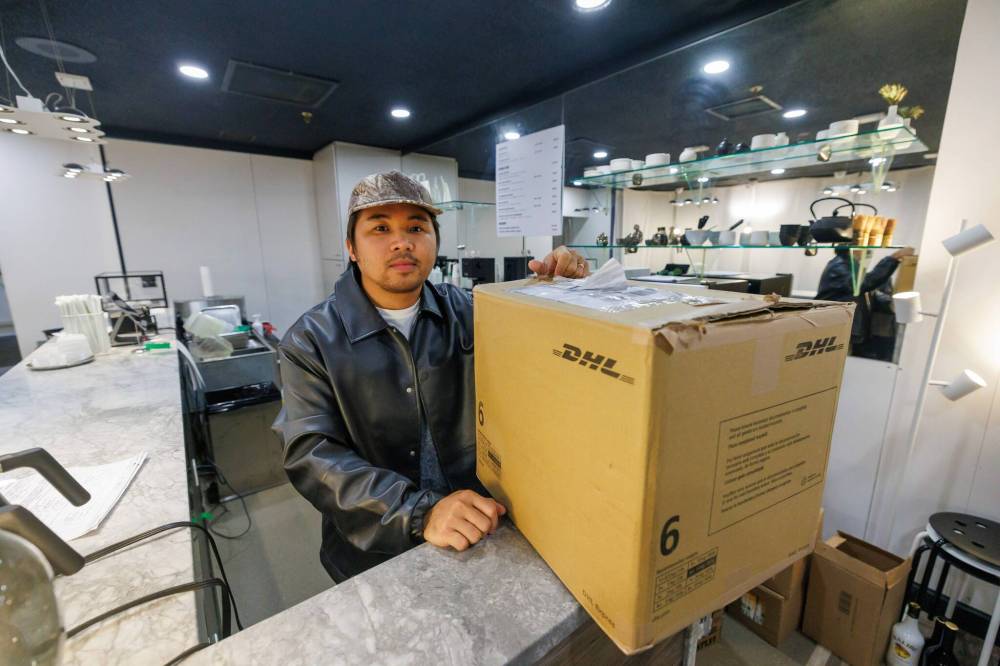
MIKE DEAL / FREE PRESS
Marro Tumaca, owner of Maro Matcha, is breathing a sigh of relief after a $12,000 tea order from Japan, held up at the Canadian border for months, has arrived in Winnipeg.
It was only then when he learned federal guidelines require an import licence for large shipments of tea for commercial use. He was told he had 40 days to procure a licence.
“This situation was extremely stressful for my partner and me. At one point, we considered treating this as a learning experience and moving forward (without the shipment),” Tumaca told the Free Press.
As a food product, importing large amounts of matcha for commercial use requires a Safe Food for Canadians import licence before the shipment arrives. The document is good for two years.
Tumaca said he had never encountered the issue before because he’d only imported small amounts at a time.
He had no idea how to apply for a licence and described the online guidelines as difficult to understand and filled with confusing jargon, even running parts of the Canada Border Service Agency’s website through ChatGPT in hopes of simplifying the rules. Some of his products ran out of stock in the meantime.
It was down to the wire, but Tumaca submitted a licence application just before the deadline. He received the shipment of matcha two weeks ago, and was able to restock the storefront.
As a small-business owner with what he describes as an especially niche product and customer base, Tumaca said he wished there were more accessible resources for businesses like his to prevent such mix-ups.
“In hindsight, I wish we had done more thorough research before placing a large matcha order, but we also started as a business not knowing everything, so we learned along the way, and this situation was part of the learning process.”
Simplifying trade at the border for small businesses has been a recurring issue for members of the Canadian Federation of Independent Business — so much so, its yearly “Paperweight Award,” which highlights “the most ridiculous examples of red tape from across the country,” was awarded last week to the CBSA.
It received the dubious honour for its CBSA Assessment and Revenue Management (CARM) system, an online portal launched in October 2024 meant to streamline how taxes and duties are collected for imports at the border.
Instead, the system was rolled out too quickly to give small businesses time to adapt, brought in at an opportune time as tariffs were being implemented from the ongoing U.S. trade war and resulted in “chaos,” including piles of new paperwork and hoops to jump through, said CFIB senior policy analyst Tyler Slobogian.
“Overall, it’s really unfortunate to see a small business blindsided by complex border rules they had no idea applied to them.”
Exacerbating the CARM system’s issues is the new “Release Prior to Payment” program, implemented in May 2025, which requires a cash deposit or a written security agreement from the business to have their goods released from the border. For smaller business owners with limited cash flow, it can be disruptive to have money tied up in a new program, and some are forced to get to the border themselves to clear their shipments, Slobogian said.
He said CFIB works to put more reader-friendly explanations of the systems businesses need to navigate because the official websites can be unclear.

“It’s really hidden in plain sight. In most cases, it’s hard to find, difficult to navigate and small-business owners don’t have the time, necessarily, to do all that,” he said. “That’s something that we’re obviously pushing for, is to make it more accessible for small businesses.”
With growing interest in shopping and buying local one year into the aforementioned trade war, University of Manitoba economics Prof. Fletcher Baragar said it makes sense to see some of those businesses expanding.
He called Maro Matcha an “interesting case study” of that growth and its potential hurdles.
“Part of the creativity of businesses, especially small businesses, are that they’re innovative, they’re flexible, they’re often well-positioned to consider other possibilities,” he said. “And whenever businesses pivot or make a big change or make a move like that, they’re putting a lot on the line. It’s a bit of a risk, it’s a bit of a step into the unknown.”
malak.abas@freepress.mb.ca
Malak Abas is a city reporter at the Free Press. Born and raised in Winnipeg’s North End, she led the campus paper at the University of Manitoba before joining the Free Press in 2020. Read more about Malak.
Every piece of reporting Malak produces is reviewed by an editing team before it is posted online or published in print — part of the Free Press‘s tradition, since 1872, of producing reliable independent journalism. Read more about Free Press’s history and mandate, and learn how our newsroom operates.
Our newsroom depends on a growing audience of readers to power our journalism. If you are not a paid reader, please consider becoming a subscriber.
Our newsroom depends on its audience of readers to power our journalism. Thank you for your support.
Malak Abas is a city reporter at the Free Press. Born and raised in Winnipeg’s North End, she led the campus paper at the University of Manitoba before joining the Free Press in 2020. Read more about Malak.
Every piece of reporting Malak produces is reviewed by an editing team before it is posted online or published in print — part of the Free Press‘s tradition, since 1872, of producing reliable independent journalism. Read more about Free Press’s history and mandate, and learn how our newsroom operates.
Our newsroom depends on a growing audience of readers to power our journalism. If you are not a paid reader, please consider becoming a subscriber.
Our newsroom depends on its audience of readers to power our journalism. Thank you for your support.
Advertisement Advertise With Us
Advertisement Advertise With Us