Italy gets creative as it works to make art accessible for blind people
Advertisement
Read this article for free:
or
Already have an account? Log in here »
To continue reading, please subscribe:

Digital Subscription
One year of digital access for only $205*
- Enjoy unlimited reading on winnipegfreepress.com
- Read the E-Edition, our digital replica newspaper
- Access News Break, our award-winning app
- Play interactive puzzles
*First annual payment billed as $205.00 + GST for one year. This annual subscription will automatically renew at $233.00 + GST every 52 weeks (10% off the regular annual price of $259.35). Offer available to new and qualified returning subscribers only. Cancel any time.
To continue reading, please subscribe:
Add Free Press access to your Brandon Sun subscription for only an additional
$1 for the first 4 weeks*
- Enjoy unlimited reading on winnipegfreepress.com
- Read the E-Edition, our digital replica newspaper
- Access News Break, our award-winning app
- Play interactive puzzles
*Your next Brandon Sun subscription payment will increase by $1.00 and you will be charged $17.95 plus GST for four weeks. After four weeks, your payment will increase to $24.95 plus GST every four weeks.
Read unlimited articles for free today:
or
Already have an account? Log in here »
Hey there, time traveller!
This article was published 03/02/2026 (225 days ago), so information in it may no longer be current.
ROME (AP) — On a recent weeknight, long after the swarms of tourists had left Rome’s Colosseum, a small group of people walked around outside the darkened amphitheater, pausing every so often to take in a new aspect of its history, art or architecture with every sense but sight.
Michela Marcato, 54, has been blind since birth. She and her partially sighted partner were touring the site amid a new effort by Italy to make its myriad artistic treasures more accessible to people with blindness or low vision and enhance how all visitors experience and perceive art.
As she listened to her tour guide, Marcato traced her fingers over a small souvenir model of the Colosseum. She felt the grooves of its archways and rugged rubble of its crumbled side. What she hadn’t realized before holding it was the elliptical shape of building.
“Walking around it, I personally would never have realized it. I would never have understood it,” she said. “But with that little model in your hand, it’s obvious!”
A different type of tourism
Italy and its art-filled cities have no shortage of tourists, but they haven’t always been overly welcoming to visitors with disabilities. People who use wheelchairs often find elevators and doorways that are too narrow, stairs without ramps and uneven pavements.
But in 2021, as a condition of receiving European Union pandemic recovery funds, Italy accelerated its accessibility initiatives, dedicating more attention and resources to removing architectural barriers and making its tourist sites and sporting venues more accessible.
The ancient city of Pompeii recently installed a new system of signage to make the vast archaeological site more accessible to blind and disabled people. The project uses braille signs, QR-coded audio guides, tactile models and bas-relief replicas of artifacts that have been excavated over the years.
The city of Florence, for its part, has produced a guide on the accessibility options at the Uffizi Gallery and its other museums, with detailed information on routes and requirements — including the presence of companions — for sites such as the Boboli Gardens, which because of their historic structures are not fully accessible.
An inclusive tourism model doesn’t just honor the human rights of people with disabilities; it also makes economic sense. Nearly half of the world’s population aged over 60 has a disability, and disabled travelers tend to bring two or more companions, according to the World Tourism Organization.
A different way to experience art
Giorgio Guardi, a tour guide with the Radici Association, which has been leading tours of Rome for people with disabilities since 2015, said the aim of accessible tourism is to create an experience that is enjoyable for everyone involved, companions included.
That often means slowing down, touching what can be touched and experiencing artwork with different senses. The association often organizes walking tours at night, when there are fewer people out and less distracting ambient noise at famous landmarks.
But it isn’t always possible for blind people to touch artworks, so guides have to get creative.
Take Rome’s central Campo dei Fiori piazza and its imposing statue of Giordano Bruno, the 16th-century philosopher burned at the stake during the Inquisition for alleged heresy.
The statue, which stands atop a large pedestal in the middle of the piazza, is too high for visitors to touch. On a recent nighttime tour of the piazza, Guardi encouraged his clients to instead assume Bruno’s position: Hunched over, wearing a heavy hooded cape and clasping a book with both hands.
As one of his clients assumed the position, Guardi draped the cape over him. Others in the group lined up to touch the Bruno impersonator to feel the contours of his drooped shoulders, heavy with the weight of the Inquisition. Visitors who were deaf were also part of the tour, aided by a sign-language interpreter who recounted Bruno’s tragic end.
A museum featuring art by and for blind people
Aldo and Daniela Grassini, both blind, were avid travelers and art collectors who grew increasingly frustrated that they weren’t allowed to touch art when they visited museums around the world. In the early 1990s, they founded what subsequently become Italy’s only publicly funded tactile museum, the Museo Omero in the Adriatic coastal city of Ancona, where all the art is meant to be handled.
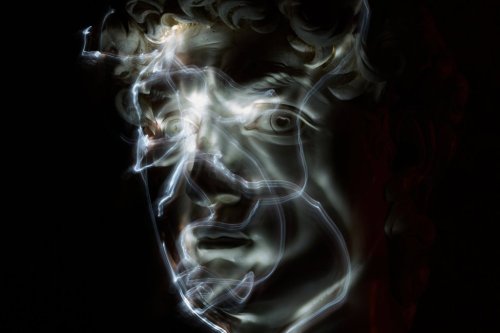
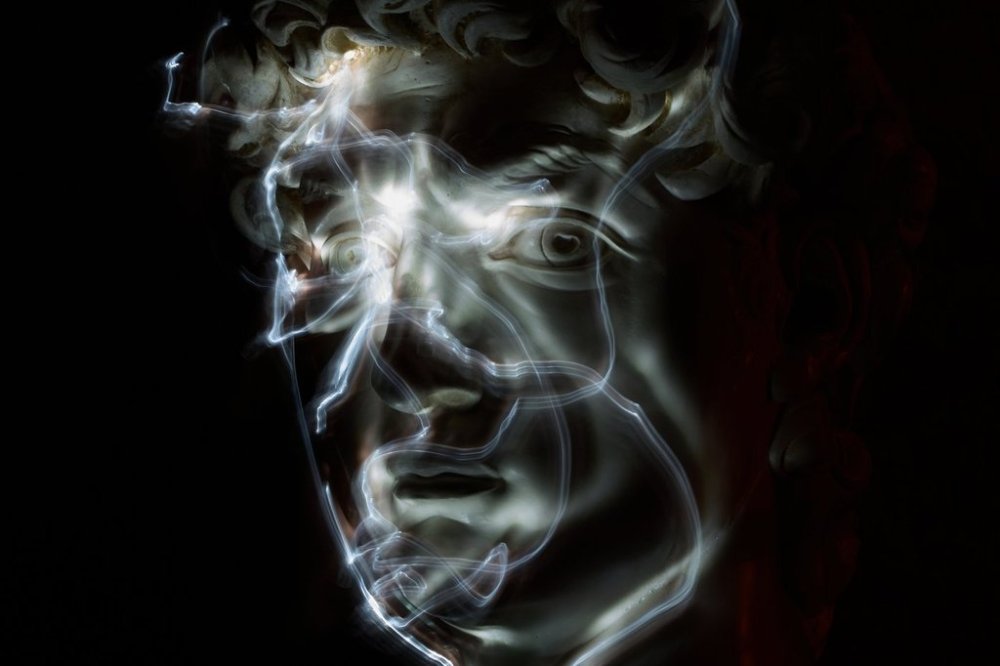
Named for the blind poet Homer, the museum features life-sized replicas of some of Italy’s most famous artworks, from ancient Roman and Greek statues to the head of Michelangelo’s David, as well as contemporary artworks.
“Touching something isn’t like looking at it,” said Aldo Grassini. “Not just because of the emotion it offers, but because of the type of knowledge that sensation provides.”
Sight, he said, is an “overbearing sense that tends to monopolize reality,” whereas touch offers a different dimension.
“We love with our eyes and with our hands. If we are in love with a person or an object that is particularly dear to us, is it enough to just look at it? No, we need to caress it, because caressing gives you a different emotion,” he said.
One of the artists whose work is on display at the museum is Felice Tagliaferri, who himself is blind.
At his studio on the outskirts of Cesena, Tagliaferri points to a marble bust he sculpted of his late friend Angela. Tagliaferri recalled that before Angela died of breast cancer, he lay down in bed with her, caressing her bald head.
“When she passed away, Angela remained in my hands, and I recreated this sculpture thinking of her,” he said.
Unpacking a picture of the sea
Marcato, the woman who toured the Colosseum, and her partner Massimiliano Naccarato live in a smart apartment on Rome’s east side whose living room is dominated by a huge painting of the sea.
Naccarato, who can see using his cellphone to enlarge images and with the help of special lights, purchased the painting to celebrate a professional award, and it has pride of place in their home. He installed a special light behind the work so he can see it better.
Marcato can’t see it at all, but she knows it’s there. And her own experience at the beach informs the way she enjoys the painting.
For her, the painting recalls her love of the sea, “for the noise it makes, for the thousand different sounds it produces, for the smell you breathe in, for the walks you can take in any season.”
It is a sensory way of appreciating art that has absolutely nothing to do with seeing it.
___
Associated Press writer Nicole Winfield in Rome contributed to this report.