Trump administration approves weed killer dicamba for two common genetically modified crops

Advertisement

Advertise with us

WASHINGTON (AP) — The Environmental Protection Agency on Friday reapproved the weed killer dicamba for use on genetically modified soybeans and cotton, a pesticide that has raised widespread concern over its tendency to drift and destroy nearby crops.

Read this article for free:


or

Already have an account? Log in here »

To continue reading, please subscribe:

Subscribe and receive a limited-edition Free Press branded hat or tote.

Digital Subscription

One year of digital access for only $205*

  • Enjoy unlimited reading on winnipegfreepress.com
  • Read the E-Edition, our digital replica newspaper
  • Access News Break, our award-winning app
  • Play interactive puzzles

*First annual payment billed as $205.00 + GST for one year. This annual subscription will automatically renew at $233.00 + GST every 52 weeks (10% off the regular annual price of $259.35). Offer available to new and qualified returning subscribers only. Cancel any time.

To continue reading, please subscribe:

Add Free Press access to your Brandon Sun subscription for only an additional

$1 for the first 4 weeks*

  • Enjoy unlimited reading on winnipegfreepress.com
  • Read the E-Edition, our digital replica newspaper
  • Access News Break, our award-winning app
  • Play interactive puzzles
Start now

*Your next Brandon Sun subscription payment will increase by $1.00 and you will be charged $17.95 plus GST for four weeks. After four weeks, your payment will increase to $24.95 plus GST every four weeks.

Hey there, time traveller!
This article was published 06/02/2026 (190 days ago), so information in it may no longer be current.

WASHINGTON (AP) — The Environmental Protection Agency on Friday reapproved the weed killer dicamba for use on genetically modified soybeans and cotton, a pesticide that has raised widespread concern over its tendency to drift and destroy nearby crops.

The agency said dicamba was critical for farmers who would otherwise have their crops threatened by fast growing weeds. To ensure the pesticide is used safely, the agency said it imposed strong protections and limits on its use.

Dicamba is a common weed killer that can be sprayed on top of genetically engineered crops. It kills the weeds but doesn’t hurt the crops. It has been in use for decades, but it has become more widespread on farms in recent years.
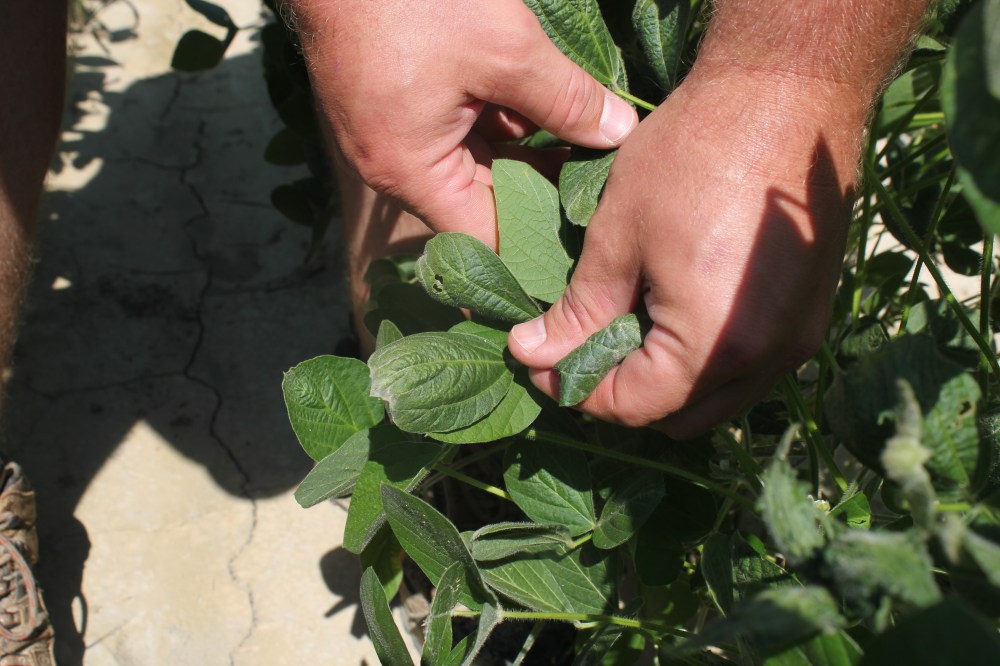
FILE - In this July 11, 2017, file photo, a farmer shows damage to soybean plants from dicamba in Marvell, Ark. (AP Photo/Andrew DeMillo, File)

Advocates sharply criticized the agency, saying they are moving forward after courts blocked similar efforts in 2020 and 2024. Allowing its use on these two common crops will drastically expand how much is applied and increase harm, advocates say.

Kelly Ryerson, an activist with the Make American Healthy Again movement that has forged a fragile political allegiance with the Trump administration, said she was disheartened by the decision.

“A top priority of mine was to have the use of Dicamba for over-the-top applications permanently discontinued because” of their harm, she said. “New restrictions on use are not sufficient, and will perpetuate the chemical treadmill where many farmers are trapped.”

The EPA said growers want the weed killer and they need to be supported — and that it isn’t a MAHA versus EPA issue.

The agency said concerns about dicamba drifting to places where it was not intended are real and must be managed. It set limits on how much can be applied per acre, how much can be applied on hot days and established buffer zones to prevent harm to nearby crops. If followed, the chemical can be used without threatening humans or the environment, according to EPA.

The American Soybean Association applauded the decision, saying clear rules would help farmers prepare for the next growing season and control destructive weeds.

Environmental groups said dicamba drift has damaged immense acreage, devastating vegetable farms, trees and other critical plants.

“When push comes to shove, this administration is willing to bend over backward to appease the pesticide industry, regardless of the consequences to public health or the environment,” said Nathan Donley, environmental health science director at the nonprofit Center for Biological Diversity.

Environmentalists said the EPA’s use restrictions are insufficient, allowing application for too much of the time and for too many days of the year. The buffer the agency uses to prevent harm to nearby plants has already proved ineffective, they said.

Researchers have been working to better understand its health risks. A 2020 study in the International Journal of Epidemiology found that dicamba exposure was linked to an increased risk for some cancers, including liver cancer and a type of leukemia affecting the blood and bone marrow.

Bayer, a manufacturer of dicamba, said the federal registration will allow them to now seek state approvals. They’ll launch training for applicators in the coming weeks.

___

The Associated Press receives support from the Walton Family Foundation for coverage of water and environmental policy. The AP is solely responsible for all content. For all of AP’s environmental coverage, visit https://apnews.com/hub/climate-and-environment

Report Error Submit a Tip

More Stories

Revered Broadway rail anchors Winnipeg’s resilient skateboarding scene

Benjamin Waldman 11 minute read Preview

Revered Broadway rail anchors Winnipeg’s resilient skateboarding scene

Benjamin Waldman 11 minute read Yesterday at 11:13 AM CDT

The Woodsworth Building at the corner of Broadway and Kennedy Street is an accidental, unofficial mecca of Winnipeg skateboarding.

Read
Yesterday at 11:13 AM CDT

Classic Scoop founder left lucrative job to start business offering treats on-site for parties, festivals

Aaron Epp 5 minute read Preview

Classic Scoop founder left lucrative job to start business offering treats on-site for parties, festivals

Aaron Epp 5 minute read Yesterday at 2:00 AM CDT

Days off used to be infrequent for Paul Abdul-Raymond, but now every day’s a sundae.

The Winnipeg entrepreneur is the owner of the Classic Scoop, an ice cream trailer that customers can book events such as birthday parties, corporate functions and community festivals. Abdul-Raymond and his staff show up to serve classic cones with customizable toppings, ice cream sandwiches and seasonal specials.

It’s a lot of work but it’s also a lot of fun for the 39-year-old, who left a lucrative but stressful job at a health-care company to get the Classic Scoop going in spring 2025.

Customers affirmed his career pivot from the start.

Read
Yesterday at 2:00 AM CDT

Indomitable spirit

Janine LeGal 7 minute read Preview

Indomitable spirit

Janine LeGal 7 minute read 3:00 AM CDT

Catherine Mary Burke was strong and motivated in ways many of us could never imagine.

She was known for fighting the good fight, and she fought as hard as she could for as long as she could. But something set her apart. Even when it was too late for her, she insisted cancer survival rates had to be better for other women. And they are today because of her fierce determination.

Burke died on Nov. 29, 2025, at age 67 after courageously facing breast cancer for more than a decade.

“Cathy was born happy,” said her husband, Patrick Burke. “She was a glass-half-full person. What a gift this attitude was to me and the boys. She never once said ‘Why me?’ or complained. She was just so happy to be alive.

Read
3:00 AM CDT

Human cost of AI bubble outweighs tech’s potential

Reviewed by Brandi Field 4 minute read Preview

Human cost of AI bubble outweighs tech’s potential

Reviewed by Brandi Field 4 minute read 3:00 AM CDT

Despite the title of his new book, Cory Doctorow isn’t against artificial intelligence (AI). At least, not exactly — although, admittedly, the “Before It’s Too Late” of the book’s subtitle sounds ominous.

A self-described AI critic, Doctorow is against the scammy story tech companies are selling investors and bosses: that AI can replace workers, cut costs and keep tech companies growing forever.

Doctorow introduces the idea of “centaurs” and “reverse centaurs” to expose power relationships between people and AI. In automation theory, a centaur is a person who is helped by a machine. A reverse centaur is a person who is forced to help a machine. The difference, Doctorow argues, is whether the person gets to choose when, where and how to use the tool.

He wants readers to stop being dazzled by AI and start asking who uses it, from it and gets used by it.

Read
3:00 AM CDT

Rise of social media reflects rise of self-promotion — to the detriment of genuine storytelling

Reviewed by Matt Henderson 4 minute read Preview

Rise of social media reflects rise of self-promotion — to the detriment of genuine storytelling

Reviewed by Matt Henderson 4 minute read 3:00 AM CDT

A conversation is overheard between two people; one congratulates the other on their success, evident through countless posts on LinkedIn, but the other confesses the prolific aggrandizement is due to slumping success.

A young man on an airplane spends three hours poring over selfies taken on a vacation, zooming in on his biceps and using AI to retouch photos before posting on Instagram.

Anonymous and cowardly trolls on Reddit attempt to end another person’s career.

All this “storytelling” was observed in one day by this reviewer.

Read
3:00 AM CDT

‘Disrespectful’: residents frustrated after Wyatt arrives hour late to committee meeting

Joyanne Pursaga 3 minute read Preview

‘Disrespectful’: residents frustrated after Wyatt arrives hour late to committee meeting

Joyanne Pursaga 3 minute read Updated: Yesterday at 1:00 PM CDT

Several Winnipeggers attending a city development hearing on Thursday expressed frustration that one councillor arrived about an hour late, delaying the matter from being heard.

Coun. Russ Wyatt, who continues to attend city hall while facing criminal charges, began participating in the 9:30 a.m. East Kildonan-Transcona community committee meeting at 10:35 a.m.

A resident who hoped to speak at the meeting about a development plan in south Transcona noted the tardiness led the committee to bump the topic down on its agenda, while dozens waited to speak on it.

Christina Pyra eventually opted to leave city hall instead of waiting for her turn to make a presentation, to avoid missing a work commitment.

Read
Updated: Yesterday at 1:00 PM CDT