

It’s high time people stopped opposing Pride events

Advertisement
Read this article for free:
or
Already have an account? Log in here »
To continue reading, please subscribe:

Digital Subscription
One year of digital access for only $205*
- Enjoy unlimited reading on winnipegfreepress.com
- Read the E-Edition, our digital replica newspaper
- Access News Break, our award-winning app
- Play interactive puzzles
*First annual payment billed as $205.00 + GST for one year. This annual subscription will automatically renew at $233.00 + GST every 52 weeks (10% off the regular annual price of $259.35). Offer available to new and qualified returning subscribers only. Cancel any time.
To continue reading, please subscribe:
Add Free Press access to your Brandon Sun subscription for only an additional
$1 for the first 4 weeks*
- Enjoy unlimited reading on winnipegfreepress.com
- Read the E-Edition, our digital replica newspaper
- Access News Break, our award-winning app
- Play interactive puzzles
*Your next Brandon Sun subscription payment will increase by $1.00 and you will be charged $17.95 plus GST for four weeks. After four weeks, your payment will increase to $24.95 plus GST every four weeks.
Read unlimited articles for free today:
or
Already have an account? Log in here »
There is something profoundly disappointing — and frankly exhausting — about the fact that holding a Pride parade is still controversial in parts of Canada in 2026.
Not illegal, dangerous or disruptive — just controversial.
That’s the word that still clings to a simple, peaceful march by LGBTTQ+ people and their allies who want to be visible in their own communities. Nowhere is that more evident than in southern Manitoba, where the City of Winkler is carefully distancing itself from the Pembina Valley Pride parade planned for June — even as the mayor urges residents to respect those who take part.
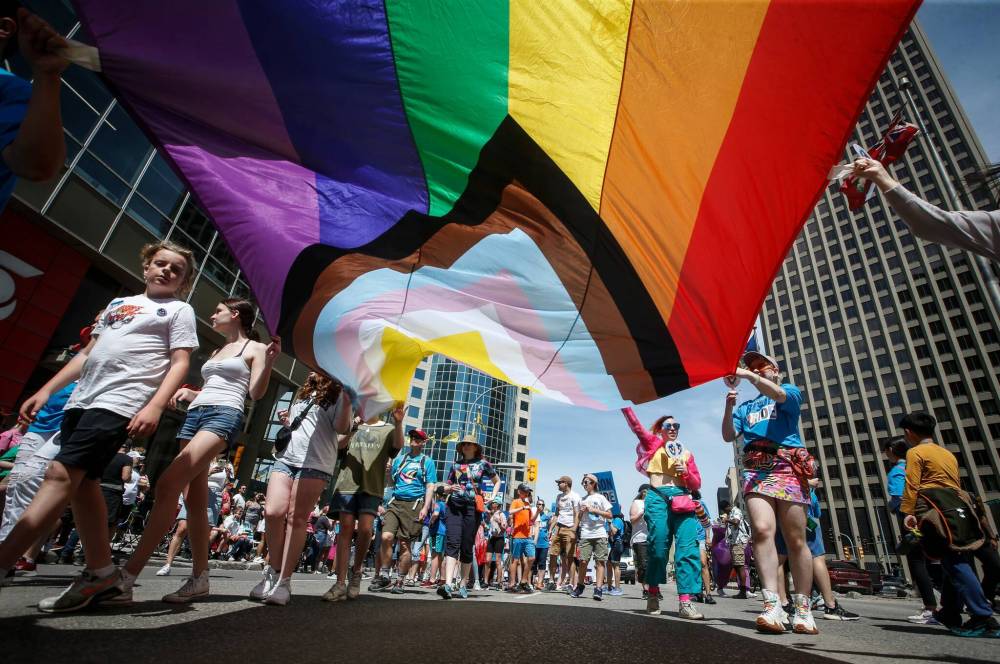
Comments made by Mayor Henry Siemens are revealing.
“Council and I don’t personally support all of the beliefs or ideologies of the various groups or events that might take place in Winkler,” he wrote, while adding the city supports people’s individual freedom to plan and host their own events.
On one level, this is a civics lesson: in a free society, municipalities don’t get to veto lawful assemblies just because some people don’t like them. On another level, it’s a reminder of how low the bar still is.
We’re still at a point where some elected officials feel compelled to publicly clarify that allowing a Pride parade does not mean they “endorse” it — as if the mere presence of LGBTTQ+ people in a public space is something from which they must carefully step back.
Imagine the city issuing a disclaimer every time there’s a Santa Claus parade, a church picnic or a Canada Day celebration. “Just to be clear, council doesn’t personally support all of this.” It’s absurd.
And yet Pride still gets treated as something vaguely suspect, something that needs to be tolerated rather than welcomed.
That’s not just disagreement, that’s a fundamental misunderstanding of how rights work. It’s also homophobic.
The reaction to the Winkler announcement says a lot. Many residents echoed the mayor’s emphasis on freedom and respect. Others went further by arguing the city should not allow the parade, calling it sinful, filthy or something the mayor should “control.”
That’s not just disagreement, that’s a fundamental misunderstanding of how rights work. It’s also homophobic.
As Pembina Valley Pride president Pauline Emerson-Froebe put it: “There are queers in Winkler.” That statement shouldn’t be provocative. It should be obvious.
LGBTTQ+ people live everywhere — in cities and suburbs, on farms, in Bible Belt towns and on gravel roads between them.
The idea that Pride is somehow imported from outside, imposed on an otherwise “pure” community, is a convenient fiction. It erases the reality of people who have grown up, worked, raised families and quietly endured isolation in places where being visibly queer can still feel risky.
That’s why Winkler topped last year’s post-Pride survey that asked where the rally should take place next. It wasn’t because organizers wanted to stir the pot, but because visibility matters most where it’s least assumed.
Emerson-Froebe is right when she says Pride events make a difference in the towns that host them; they tell people who feel alone that they are not and they give allies a chance to be visible. In rural areas, where anonymity is tougher and social circles are tighter, that visibility can be life-changing.
It’s also why the loudest online voices shouldn’t be mistaken for the majority. As Emerson-Froebe noted, hateful comments tend to dominate comment sections precisely because they’re loud — and often anonymous.
Meanwhile, quieter supporters, and those who simply don’t see the parade as a big deal, go about their lives.
It’s disappointing that Pride is still controversial… But it’s also telling that Pride keeps moving forward anyway… town by town, march by march.
The irony is that Pride events in southern Manitoba have a track record of being peaceful, positive and community-minded. Last year’s rally in Carman drew about 250 people before being cut short by a thunderstorm. Pushback didn’t hurt attendance; if anything, it motivated more people to show up in support.
Pembina Valley Pride has been doing this since 2019, moving between communities — Morden, Altona, Carman — and building connections along the way.
Emerson-Froebe and her wife, Melissa, have been together for more than 25 years. They run Paul’s Place in Carman, a business that doubles as an arts space and a safe haven for people who feel excluded.
These are not radicals parachuting in to the community. They are neighbours. They are human beings.

So yes, it’s disappointing that Pride is still controversial. Disappointing that mayors feel the need to hedge. Disappointing that some residents still frame basic inclusion as a moral threat.
But it’s also telling that Pride keeps moving forward anyway — town by town, march by march.
No one event defines a community, as Siemens said. How a community responds to its most vulnerable members does say something about its character.
Winkler has a chance to show that respect is more than a carefully worded Facebook post. And for the people who have been waiting a long time to feel seen where they live, that matters more than any disclaimer ever could.
tom.brodbeck@freepress.mb.ca
Tom Brodbeck is an award-winning author and columnist with over 30 years experience in print media. He joined the Free Press in 2019. Born and raised in Montreal, Tom graduated from the University of Manitoba in 1993 with a Bachelor of Arts degree in economics and commerce. Read more about Tom.
Tom provides commentary and analysis on political and related issues at the municipal, provincial and federal level. His columns are built on research and coverage of local events. The Free Press’s editing team reviews Tom’s columns before they are posted online or published in print – part of the Free Press’s tradition, since 1872, of producing reliable independent journalism. Read more about Free Press’s history and mandate, and learn how our newsroom operates.
Our newsroom depends on a growing audience of readers to power our journalism. If you are not a paid reader, please consider becoming a subscriber.
Our newsroom depends on its audience of readers to power our journalism. Thank you for your support.
Tom Brodbeck is an award-winning author and columnist with over 30 years experience in print media. He joined the Free Press in 2019. Born and raised in Montreal, Tom graduated from the University of Manitoba in 1993 with a Bachelor of Arts degree in economics and commerce. Read more about Tom.
Tom provides commentary and analysis on political and related issues at the municipal, provincial and federal level. His columns are built on research and coverage of local events. The Free Press’s editing team reviews Tom’s columns before they are posted online or published in print – part of the Free Press’s tradition, since 1872, of producing reliable independent journalism. Read more about Free Press’s history and mandate, and learn how our newsroom operates.
Our newsroom depends on a growing audience of readers to power our journalism. If you are not a paid reader, please consider becoming a subscriber.
Our newsroom depends on its audience of readers to power our journalism. Thank you for your support.
Related Articles
Steinbach church hopes LGBTTQ+-friendly holiday performance welcoming for all




Advertisement Advertise With Us
Advertisement Advertise With Us