‘God bless América’: Why Bad Bunny’s Super Bowl halftime show resonated far beyond the US
Advertisement
Read this article for free:
or
Already have an account? Log in here »
To continue reading, please subscribe:

Digital Subscription
One year of digital access for only $205*
- Enjoy unlimited reading on winnipegfreepress.com
- Read the E-Edition, our digital replica newspaper
- Access News Break, our award-winning app
- Play interactive puzzles
*First annual payment billed as $205.00 + GST for one year. This annual subscription will automatically renew at $233.00 + GST every 52 weeks (10% off the regular annual price of $259.35). Offer available to new and qualified returning subscribers only. Cancel any time.
To continue reading, please subscribe:
Add Free Press access to your Brandon Sun subscription for only an additional
$1 for the first 4 weeks*
- Enjoy unlimited reading on winnipegfreepress.com
- Read the E-Edition, our digital replica newspaper
- Access News Break, our award-winning app
- Play interactive puzzles
*Your next Brandon Sun subscription payment will increase by $1.00 and you will be charged $17.95 plus GST for four weeks. After four weeks, your payment will increase to $24.95 plus GST every four weeks.
Read unlimited articles for free today:
or
Already have an account? Log in here »
Hey there, time traveller!
This article was published 10/02/2026 (240 days ago), so information in it may no longer be current.
MEXICO CITY (AP) — When Bad Bunny said “God bless America” during the Super Bowl halftime show and then began naming countries across the continent, the line landed as both wordplay and statement. In Spanish, América often means the entire hemisphere, not a single nation, and the distinction mattered to millions watching from afar.
In a packed bar in Mexico City, the moment drew cheers loud enough to cut through the music.
Plates of brisket, pulled pork and mac and cheese moved between tables as beers kept flowing. Fans in NFL jerseys had spent the first half reacting to every play. Several giant foam fingers bobbed above the crowd. When halftime arrived, the attention did not disappear. It shifted.
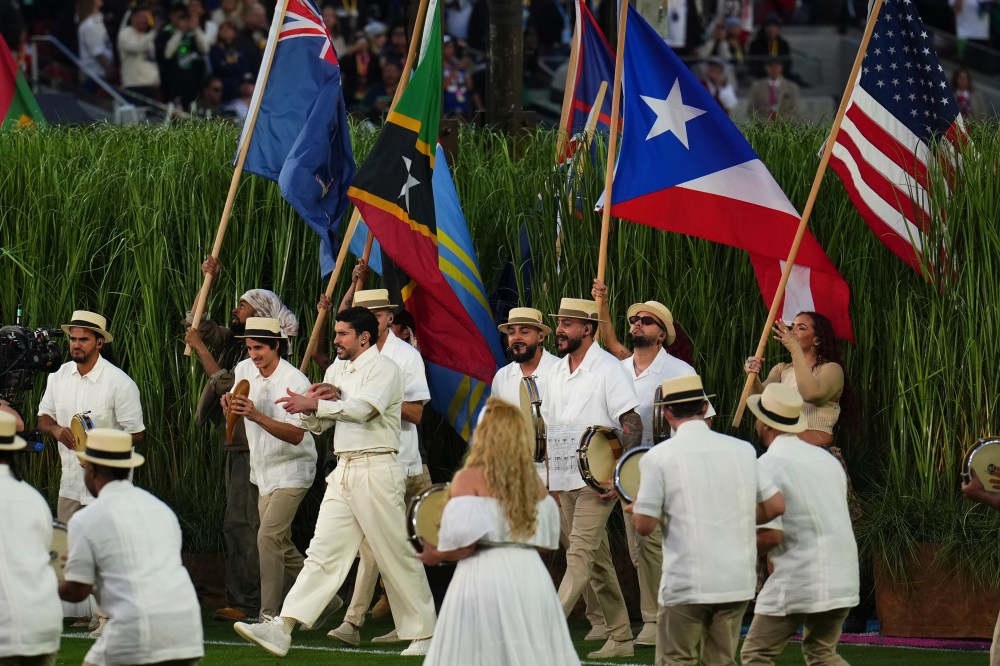
As Bad Bunny took the stage, people stood up, phones raised. Some danced between tables. When he listed countries across the Americas, the cheers grew louder. When he said “Mexico,” the bar erupted.
“It really moved me,” said Laura Gilda Mejía, a 51-year-old schoolteacher and longtime NFL fan watching the game with her two children. “With everything that’s going on politically in the United States, and all the hostility toward Latinos … seeing a Latino come out and sing in Spanish at the biggest show in the world was incredible.”
Across Mexico, Puerto Rico and Latino communities in the United States, Bad Bunny’s halftime performance was received as more than entertainment. Many fans described it as a moment of pride and recognition: a Spanish-language artist commanding one of the most watched stages in American pop culture without translating himself, at a time when Latinos say cultural visibility and political vulnerability exist side by side.
Many in Latin America resist the idea that “American” belongs to a single country. By invoking “God bless America” and then expanding it to include dozens of nations, Bad Bunny turned that linguistic tension into a statement of inclusion.
U.S. President Donald Trump railed against the performance on Truth Social, calling it “absolutely terrible” and “an affront to the Greatness of America.”
Mexico watched closely
Mexico is one of the NFL’s largest international markets, with tens of millions of fans and a long-running presence of regular-season games. The Super Bowl has become a major social event, drawing viewers who tune in for the game as much as for the commercials and the halftime show.
That made the performance feel especially consequential there.
Chrystian Plata, a 33-year-old singer and New York Giants fan watching with his parents, in-laws and his 2-year-old child, said the halftime show was the emotional high point of the game for him with the way it tried “to unite the traditions of all the people who migrated there and also made the United States rich.”
“I’m not a huge Bad Bunny fan musically,” he said, “but culturally he did it very well.”
Those reactions echo what many in Mexico have been expressing since Bad Bunny was announced as the halftime headliner.
In early December, as fans walked past street vendors selling his merchandise ahead of his Mexico City tour opener, María Fernanda Simón, a 35-year-old psychologist, described feeling surprised by the scale of his influence.
“I love that people want to speak Spanish because of him,” she said. “For a long time… everything Anglo, everything ‘gringo,’ everything light-skinned, English — that was what was ‘in,’ what was ‘fashionable’ — and now seeing it flipped makes me feel excited, like being Latino is ‘cool.’”
Not everyone in Mexico shares that framing. José Manuel Valenzuela, a cultural studies researcher at El Colegio de la Frontera Norte in Tijuana, cautions that the belief that cultural value flows only from the United States reflects a long-standing, “colonized” perspective shaped by history, power and media. In his view, Bad Bunny’s moment is real, but it does not erase deeper inequalities that made such a reversal feel novel.
Puerto Rico in the spotlight
In Puerto Rico, watch parties treated the game as a prelude. In San Juan and nearby communities, neighborhoods buzzed as the Super Bowl itself faded into the background and attention turned entirely to Bad Bunny’s 13 minutes on stage.
Alexandra Núñez, a resident of Caguas south of San Juan, wore a traditional pava hat and clothing in the colors of the Puerto Rican flag as she watched.
“This is an achievement,” she said. “Music has no borders. Language has no borders. … You don’t have to speak our language to enjoy our culture. This is global.”
She drew a careful distinction between Bad Bunny and earlier Latin pop stars who reached U.S. audiences by adapting their sound or language.
“When Ricky Martin did it, that was a breakthrough, crossing over,” she said. “Bad Bunny didn’t have to cross over. … He took what already existed and brought it there. He didn’t have to change anything.”
Celebration alongside unease
In the U.S., the celebration unfolded against a backdrop of heightened immigration enforcement and protests over raids and deportations, a context that shaped how many Latinos received the show.
Carlos Benítez, a 29-year-old risk analyst in New York City who was born in Cali, Colombia, and raised in Miami, described the performance as both a milestone and a reminder of its limits.
“For me, it’s an achievement,” he said, recalling that artists once felt pressure to sing in English to reach the highest levels. “Bad Bunny is saying, ‘I’m going to do my music in Spanish, and whoever understands it, understands it.’”
At the same time, Benítez said, visibility does not automatically translate into immediate change. “This isn’t going to be direct,” he said. “It’s not like an ICE agent watching the Super Bowl suddenly changes their views.”
That tension sits at the heart of how many Latinos interpreted the night.
Vanessa Díaz, an associate professor of Chicano and Latino studies at Loyola Marymount University and co-author of “P FKN R: How Bad Bunny Became the Global Voice of Puerto Rican Resistance,” said the performance reflects a broader shift in what “mainstream” means in the United States.
Bad Bunny is not an alternative act but a mainstream one, even if that mainstream no longer looks centered on English-language music or white audiences, Díaz said.
She added that what has surprised many observers is not just that a Spanish-language artist reached the Super Bowl stage, but that Bad Bunny has done so after years of repeated global hits, including among listeners who do not speak Spanish. Art, she said, has always crossed language barriers, but the scale and consistency of his success challenge older assumptions about who mainstream audiences are.
Mexico President Claudia Sheinbaum said Monday that a phrase shown during Bad Bunny’s performance — “the only thing more powerful than hate is love” — underscored her view of the message of unity he sent by singing in Spanish at the Super Bowl.
Back in the Mexico City bar, as the game resumed and fans turned their attention back to the field, the excitement lingered.
For Mejía, the schoolteacher, the night did not resolve the contradictions she sees between cultural celebration and discrimination. But it mattered that the moment happened, and that it happened in Spanish.
___
AP journalist Alejandro Granadillo in San Juan, Puerto Rico contributed to this report.
Follow AP’s coverage of Latin America and the Caribbean at https://apnews.com/hub/latin-america