Privacy activists call on California to remove covert license plate readers
Advertisement
Read this article for free:
or
Already have an account? Log in here »
To continue reading, please subscribe:

Digital Subscription
One year of digital access for only $205*
- Enjoy unlimited reading on winnipegfreepress.com
- Read the E-Edition, our digital replica newspaper
- Access News Break, our award-winning app
- Play interactive puzzles
*First annual payment billed as $205.00 + GST for one year. This annual subscription will automatically renew at $233.00 + GST every 52 weeks (10% off the regular annual price of $259.35). Offer available to new and qualified returning subscribers only. Cancel any time.
To continue reading, please subscribe:
Add Free Press access to your Brandon Sun subscription for only an additional
$1 for the first 4 weeks*
- Enjoy unlimited reading on winnipegfreepress.com
- Read the E-Edition, our digital replica newspaper
- Access News Break, our award-winning app
- Play interactive puzzles
*Your next Brandon Sun subscription payment will increase by $1.00 and you will be charged $17.95 plus GST for four weeks. After four weeks, your payment will increase to $24.95 plus GST every four weeks.
Read unlimited articles for free today:
or
Already have an account? Log in here »
Hey there, time traveller!
This article was published 10/02/2026 (220 days ago), so information in it may no longer be current.
More than two dozen privacy and advocacy organizations are calling on California Gov. Gavin Newsom to remove a network of covert license plate readers deployed across Southern California that the groups believe feed data into a controversial U.S. Border Patrol predictive domestic intelligence program that scans the country’s roadways for suspicious travel patterns.
“We ask that your administration investigate and release the relevant permits, revoke them, and initiate the removal of these devices,” read the letter sent Tuesday by the Electronic Frontier Foundation, Imperial Valley Equity and Justice and other nonprofits.
An Associated Press investigation published in November revealed that the U.S. Border Patrol, an agency under U.S. Customs and Border Protection, had hidden license plate readers in ordinary traffic safety equipment. The data collected by the Border Patrol plate readers was then fed into a predictive intelligence program monitoring millions of American drivers nationwide to identify and detain people whose travel patterns it deems suspicious.
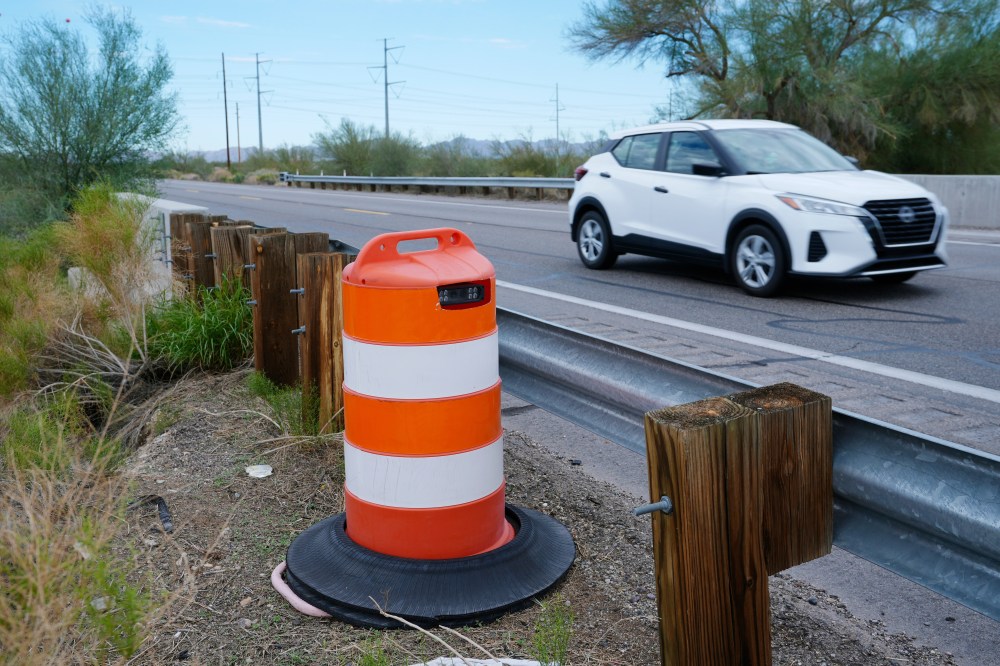
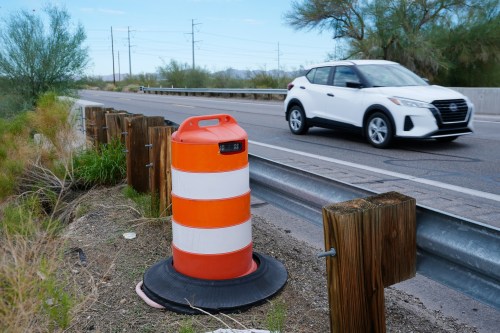
AP obtained land use permits from Arizona showing that the Border Patrol went to great lengths to conceal its surveillance equipment in that state, camouflaging it by placing it inside orange and yellow construction barrels dotting highways.
The letter said the groups’ researchers have identified a similar network of devices in California, finding about 40 license plate readers in San Diego and Imperial counties, both of which border Mexico. More than two dozen of the plate readers identified by the groups were hidden in construction barrels.
They could not determine of the ownership of every device, but the groups said in the letter that they obtained some permits from the California Department of Transportation, showing both the Border Patrol and Drug Enforcement Administration had applied for permission to place readers along state highways. DEA shares its license plate reader data with Border Patrol, documents show.
The letter cited the AP’s reporting, which found that Border Patrol uses a network of cameras to scan and record vehicle license plate information. An algorithm flags vehicles deemed suspicious based on where they came from, where they were going and which route they took. Agents appeared to be looking for vehicles making short trips to the border region, claiming that such travel is indicative of potential drug or human smuggling.
Federal agents in turn sometimes refer drivers they deem suspicious to local law enforcement who make a traffic stop citing a reason like speeding or lane change violations. Drivers often have no idea they have been caught up in a predictive intelligence program being run by a federal agency.
The AP identified at least two cases in which California residents appeared to have been caught up in the Border Patrol’s surveillance of domestic travel patterns. In one 2024 incident described in court documents, a Border Patrol agent pulled over the driver of a Nissan Altima based in part on vehicle travel data showing that it took the driver six hours to travel the approximately 50 miles between the U.S.-Mexican border and Oceanside, California, where the agent had been on patrol.
“This type of delay in travel after crossing the International Border from Mexico is a common tactic used by persons involved in illicit smuggling,” the agent wrote in a court document.
In another case, Border Patrol agents said in a court document in 2023 they detained a woman at an internal checkpoint because she had traveled a circuitous route between Los Angeles and Phoenix. In both cases, law enforcement accused the drivers of smuggling immigrants in the country unlawfully and were seeking to seize their property or charge them with a crime.
The intelligence program, which has existed under administrations of both parties, has drawn scrutiny from lawmakers since the AP revealed its existence last year.
A spokesperson for the California Department of Transportation said state law prioritizes public safety and privacy.
The office of Newsom, a Democrat, did not immediately respond to requests for comment.
Courts have generally upheld license plate reader collection on public roads but have curtailed warrantless government access to other kinds of persistent tracking data that might reveal sensitive details about people’s movements, such as GPS devices or cellphone location data. Some scholars and civil libertarians argues that large-scale collection systems like plate readers might be unconstitutional under the Fourth Amendment.
“Increasingly, courts have recognized that the use of surveillance technologies can violate the Fourth Amendment’s protections against unreasonable searches and seizures. Although this area of law is still developing, the use of LPRs and predictive algorithms to track and flag individuals’ movements represents the type of sweeping surveillance that should raise constitutional concerns,” the organizations wrote.
CBP did not immediately respond to a request for comment, but previously said the agency uses plate readers to help identify threats and disrupt criminal networks and their use of the technology is “governed by a stringent, multi-layered policy framework, as well as federal law and constitutional protections, to ensure the technology is applied responsibly and for clearly defined security purposes.”

The DEA said in a statement that the agency does not publicly discuss its investigative tools and techniques.
___
Burke reported from San Francisco. Tau reported from Washington.
___
Contact AP’s global investigative team at Investigative@ap.org or https://www.ap.org/tips/.