

Shopify sees jump in number of sales AI searches are generating: president
Advertisement
Read this article for free:
or
Already have an account? Log in here »
To continue reading, please subscribe:

Digital Subscription
One year of digital access for only $205*
- Enjoy unlimited reading on winnipegfreepress.com
- Read the E-Edition, our digital replica newspaper
- Access News Break, our award-winning app
- Play interactive puzzles
*First annual payment billed as $205.00 + GST for one year. This annual subscription will automatically renew at $233.00 + GST every 52 weeks (10% off the regular annual price of $259.35). Offer available to new and qualified returning subscribers only. Cancel any time.
To continue reading, please subscribe:
Add Free Press access to your Brandon Sun subscription for only an additional
$1 for the first 4 weeks*
- Enjoy unlimited reading on winnipegfreepress.com
- Read the E-Edition, our digital replica newspaper
- Access News Break, our award-winning app
- Play interactive puzzles
*Your next Brandon Sun subscription payment will increase by $1.00 and you will be charged $17.95 plus GST for four weeks. After four weeks, your payment will increase to $24.95 plus GST every four weeks.
Read unlimited articles for free today:
or
Already have an account? Log in here »
Hey there, time traveller!
This article was published 11/02/2026 (222 days ago), so information in it may no longer be current.
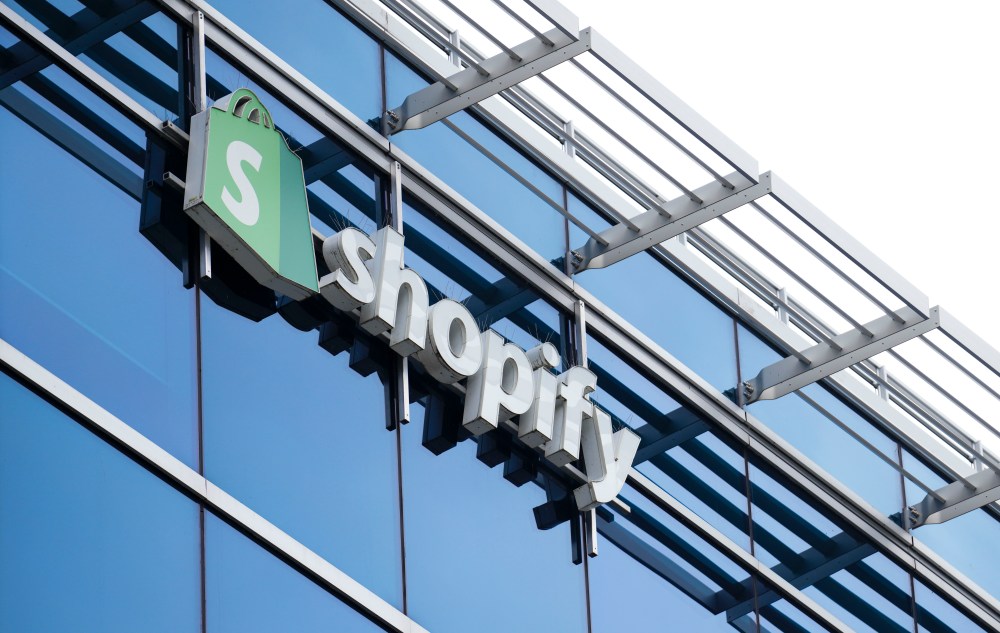
Shopify Inc. is seeing signs that shoppers are growing increasingly comfortable with artificial intelligence.
Harley Finkelstein, president of the software giant, said Wednesday that the number of orders AI searches bring to Shopify is 15 times higher than it was in January 2025.
“Now, that’s not a small base, but that’s still a really big jump in 12 months. And this matters,” he said.
Finkelstein argued it matters because it means smaller merchants are being exposed to buyers who might otherwise have never discovered them and consumers get the feeling of “having a personal shopper in your pocket, someone who really understands them, their taste, their preference, their size.”
“This used to be a luxury, but now it’s available to everyone 24/7,” Finkelstein said.
Shopify has been working in recent years to position its merchant customers to best take advantage of the materializing era of AI shopping.
Over the last few months, it launched partnerships helping Shopify merchants sell their products through OpenAI’s ChatGPT, Google’s Gemini and Microsoft’s Copilot.
Shopify has also put plenty of resources into its own AI assistant, Sidekick. Merchants can query the chatbot to examine things like what is behind fluctuations in their sales levels and then receive help setting up promotions or redesigning their online stores to address any issues.
Finkelstein likens it to a “co-founder” for merchants because it knows everything about their businesses and proactively tells them what to prioritize. Sometimes, it can even help execute the tasks.
In the three weeks since Sidekick’s latest edition was launched, it was used to generate almost 4,000 custom apps, create more than 29,000 automations, build almost 355,000 task lists and edited more than 1.2 million photos.
Finkelstein foresees those numbers being kicked into high gear this year with Sidekick Pulse, a new feature that works in the background to tailor advice to merchants.
“Last week, Sidekick Pulse made a recommendation to one of our jewelry brands. It suggested bundling four separate products and selling them together as a stack. Why?” Finkelstein said. “Because it knew that those four products were already bestsellers, and it also knew that bundles tend to convert better and drive up cart value.”
As he spoke, Shopify’s stock dropped by about 10 per cent to $154.49 in morning trading on the Toronto Stock Exchange. It ended the day down seven per cent or $12.13 at $160.41.
Before his remarks, Shopify reported a fourth-quarter profit of US$743 million or 57 cents US per diluted share, which compared with a profit of US$1.29 billion or 99 cents US per diluted share in the last three months of 2024.
The e-commerce company, which keeps its books in U.S. dollars, said revenue for the quarter ended Dec. 31 rose 31 per cent to US$3.67 billion from US$2.81 billion a year earlier.
Merchant solutions revenue reached US$2.90 billion, up from US$2.15 billion a year earlier, while subscription solutions revenue amounted US$777 million, up from US$666 million.
Finkelstein said the results were “remarkable” because it signalled the company could find gains while remaining profitable rather than ascribing to the “growth at any cost” business model.
In its outlook, Shopify said it expects revenue for the first quarter of 2026 to grow at a low-thirties percentage rate on a year-over-year basis, similar to the fourth quarter of 2025.

Shopify also announced its board of directors has authorized a share repurchase program of up to US$2 billion.
By buying back its shares, a company reduces its equity base, spreading profits over fewer shares. That increases its return on equity and earnings per share, two key ratios used to determine a company’s financial health and investment rating.
This report by The Canadian Press was first published Feb. 11, 2026.
Companies in this story: (TSX:SHOP)
Note to readers:This is a corrected story. A previous version erroneously cited information and quotes from the third-quarter conference call.