

‘Nowhere good enough’
Doctors Manitoba issues update on health care system

Advertisement
Read this article for free:
or
Already have an account? Log in here »
To continue reading, please subscribe:

Digital Subscription
One year of digital access for only $205*
- Enjoy unlimited reading on winnipegfreepress.com
- Read the E-Edition, our digital replica newspaper
- Access News Break, our award-winning app
- Play interactive puzzles
*First annual payment billed as $205.00 + GST for one year. This annual subscription will automatically renew at $233.00 + GST every 52 weeks (10% off the regular annual price of $259.35). Offer available to new and qualified returning subscribers only. Cancel any time.
To continue reading, please subscribe:
Add Free Press access to your Brandon Sun subscription for only an additional
$1 for the first 4 weeks*
- Enjoy unlimited reading on winnipegfreepress.com
- Read the E-Edition, our digital replica newspaper
- Access News Break, our award-winning app
- Play interactive puzzles
*Your next Brandon Sun subscription payment will increase by $1.00 and you will be charged $17.95 plus GST for four weeks. After four weeks, your payment will increase to $24.95 plus GST every four weeks.
Read unlimited articles for free today:
or
Already have an account? Log in here »
Hey there, time traveller!
This article was published 11/02/2026 (245 days ago), so information in it may no longer be current.
Manitoba’s health care system has improved since 2023, but there’s much more work to do, provincial business leaders were told during a “checkup” with Doctors Manitoba Wednesday.
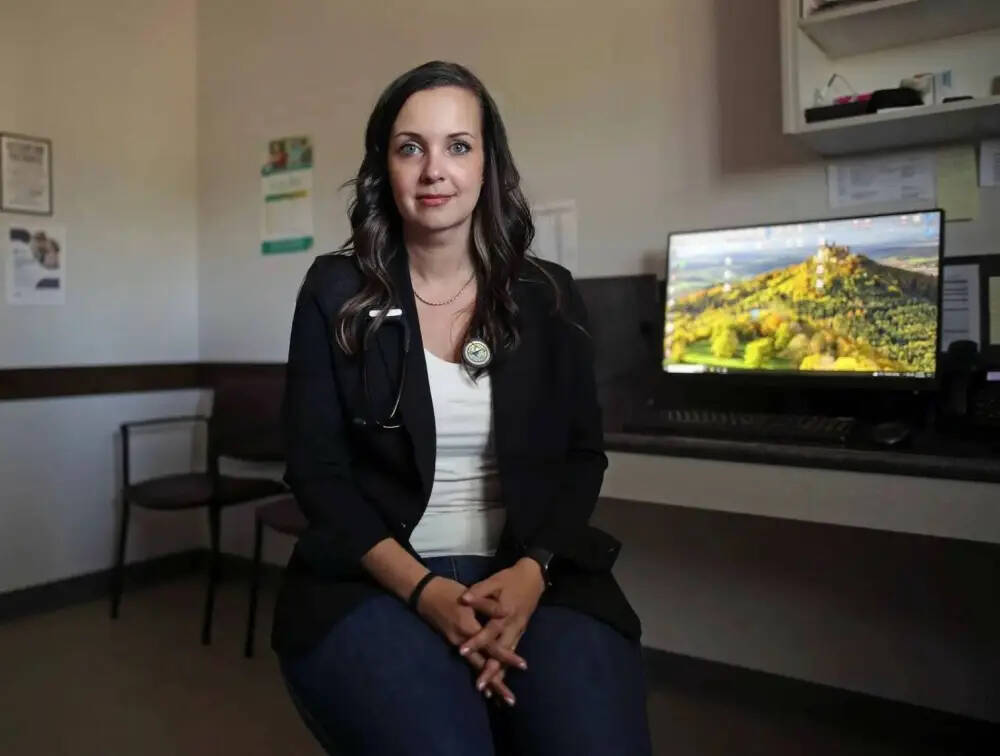
“Manitoba lags behind national and international benchmarks,” said Dr. Nichelle Desilets, president of the physician advocacy organization.
In 2022, it held a rural and northern summit with the Manitoba Chambers of Commerce to address the dire shortage of physicians. On Wednesday, she offered a prescription to build “one the best health care systems in Canada.”
TIM SMITH / THE BRANDON SUN FILES
Dr. Nichelle Desilets, president of Doctors Manitoba
“We’re a small province but that means that we can be agile, and pick and choose from systems that we know will work and we can get there quickly,” the rural family doctor told the crowd of close to 300 at the RBC Convention Centre.
To get there, the provincial leaders must listen to more providers, and replace outdated, ineffective systems that rely on fax machines with modern technology.
“Only one in five providers in Manitoba can easily share their patient’s information electronically,” Desilets said. “Our students and residents walk down the road to HSC — Manitoba’s biggest hospital — and they see paper charts and fax machines. That’s not how modern physicians want to practise medicine.”
She said she wants the provincial government to make good on its promise to provide 250 team-based care staff in its spring budget.
“Adding physician assistants, nurses and allied health providers to physicians’ practices is one of the fastest and most cost-effective ways to improve access, quality and retention of physicians,” Desilets said.
Forty per cent of medical school grads and residents plan to leave Manitoba and 43 per cent of physicians plan to retire, leave or reduce their hours in the next three years, a report by Doctors Manitoba, which was conducted in 2025, found.
“If there is one immediate, high impact, cost-effective investment that would help stabilize our health-care system, this is it,” she said of team-based care staff.
Desilets presented data showing where health care has or hasn’t been fixed and the status of 2023 election promises made by the governing NDP.
It has kept its promise to institute free prescription birth control, universal school nutrition and buy an MRI for the northern region. In addition, it’s forging ahead with a new CancerCare building and has opened six of 10 promised new government clinics. Construction has begun on new personal care homes. While it has introduced plastic and digital health cards, many patients continue to use paper cards, says Doctors Manitoba.
The government promised to add 400 doctors during its four-year mandate and so far has hired 285 physicians. Last year, Manitoba hired a record number of doctors (164) — the largest percentage increase in Canada (5.3 per cent). It has gone from having the biggest doctor shortage to being closer to on par with the rest of Canada, said Desilets.
From 2021 to 2024, all regional health authorities have had an increase in the physician per capita rate. The northern region has had the biggest increase, at 31 per cent. All Manitoba rural regions, however, still lag behind peer regions across Canada, she said.
Medical school and rural residencies have expanded with the addition of 29 medical residency spaces. There’s been a major U.S. recruitment campaign and licensure program for international physicians. Rural retention incentives and a provincial recruitment agency were established. Efforts have been made to address discrimination and mistreatment, and to expose more rural and Indigenous youth to medical career opportunities.
Slightly more Manitobans have a family doctor than the Canadian average, but experience the longest ER waits in the country, which continue to get longer, she said. Nearly three-quarters of Manitobans reported easy access to non-urgent care — the highest rate in Canada — but 187,000 Manitobans still don’t have access to a family doctor, she said.
The province promised to hire 600 more nurses and says it has hired 1,100 to date.

“On a nurse per capita basis, Manitoba now exceeds the national average,” Desilets said, citing a Canadian Institute for Health Information report Nursing in Canada 2024.
Promises to end mandatory overtime and to legislate nurse-to-patients ratios have not been kept, she noted.
The province is still short more than 400 allied health workers. Waits have increased for CT and MRI testing in Manitoba, and are significantly longer than the Canadian average. Surgery waits are still longer than the Canadian average, but they are steadily improving, she said.
“Even with the progress that’s been made so far, our health care system is nowhere good enough,” Desilets said.
carol.sanders@freepress.mb.ca
Carol Sanders
Legislature reporter
Carol Sanders is a reporter at the Free Press legislature bureau. The former general assignment reporter and copy editor joined the paper in 1997. Read more about Carol.
Every piece of reporting Carol produces is reviewed by an editing team before it is posted online or published in print — part of the Free Press‘s tradition, since 1872, of producing reliable independent journalism. Read more about Free Press’s history and mandate, and learn how our newsroom operates.
Our newsroom depends on a growing audience of readers to power our journalism. If you are not a paid reader, please consider becoming a subscriber.
Our newsroom depends on its audience of readers to power our journalism. Thank you for your support.
Carol Sanders
Legislature reporter
Carol Sanders is a reporter at the Free Press legislature bureau. The former general assignment reporter and copy editor joined the paper in 1997. Read more about Carol.
Every piece of reporting Carol produces is reviewed by an editing team before it is posted online or published in print — part of the Free Press‘s tradition, since 1872, of producing reliable independent journalism. Read more about Free Press’s history and mandate, and learn how our newsroom operates.
Our newsroom depends on a growing audience of readers to power our journalism. If you are not a paid reader, please consider becoming a subscriber.
Our newsroom depends on its audience of readers to power our journalism. Thank you for your support.
Related Articles
When it comes to fixing health care, province must follow doctors’ orders
Advertisement Advertise With Us
Advertisement Advertise With Us
History
Updated on Wednesday, February 11, 2026 8:22 PM CST: Updates headline, body of story