

Tired of waiting, First Nation buys $8M worth of generators
Mathias Colomb chief asks province, feds to ‘cost-share my investment’

Advertisement
Read this article for free:
or
Already have an account? Log in here »
To continue reading, please subscribe:

Digital Subscription
One year of digital access for only $205*
- Enjoy unlimited reading on winnipegfreepress.com
- Read the E-Edition, our digital replica newspaper
- Access News Break, our award-winning app
- Play interactive puzzles
*First annual payment billed as $205.00 + GST for one year. This annual subscription will automatically renew at $233.00 + GST every 52 weeks (10% off the regular annual price of $259.35). Offer available to new and qualified returning subscribers only. Cancel any time.
To continue reading, please subscribe:
Add Free Press access to your Brandon Sun subscription for only an additional
$1 for the first 4 weeks*
- Enjoy unlimited reading on winnipegfreepress.com
- Read the E-Edition, our digital replica newspaper
- Access News Break, our award-winning app
- Play interactive puzzles
*Your next Brandon Sun subscription payment will increase by $1.00 and you will be charged $17.95 plus GST for four weeks. After four weeks, your payment will increase to $24.95 plus GST every four weeks.
Read unlimited articles for free today:
or
Already have an account? Log in here »
Hey there, time traveller!
This article was published 13/02/2026 (220 days ago), so information in it may no longer be current.
A northern First Nation that was evacuated almost all summer due to a wildfire and power outage has bought an $8-million emergency backup generator system, the chief announced Friday.
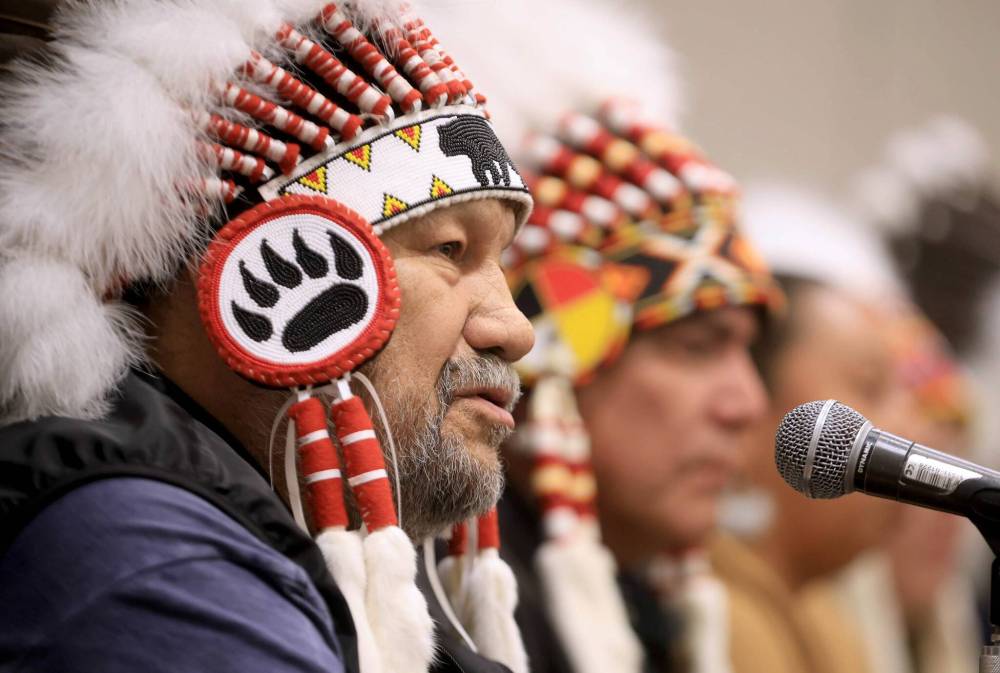
Mathias Colomb First Nation Chief Gordie Bear said he wants the federal and provincial governments to reimburse the community, which had asked the two governments to purchase and provide diesel-powered generators before power was restored in September.
“I don’t know why they didn’t come through with the request that we made when we were out in the boondocks,” Bear told the Free Press. “I just hope they all get together — have a tea party — and cost-share my investment.”
RUTH BONNEVILLE / FREE PRESS FILES
Mathias Colomb First Nation Chief Gordie Bear said he wants the federal and provincial governments to reimburse the community for the backup generator system.
He accused the governments of ignoring the First Nation’s concerns. Bear said four generators were purchased using own-sourced revenue.
“We’ve been working closely with the community for a huge chunk of the past year because of the wildfire impacts that they’ve seen,” Premier Wab Kinew said.
“When I saw news that they went ahead and got this generator, I just thought this is a great example of self-reliance and self-determination and action. I fully support them and I commend them.”
Bear wants Adrien Sala, the minister responsible for Manitoba Hydro, to order the Crown corporation to connect the generators to the distribution system as soon as possible. The generators are in shipping-like containers on three-axle trailers.
“We are pleased the community acquired their own backup generation as this is their responsibility,” Manitoba Hydro spokesman Peter Chura said in an email. “We do follow a specific process for connecting customer-owned generation to our grid, and if a request is received, that process would be followed in this case.”
Chura said the public utility paid for consultants to help Mathias Colomb determine what it may need for backup generation.
“We are glad this effort helped them,” he said.
Indigenous Services Canada spokesman Eric Head said Manitoba Hydro is responsible for “assessing the need for and approving new or alternative energy sources” for the First Nation.
About 2,200 residents of Mathias Colomb, also known as Pukatawagan, were forced to flee their homes due to a wildfire May 28. The fire threat eased, but the prolonged power outage prevented evacuees from returning home.
Power was restored by Sept. 11, about three weeks earlier than anticipated, clearing the way for evacuees to return home.
Bear said residents could have returned sooner if Mathias Colomb had had backup generators, the cost of which pales in comparison with the expense of transporting, sheltering and feeding evacuees for prolonged periods.
After a wildfire in 2022, Manitoba Hydro delivered large industrial generators by rail for a temporary power supply, which allowed evacuees to return while crews continued to repair or replace power lines, poles and equipment in a remote, rugged area.
The rail line was cut off by fire for some time in 2025.
“Manitoba Hydro advised the community leadership last summer that transporting and setting up large generators at that time was not feasible due to continuing wildfires and limited rail service,” Chura said.
He said the full restoration of power would have been delayed if crews were diverted from that job to transport and set up generators.
Bear said generators should be on permanent standby in the First Nation because another power outage is inevitable. Mathias Colomb is accessible only by rail and air.
Bear said the 128-day evacuation had a physical and mental toll on evacuees, who were spread across hotels in Manitoba and Niagara Falls, Ont.
“We had no front yards, we had no backyards. We had concrete,” he said. “Our children suffered the most, along with our elders. Our elders had no peace of mind.”
Several northern First Nations have aired grievances regarding Hydro operations and governments’ handling of emergencies.
Pimicikamak Cree Nation’s council asked for a power line to be moved closer to a highway after a days-long power outage in a remote area led to a water crisis in the northern community.
The First Nation was not happy last month when Hydro, despite stating the definitive cause of the outage was not yet known, said shotgun pellets were found in a broken line and aerial marker balls attached to it.
Chura said Friday the cause remains under investigation, and it has not been established whether shotgun pellets caused the line to break.
Manitoba experienced its worst wildfire season in 30 years in 2025. The province has promised multiple reviews.

The forecast for 2026 is not yet clear. It is possible some of last year’s fires could “overwinter” if they burned deep into the organic layer underground.
“When conditions warm up and dry out in the spring, it is possible these fires could flare up,” a spokesperson for the Manitoba Wildfire Service said.
“As the spring thaw gets closer, (the service) will be watching for any signs of activity and be ready to address them as needed.”
— with files from Carol Sanders
chris.kitching@freepress.mb.ca
Chris Kitching is a general assignment reporter at the Free Press. He began his newspaper career in 2001, with stops in Winnipeg, Toronto and London, England, along the way. After returning to Winnipeg, he joined the Free Press in 2021, and now covers a little bit of everything for the newspaper. Read more about Chris.
Every piece of reporting Chris produces is reviewed by an editing team before it is posted online or published in print — part of the Free Press‘s tradition, since 1872, of producing reliable independent journalism. Read more about Free Press’s history and mandate, and learn how our newsroom operates.
Our newsroom depends on a growing audience of readers to power our journalism. If you are not a paid reader, please consider becoming a subscriber.
Our newsroom depends on its audience of readers to power our journalism. Thank you for your support.
Chris Kitching is a general assignment reporter at the Free Press. He began his newspaper career in 2001, with stops in Winnipeg, Toronto and London, England, along the way. After returning to Winnipeg, he joined the Free Press in 2021, and now covers a little bit of everything for the newspaper. Read more about Chris.
Every piece of reporting Chris produces is reviewed by an editing team before it is posted online or published in print — part of the Free Press‘s tradition, since 1872, of producing reliable independent journalism. Read more about Free Press’s history and mandate, and learn how our newsroom operates.
Our newsroom depends on a growing audience of readers to power our journalism. If you are not a paid reader, please consider becoming a subscriber.
Our newsroom depends on its audience of readers to power our journalism. Thank you for your support.
Related Articles
First Nations awaiting Hydro consults
Advertisement Advertise With Us
Advertisement Advertise With Us
History
Updated on Friday, February 13, 2026 5:19 PM CST: Updates with final version