Modern-day parallels abound in Winter War historical novel

Advertisement

Advertise with us

It isn’t hard to see how recent events have brought a new currency to the 1939-40 Winter War between Finland and the Soviet Union, the setting of this first historical novel by a leading French crime writer.

Read this article for free:


or

Already have an account? Log in here »

To continue reading, please subscribe:

Subscribe and receive a limited-edition Free Press branded hat or tote.

Digital Subscription

One year of digital access for only $205*

  • Enjoy unlimited reading on winnipegfreepress.com
  • Read the E-Edition, our digital replica newspaper
  • Access News Break, our award-winning app
  • Play interactive puzzles

*First annual payment billed as $205.00 + GST for one year. This annual subscription will automatically renew at $233.00 + GST every 52 weeks (10% off the regular annual price of $259.35). Offer available to new and qualified returning subscribers only. Cancel any time.

To continue reading, please subscribe:

Add Free Press access to your Brandon Sun subscription for only an additional

$1 for the first 4 weeks*

  • Enjoy unlimited reading on winnipegfreepress.com
  • Read the E-Edition, our digital replica newspaper
  • Access News Break, our award-winning app
  • Play interactive puzzles
Start now

*Your next Brandon Sun subscription payment will increase by $1.00 and you will be charged $17.95 plus GST for four weeks. After four weeks, your payment will increase to $24.95 plus GST every four weeks.

Hey there, time traveller!
This article was published 14/02/2026 (203 days ago), so information in it may no longer be current.

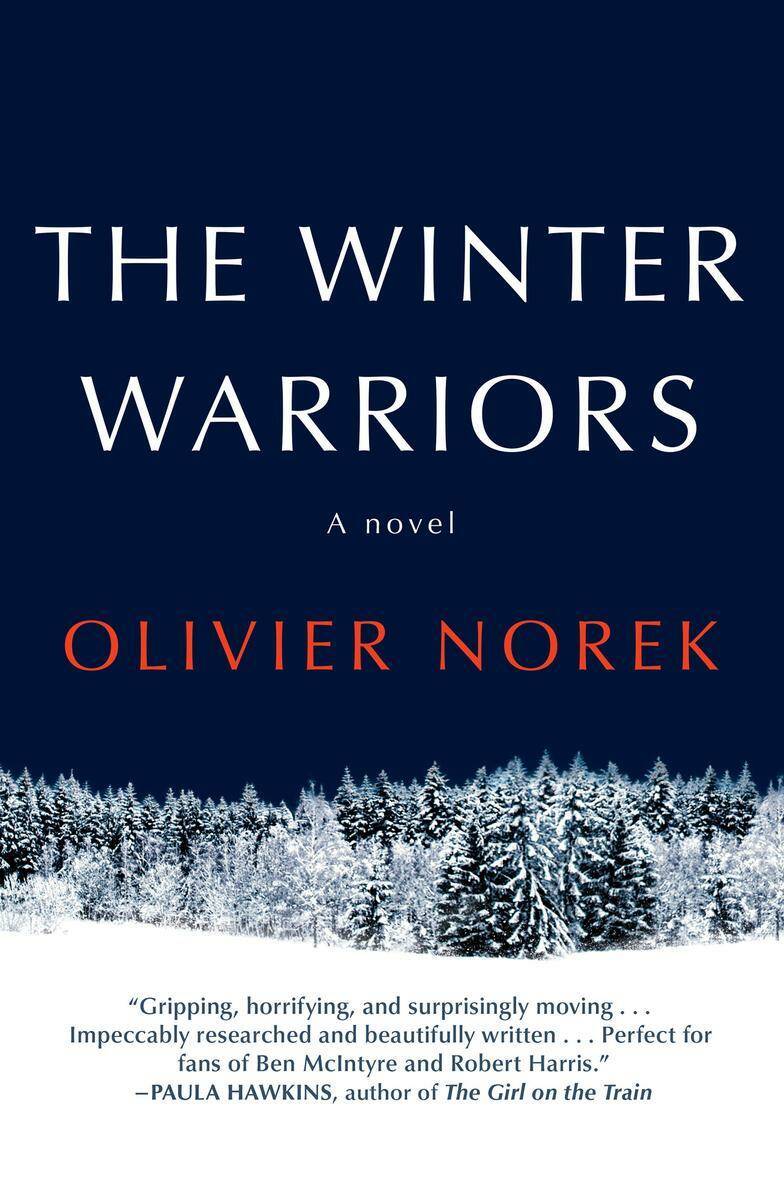
It isn’t hard to see how recent events have brought a new currency to the 1939-40 Winter War between Finland and the Soviet Union, the setting of this first historical novel by a leading French crime writer.

Author Olivier Norek is a former police officer who has written a string of bestselling novels, including a series set in the crime-ridden immigrant suburbs (banlieus) surrounding Paris. Several, including The Lost and the Damned and Between Two Worlds, have been translated into English.

In The Winter Warriors, translated by Nick Caistor and based on the 105-day Winter War (and especially on the exploits of Finnish sniper Simo Hayha, who earns the nickname White Death), parallels abound with Russia’s war against Ukraine.
The novel begins with young Finns being called up for military exercises in response to Soviet territorial demands, and follows one group of village youths through the nightmare of battle with a numerically superior foe.

Scenes from the young soldiers’ perspectives are interspersed with sections focusing on the high command in Finland and Moscow, civilians in Helsinki and even diplomatic activity in Paris.

In these scenes beyond the frontline, Norek underlines the historical connections between past and present. The head of Finland’s military, Carl Gustaf Mannerheim, notes to a colleague: “Ukraine, too, wanted its independence. And he starved it. Four million dead can testify to that… I don’t know how he’ll do it, but if Stalin wants to move against Finland, he’ll find an excuse.”

Just as today’s Ukraine was part of the Soviet Union until 1991, Finland had only declared independence from Russia after the October Revolution of 1917. In the Winter War, like the Soviet invasion of eastern Poland a few months earlier, Stalin sought to re-establish the Czar’s empire under the hammer and sickle.

The parallels continue with Vladimir Putin’s “special operation” against Ukraine, which the Kremlin thought would be over in a few days. Norek has Soviet foreign minister Vyacheslav Molotov demonstrate the arrogance of the invaders: “Stalin wants to celebrate his birthday on the steps of the Finnish parliament. In other words, in precisely 20 days. We will be facing an army hastily thrown together, badly equipped, few in numbers and unevenly trained … After all, it’s only Finland.”

As it turned out, the Red Army (whose officer class had recently been purged by Stalin) was the one that was poorly equipped and unevenly trained, and its soldiers paid for that in blood.

And in one additional parallel to today, Finland gets moral support and vague promises of military aid from France — but with Hitler threatening to turn his attentions to the West, that aid never arrives.

While the novel succeeds in showing the continuity of Russian Empire/Soviet Union/Russian Republic ambitions and ruthlessness, as a work of fiction it’s a bit flat. Some of the shortcomings may be a result of translation, such as this mathematical howler: “Each of the twelve aircraft in the first Russian wave dropped 100 kilos of bombs — that is, more than seven tonnes of incendiaries.”

More often, though, the novel suffers from Norek’s determination to pack information into every conversation, leading to unnatural sounding dialogue.

In one scene, a political commissar tells an army commander that an incoming Moscow official is a powerful figure because “He helped to plan the Holodomor.” Surely a proper Stalinist would not have used that Ukrainian word, and would have referred to the manmade starvation as the “liquidation of the kulaks.”

Ultimately, The Winter Warriors is a novel for history buffs, rather than for lovers of fiction.

Bob Armstrong is a history buff, a frequent traveller and a writer who works in every genre but poetry and ransom notes.
Report Error Submit a Tip

More Stories

NDP minister needs lesson in political civility

Dan Lett 5 minute read Preview

NDP minister needs lesson in political civility

Dan Lett 5 minute read Yesterday at 2:40 PM CDT

Families Minister Nahanni Fontaine’s decision to intercede in Winnipeg’s mayoral election may be surprising to some political observers. To others, however, it is entirely on brand.

On Tuesday, Fontaine posted a video on social media in which she expressed concern that former city councillor and Progressive Conservative cabinet minister Kevin Klein was entering the race to challenge incumbent Mayor Scott Gillingham.

The caption on the video was blunt: “I mean, really, who chooses to work for Count Dracula?”

“Kevin Klein once worked for Peter Nygard. Peter Nygard is Canada’s equivalent to (American sex offender) Jeffrey Epstein — had his own little island, did unspeakable, disgusting things to women and girls … anyways, I just thought that Winnipeggers would want to know that Kevin Klein, at one point, worked for Peter Nygard,” she says in the video.

Read
Yesterday at 2:40 PM CDT

Smith’s pretzel logic confuses

Editorial 4 minute read Preview

Smith’s pretzel logic confuses

Editorial 4 minute read 2:01 AM CDT

Alberta Premier Danielle Smith had both sides of her mouth working overtime on Aug. 30, when she spoke at an event in Calgary to commemorate Alberta Day, the annual celebration of the province’s entry into Confederation in 1905 (officially Sept. 1, it was celebrated on the weekend).

Smith’s comments — and the things she did not say — revealed a lot about the political tightrope the premier is trying to walk over the challenges currently faced by her province. At the top of that list of challenges is a persistent campaign to separate Alberta from the aforementioned Confederation. A campaign that Smith appears to both support and oppose, depending on which day of the week it is.

Her Alberta Day remarks were an excellent case in point.

Smith has decided that on Oct. 19, Albertans will vote on a series of non-binding propositions in a province referendum. One of those questions will ask Albertans whether they want to hold a referendum on separation, thus making this fall’s vote a “referendum on whether to hold a referendum,” as some observers have dubbed it.

Read
2:01 AM CDT

Art piece connects viewers to broader national landscape

Allison Gillmor 4 minute read Preview

Art piece connects viewers to broader national landscape

Allison Gillmor 4 minute read 2:01 AM CDT

WHAT IT IS: Copy Paperis a 2014 textile-based piece by Ontario-born, Winnipeg-based artist Kristin Nelson, currently on view at WAG-Qaumajuq as part of the exhibition Terra Cognita/Incognita.

Of the 125 works in the show — which uses historical and contemporary pieces from WAG-Qaumajuq’s permanent collection to explore how artists have represented the landscape over time and across cultures —probably the most attention-getting are the beautiful paintings of Canada’s lakes, plains, forests and mountains.

So, how does this seemingly modest, somewhat enigmatic work connect to Terra Cognita/Incognita’s larger themes?

WHAT IT’S ABOUT: In the middle of the exhibition, an antique desk holds several objects of beauty and utility, and this is where Copy Paper sneaks in, as something both “cognita and incognita,” known and unknown.

Read
2:01 AM CDT

Controlling pace of response path to success

Tim Kist 5 minute read 2:01 AM CDT

WITH the recent collapse of Canada-U.S. trade talks, the economic, political and social changes are coming at business leaders on a daily basis.

While you cannot control the pace of these changes, you can control the pace of response and timing of actions your organization takes. This is a time for thoughtful analysis and careful action, not chasing the latest trends.

Artificial intelligence, for example, can write articles, create images, draft emails and perform seemingly countless other tasks. But is this new tool solving a current business problem?

Successful companies know they must develop a strategy before launching any tactics. Otherwise, the strategy is based on “hope” — and we all know hope is not a strategy.

Wonderful wines to help welcome autumn

Ben Sigurdson 4 minute read Preview

Wonderful wines to help welcome autumn

Ben Sigurdson 4 minute read 3:00 AM CDT

As we creep ever closer to fall, many wine drinkers will start to think about popping corks (or screwcaps, as it were) on wines that suit cooler temperatures.

But summer’s not quite done yet. Here are six new and/or notable wines ideal for sipping as we make the transition from warmer weather into the first hints of autumn…

Wines of the weekThe Willm NV Blanc de Noirs Crémant d’Alsace Brut (Alsace, France — $28.99, Liquor Marts and beyond) is a French bubbly made from the Pinot Noir grape in the traditional method (secondary fermentation, which creates the bubbles, happens in the bottle rather than in tanks before bottling).

It’s pale gold with a hint of pink, and on the nose offers ripe cherry, cranberry, bread dough and strawberry compote notes. On the palate it’s light-bodied and mainly dry, with an almost-wild herbal component coming with the strawberry, tart peach, cranberry, raspberry and bread dough flavours.

Read
3:00 AM CDT

Neighbours relieved after fire strikes Quickie Mart

Morgan Modjeski 4 minute read Preview

Neighbours relieved after fire strikes Quickie Mart

Morgan Modjeski 4 minute read Wednesday, Sep. 2, 2026

As Janina McNaughton watched the Quickie Mart on River Avenue go up in flames on Tuesday, she felt relieved.

“The first thing I see is flames, like a fireball of flames inside,” McNaughton said about watching the blaze from her bedroom across the street.

On Wednesday, the bright green building, at 292 River Ave., was boarded up and charred on the outside.

Crews from the Winnipeg Fire Paramedic Service responded at 8:13 p.m. Tuesday to battle the blaze, said the city in a news release. It was under control within the hour.

Read
Wednesday, Sep. 2, 2026