

Manitoba increases venture capital tax credit to $30M

Advertisement
Read this article for free:
or
Already have an account? Log in here »
To continue reading, please subscribe:

Digital Subscription
One year of digital access for only $205*
- Enjoy unlimited reading on winnipegfreepress.com
- Read the E-Edition, our digital replica newspaper
- Access News Break, our award-winning app
- Play interactive puzzles
*First annual payment billed as $205.00 + GST for one year. This annual subscription will automatically renew at $233.00 + GST every 52 weeks (10% off the regular annual price of $259.35). Offer available to new and qualified returning subscribers only. Cancel any time.
To continue reading, please subscribe:
Add Free Press access to your Brandon Sun subscription for only an additional
$1 for the first 4 weeks*
- Enjoy unlimited reading on winnipegfreepress.com
- Read the E-Edition, our digital replica newspaper
- Access News Break, our award-winning app
- Play interactive puzzles
*Your next Brandon Sun subscription payment will increase by $1.00 and you will be charged $17.95 plus GST for four weeks. After four weeks, your payment will increase to $24.95 plus GST every four weeks.
Read unlimited articles for free today:
or
Already have an account? Log in here »
Hey there, time traveller!
This article was published 26/02/2026 (203 days ago), so information in it may no longer be current.
The province will add $8 million to a tax credit for small-business ventures and lower the minimum amount needed for investors to access the credit in hopes of tapping into a growing startup economy in Manitoba.
The small-business venture capital tax credit is increasing to $30 million from $22 million to meet the increasing level of investment in the province, Innovation and New Technology Minister Mike Moroz said on Thursday.
“What it means is a huge influx in interest, in getting engaged in the innovation and the tech ecosystem,” he said. “People have been sitting on the sidelines a little bit. The rules have been challenging for some potential investors.”
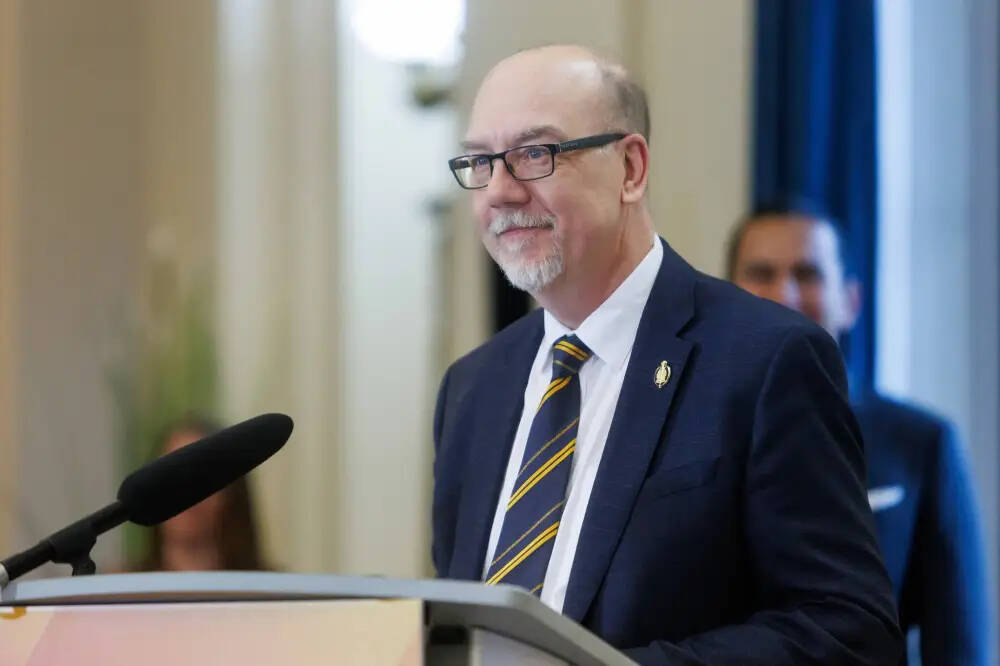
Innovation and New Technology Minister Mike Moroz. (Mike Deal/Winnipeg Free Press files)
The small-business venture capital tax credit offers Manitoba businesses a 45 per cent non-refundable tax credit on an investment of up to $500,000 per company. The maximum tax credit in a calendar year is $225,000, or $120,000 in a tax year.
Moroz said the province will also be reducing the minimum eligible investment to qualify for the credit to $5,000 to $10,000 and expanding investment eligibility to include limited partnerships beginning in April.
According to the Canadian Venture Capital and Private Equity Association, venture capital investment in Manitoba jumped to $127 million in 2025 from $4 million in 2024 — the stark difference likely in part due to Winnipeg-based financial software company Conquest Planning raising $110 million last year.
Manitoba has largely been a non-actor in the world of Canadian venture capital investment, but that’s changing, said Iain Crozier, founder of Trillick Ventures Inc., Manitoba’s first early-stage venture capital fund.
“Rather than just investing in public markets and outside of benefiting our province, we’re going to see a lot of active investment here in Manitoban companies,” he said.
“The tax credit is a huge incentive in order to invest your capital here in an asset class that is normally, and traditionally, very challenging to access.”
The province is also expanding its investment guidelines, including recognizing simple agreements for future equity, or SAFE agreements, a contract popular in other North American cities that allows an investor to purchase a future equity stake in a startup with future conditions.
They’re typically used for early stage startup funding because they’re more flexible than typical financing models.

Winnipeg-based tech firm Taiv Inc., is one of the startup turned-success stories in the city.
It closed a US$13 million growth round this year, less than nine months after raising US$10.5 million in series A financing.
The changes coming in April will help Manitoba investors build companies like theirs at home, said Taiv co-founder Noah Palansky.
“These changes are a huge key piece in unlocking that flywheel, making it so that when people have that liquidity, and they look at the startup ecosystem, they look at how strong an asset class it is, and say, ‘Yeah, I want to invest back in that,’ they can now do it.”
malak.abas@freepress.mb.ca
Malak Abas is a city reporter at the Free Press. Born and raised in Winnipeg’s North End, she led the campus paper at the University of Manitoba before joining the Free Press in 2020. Read more about Malak.
Every piece of reporting Malak produces is reviewed by an editing team before it is posted online or published in print — part of the Free Press‘s tradition, since 1872, of producing reliable independent journalism. Read more about Free Press’s history and mandate, and learn how our newsroom operates.
Our newsroom depends on a growing audience of readers to power our journalism. If you are not a paid reader, please consider becoming a subscriber.
Our newsroom depends on its audience of readers to power our journalism. Thank you for your support.
Malak Abas is a city reporter at the Free Press. Born and raised in Winnipeg’s North End, she led the campus paper at the University of Manitoba before joining the Free Press in 2020. Read more about Malak.
Every piece of reporting Malak produces is reviewed by an editing team before it is posted online or published in print — part of the Free Press‘s tradition, since 1872, of producing reliable independent journalism. Read more about Free Press’s history and mandate, and learn how our newsroom operates.
Our newsroom depends on a growing audience of readers to power our journalism. If you are not a paid reader, please consider becoming a subscriber.
Our newsroom depends on its audience of readers to power our journalism. Thank you for your support.
Related Articles
Canadian ends volatile 2025 with a contraction in Q4: StatCan
Advertisement Advertise With Us
Advertisement Advertise With Us