NASA revamps Artemis moon landing program by modeling it after speedy Apollo

Advertisement

Advertise with us

NASA said Friday it's revamping its Artemis moon exploration program to make it more like the fast-paced Apollo program half a century ago, adding an extra practice flight before attempting a high-risk lunar landing with a crew in two years.

Read this article for free:

or

Already have an account? Log in here »

To continue reading, please subscribe:

Subscribe and receive a limited-edition Free Press branded hat or tote.

Digital Subscription

One year of digital access for only $205*

  • Enjoy unlimited reading on winnipegfreepress.com
  • Read the E-Edition, our digital replica newspaper
  • Access News Break, our award-winning app
  • Play interactive puzzles

*First annual payment billed as $205.00 + GST for one year. This annual subscription will automatically renew at $233.00 + GST every 52 weeks (10% off the regular annual price of $259.35). Offer available to new and qualified returning subscribers only. Cancel any time.

To continue reading, please subscribe:

Add Free Press access to your Brandon Sun subscription for only an additional

$1 for the first 4 weeks*

  • Enjoy unlimited reading on winnipegfreepress.com
  • Read the E-Edition, our digital replica newspaper
  • Access News Break, our award-winning app
  • Play interactive puzzles
Start now

*Your next Brandon Sun subscription payment will increase by $1.00 and you will be charged $17.95 plus GST for four weeks. After four weeks, your payment will increase to $24.95 plus GST every four weeks.

NASA said Friday it’s revamping its Artemis moon exploration program to make it more like the fast-paced Apollo program half a century ago, adding an extra practice flight before attempting a high-risk lunar landing with a crew in two years.

The overhaul in the flight lineup came just two days after NASA’s new moon rocket returned to its hangar for more repairs, and a safety panel warned the space agency to scale back its overly ambitious goals for humanity’s first lunar landing since 1972.

Artemis II, a lunar fly-around by four astronauts, is off until at least April because of rocket problems.
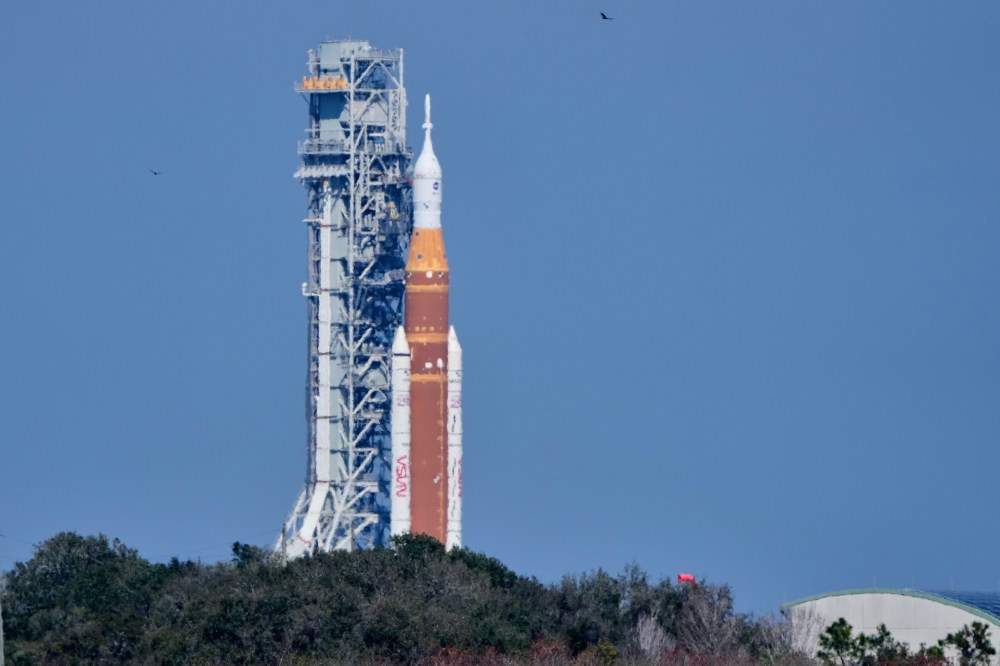
NASA's Artemis II SLS (Space Launch System) moon rocket with the Orion spacecraft slowly rolls back towards the Vehicle Assembly Building at the Kennedy Space Center, Wednesday, Feb. 25, 2026, in Cape Canaveral, Fla. (AP Photo/John Raoux)

The follow-up mission, Artemis III, had been targeting a landing near the moon’s south pole by another pair of astronauts in about three years. But with long gaps between flights and concern growing over the readiness of a lunar lander and moonwalking suits, NASA’s new administrator Jared Isaacman announced that mission would instead focus on launching a lunar lander into orbit around Earth in 2027 for docking practice by astronauts flying in an Orion capsule.

The new plan calls for a moon landing — potentially even two moon landings — by astronauts in 2028.

“Everybody agrees. This is the only way forward,” Isaacman said.

The hydrogen fuel leaks and helium flow problems that struck the Space Launch System rocket on the pad at NASA’s Kennedy Space Center earlier this month had also plagued the first Artemis test flight without a crew in 2022.

Another three-year gap was looming between Artemis II and the moon landing by astronauts as originally envisioned, Isaacman said.

Isaacman stressed that “it should be incredibly obvious” that three years between flights is unacceptable. He’d like to get it down to one year or even less.

Isaacman, a tech billionaire who bought his own trips to orbit and performed the world’s first private spacewalk, took the helm at NASA in December.

During NASA’s storied Apollo program, he said, astronauts’ first flight to the moon was followed by two more missions before Neil Armstrong and Buzz Aldrin landed on the moon. What’s more, he added, the Apollo moonshots followed one another in quick succession, just as the earlier Projects Mercury and Gemini had rapid flight rates, sometimes coming just a few months apart.

Twenty-four Apollo astronauts flew to the moon from 1968 through 1972, with 12 of them landing.

“No one at NASA forgot their history books. They knew how to do this,” Isaacman said. “Now we’re putting it in action.”

To pick up the pace and reduce risk, NASA will standardize its Space Launch System rockets moving forward, Isaacman said. These are the massive rockets that will launch astronauts to the moon aboard Orion capsules. At the same time, Elon Musk’s SpaceX and Jeff Bezos’ Blue Origin are speeding up their work on the landers needed to get the astronauts from lunar orbit down to the surface.

Isaacman said next year will see an Orion crew rendezvousing in orbit around Earth with SpaceX’s Starship, Blue Origin’s Blue Moon or both landers. It’s similar to the methodical approach that worked so well during Apollo in the late 1960s, he noted. Apollo 8, astronauts’ first flight to the moon, was followed by two more missions before Armstrong and Aldrin aimed for the lunar surface.

“We should be getting back to basics and doing what we know works,” he said.

The Aerospace Safety Advisory Panel recommended this week that NASA revise its objectives for Artemis III “given the demanding mission goals.” It’s urgent the space agency do that, the panel said, if the United States hopes to safely return astronauts to the moon. Isaacman said the revised Artemis flight plan addresses the panel’s concerns and is supported by industry and the Trump administration.

___

The Associated Press Health and Science Department receives support from the Howard Hughes Medical Institute’s Department of Science Education and the Robert Wood Johnson Foundation. The AP is solely responsible for all content.

Report Error Submit a Tip

More Stories

Gilbert Plains Country Club closes for remainder of season due to flood damage

Ken Wiebe 6 minute read Preview

Gilbert Plains Country Club closes for remainder of season due to flood damage

Ken Wiebe 6 minute read Yesterday at 5:50 PM CDT

Scott McCallum has made the trek to the Gilbert Plains Country Club clubhouse countless times.

But this was the first time the golf professional and general manager of the course required hip waders to get to his office.

Walking hand in hand with his wife Lindsay, McCallum didn’t need much time to see the devastation caused by the flash flooding in the Parkland region in late June.

“We’re on a river and it’s a beautiful golf course, but anytime you’re on a body of water you know that you’re taking a chance of events like this happening,” McCallum said in a telephone interview. “To this magnitude, we’ve never seen anything like it before. So, this is new to us.

Read
Yesterday at 5:50 PM CDT

Mayoral race lineup grows to 10 candidates

Joyanne Pursaga 2 minute read Preview

Mayoral race lineup grows to 10 candidates

Joyanne Pursaga 2 minute read Yesterday at 1:50 PM CDT

An electrical contractor has become the 10th candidate to register for the race to become Winnipeg’s next mayor.

Zac Uminski has thrown his name into the competition, after Scott Gillingham signed up to seek re-election as mayor and eight other candidates previously registered.

The father of four said concern about homelessness and addictions sparked his interest in politics.

“My campaign will focus on practical solutions to improve public safety, support families and strengthen the city services,” Uminski said. “We need safer communities.”

Read
Yesterday at 1:50 PM CDT

Local medical scrubs retailer feeling abandoned by U of M, RRC Polytech nursing programs

Maggie Macintosh 4 minute read Preview

Local medical scrubs retailer feeling abandoned by U of M, RRC Polytech nursing programs

Maggie Macintosh 4 minute read Yesterday at 7:01 PM CDT

A Winnipeg uniform store is appealing to medical students to shop locally for scrubs this back-to-school season as it grapples with growing competition online and an apparent shutout by local campuses.

Unimor Healthwear has long ordered uniforms in bulk in navy blue, burgundy and pewter, as nurses-in-training are required to wear those colours based on where they’re enrolled in the province.

“It’s not like it used to be,” Evan Schwartz said about customer traffic to his store at 98 Sherbrook St.

The company’s director estimated he spent about $15,000 to stock up on scrubs in pewter in preparation for the launch of Red River College Polytechnic’s upcoming nursing intake.

Read
Yesterday at 7:01 PM CDT

It’s your call on further contact with ‘dad’

Maureen Scurfield 5 minute read Yesterday at 2:01 AM CDT

DEAR MISS LONELYHEARTS: My birth father has shown up in Manitoba — he got a transfer here for a job. He has never expressed any interest in me before except to send my mother pay-off money over the years.

At his insistence, I met recently with him and his wife for lunch and then we went to a mall where he wanted to buy me really expensive running shoes. I’m an adult — not a little kid.

Also, “Dad” is not a success in my eyes. Where was he when I really needed him?

Unfortunately, I look just like him — the younger version my mom says she fell for years ago. Apparently, I passed muster at the first meeting with him and he wants to have a barbecue at their house to show me around to other relatives.

Emergency rooms need help — now

Editorial 4 minute read Preview

Emergency rooms need help — now

Editorial 4 minute read 2:00 AM CDT

Triage. It’s an interesting, necessary, and bluntly pragmatic concept, but it’s not for the faint of heart.

It’s a method of determining how and when to treat the injured and the sick, and it has a long (and disputed) history. Many historians credit French army surgeon Dominique-Jean Larrey, who, in Napoleonic France, came up with a classification system to help evacuate and treat injured soldiers by quickly dividing their injuries into three different classifications.

“In the Battle of Jena in 1806, the French army used the triage system developed by Larrey. The system involved categorization into three grades based on the severity of the wounds irrespective of the soldier’s rank: dangerously wounded, less dangerously wounded, and slightly wounded,” wrote researchers Hiroyuki Nakao, Isao Ukai and Joji Kotani in the medical journal Acute Medicine and Surgery.

Triage, in fact, means “breaking into threes,” and there’s a dispute over whether it was originally used to classify coffee beans or wool — but we’re not going any further down that particular rabbit hole today.

Read
2:00 AM CDT

Time-travel mystery a hallucinogenic trip

Alison Gillmor 4 minute read Preview

Time-travel mystery a hallucinogenic trip

Alison Gillmor 4 minute read 3:00 AM CDT

Here’s a spooky premise: A fishing boat, the Rose of Nevada, that disappeared along with its crew 30 years ago, makes a mysterious return — empty but unchanged — to a small village in Cornwall, on England’s southwest coast.

“She’s back,” the boat’s owner says ominously. Even more ominously, he doesn’t sound particularly surprised. It feels as if this has happened before.

There’s something unsettling going on in this strange and singular film. Cornish writer-director Mark Jenkin (Bait, Enys Men) has crafted a ghostly time-travel tale that collapses past and present, leaving his characters — and the audience — in haunting emotional and moral quandaries.

If the film’s sense of time can be deliberately hazy, its sense of place is very clear. All three of Jenkin’s features have been set in Cornwall, and there’s an intimate, immediate sense of connection to this coastal town, which is depressed and dwindling, its inhabitants beset by economic precarity. The harbour is deserted, the pub is empty, shop windows are boarded up and the young people are leaving. It seems as if the disappearance of that boat and crew broke not just the men’s grieving families but the whole community.

Read
3:00 AM CDT