Musical family man
Celebrated Métis musician supported family, community

Advertisement
Read this article for free:
or
Already have an account? Log in here »
To continue reading, please subscribe:
Digital Subscription
One year of digital access for only $1.44 a week*
- Enjoy unlimited reading on winnipegfreepress.com
- Read the E-Edition, our digital replica newspaper
- Access News Break, our award-winning app
- Play interactive puzzles
*Billed as $5.77 plus GST every four weeks. After 52 weeks, price increases to the regular rate of $19.95 plus GST every four weeks. Offer available to new and qualified returning subscribers only. Cancel any time.
To continue reading, please subscribe:
Add Free Press access to your Brandon Sun subscription for only an additional
$1 for the first 4 weeks*
- Enjoy unlimited reading on winnipegfreepress.com
- Read the E-Edition, our digital replica newspaper
- Access News Break, our award-winning app
- Play interactive puzzles
*Your next Brandon Sun subscription payment will increase by $1.00 and you will be charged $17.95 plus GST for four weeks. After four weeks, your payment will increase to $24.95 plus GST every four weeks.
Read unlimited articles for free today:
or
Already have an account? Log in here »
Hey there, time traveller!
This article was published 28/02/2026 (235 days ago), so information in it may no longer be current.
Paul Allen Desjarlais — or “Big Al” Desjarlais, as everyone knew him — was a famous man.
His family expresses this matter-of-factly when they gather to remember him. Al was an award-winning country musician who toured Canada and fronted his own group. At home, he was a well-loved figure in Manitoba’s Métis community. He couldn’t go anywhere without someone popping up for a hug or a handshake.
He had a cheeky line for any time his accolades were brought up — yes, maybe he was famous, but as he put it, “famous in a 100-mile radius.”

SUPPLIED
Al Desjarlais (right) taught himself how to play guitar.
His daughters, Jocelyn and Jacqueline Desjarlais, crack up thinking about it.
“It didn’t matter where we went with him, oh my God, everyone would be like ‘Al! Al!’” Jocelyn says, as Jacqueline shakes her head, laughing.
“I’d be like, ‘Dad, who is that?’ and he’d say, ‘I’m not good with names.’”
Al Desjarlais was born in 1953 in the largely Métis community of St. Laurent, where he spoke Michif French as his first language. His family was poor, and his older siblings struggled with muscular dystrophy, putting the responsibility of acting as a provider on Al very early in life.
His family moved to Winnipeg when he was six, and only a few years later, he was working at a downtown corner store in exchange for food to help feed his family. In adulthood, he worked for the city’s parks department, but his love of music quickly became the guiding force in his life.
He taught himself the guitar and began playing gigs. He loved country music, particularly the outlaw country stylings of the 1980’s, but had influences across the gamut: he loved listening to his fellow Métis artists, Merle Haggard, Hank Williams, The Beatles.
“His practice area was in our basement; we always grew up around drum sets and microphones and guitars and ukuleles and music instruments everywhere,” Jocelyn says.
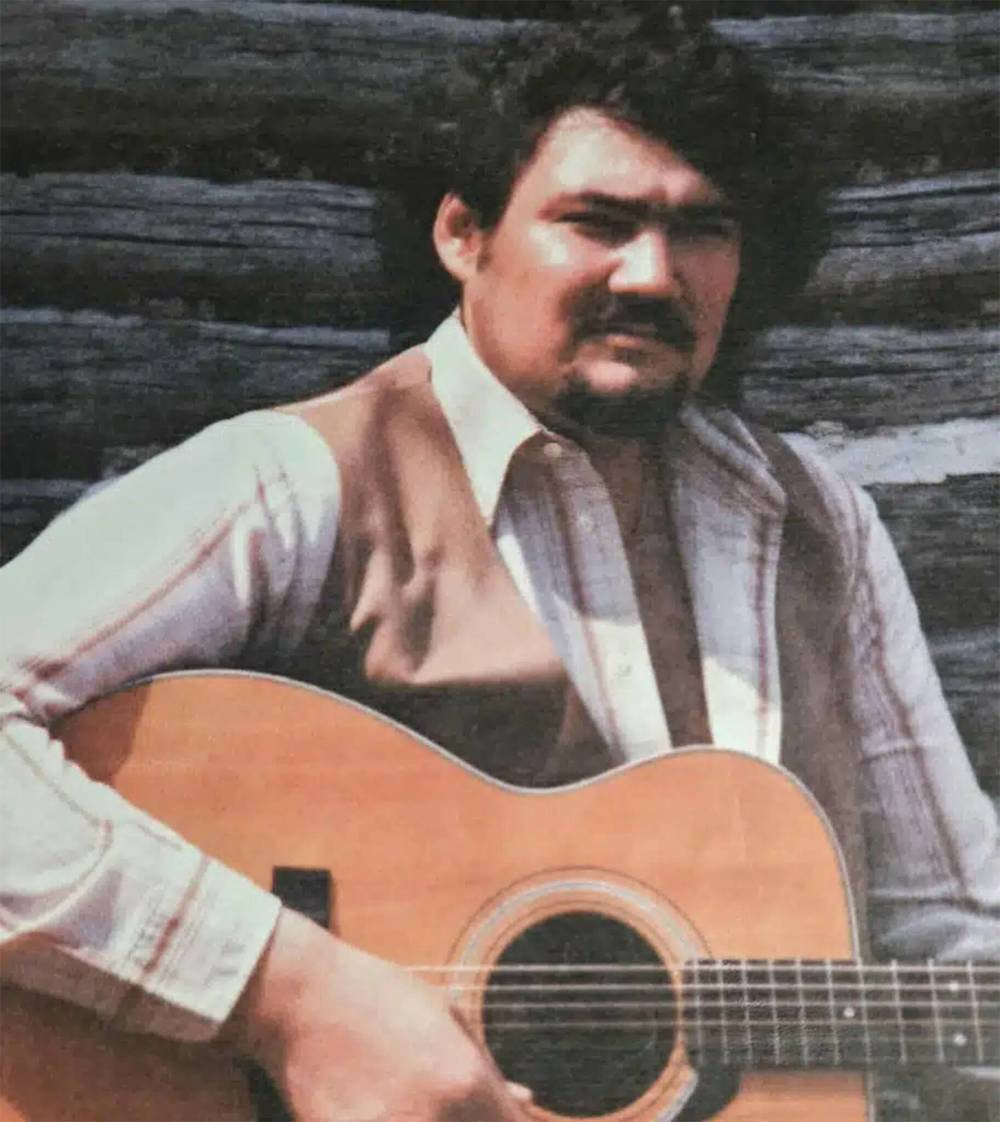
SUPPLIED
Al Desjarlais’s music career took off in the 1980s.
“We learned to sleep through loud music, that’s for sure, as young kids.”
After committing to his music career full-time in the 1980s, success came quickly. He toured Canada with Winnipeg country outfit Len Henry and Good Company, playing guitar and singing backup. Later, he started his own band, the Al Desjarlais Band, and led another band, Trapline, both mostly composed of family members.
In 1984, he received an award from the Manitoba Association of Country Arts, known today as the Manitoba Country Music Association.
In recordings, Al’s voice is soft and full, with a twang that feels uniquely his but inspired by his influences. After his death, the Manitoba Métis Federation shared a performance of him covering Silver Wings by Merle Haggard, and flew their flags at half-mast in his memory. The performance has been watched more than 47,000 times.
For a time, legendary Manitoba fiddler Oliver Boulette played with Al, and remembers what he describes as an enviable skill for tuning instruments, even tuning American country singer George Jones’ guitars by ear during a tour of the North.
Boulette and Al became close friends, both through music and, later, working with the MMF. Boulette played some fiddle on a record Al released, and the pair performed at corporate dinners in Ottawa for the federal and Métis National governments. Al was a rarity, Boulette says — a guitar player able to smoothly accompany a fiddle player.

SUPPLIED
Desjarlais with his grandson, Tristan.
“What I found was when I got to start to play with him, I just wanted to keep up with him,” Boulette says.
He played with Al for the last time just six weeks before he died.
“His heart was as big as what he was, he was just a guy that would give and help,” Boulette says. “And he was a musician, through and through.”
At a celebration of life concert held by the MMF in October, multiple people showed up to play music with instruments Al had picked out for them over the years.
“Maybe 10 different people spoke about how they got a guitar from him… it was his thing, musicians would come in with their guitars, and it was like he knew the right guitar for the right person,” Jocelyn says.
“He was always helping people, financially, too,” Jocelyn’s husband, Robert Conway, says. “He even lent me the money for the engagement ring for his daughter.”

SUPPLIED
Al performs with his granddaughter, Alexandra.
Those who didn’t know Al through music knew him through Elsie Bear’s Kitchen, a Métis cuisine restaurant located in the MMF’s headquarters he owned and operated for more than 20 years.
He liked the work and the food, but the people were his favourite part.
“He was always out front chatting with customers,” Conway says, laughing.
As the years went on, his children, and later, his grandchildren, became fixtures at the restaurant too.
He quickly took to being a grandfather, and was known as “Papa” to Jacqueline’s son, Aidan. When Aidan was diagnosed with autism, Al jumped in, offering support to Jacqueline and her son. In Jacqueline’s home, signs of their closeness are everywhere — framed photos of them together, even a pillow printed with both of their smiling faces.
This is the memory of her father Jacqueline holds dearest. It was a hard time for her and her son, made easier by his presence.
“He was there, no matter what,” Jacqueline says, wiping away tears. “He would drop whatever.”

SUPPLIED
Desjarlais’s daughter Jacqueline (right) says her father would drop everything to help.
Granddaughter Alexandra Goodman remembers his drives with her, pointing out different places he’d hosted gigs or played shows. Now, she works at Elsie’s Bear Kitchen, doing a little bit of everything.
“When I go to work every morning, it’s always a thought,” Alexandra says. “We wouldn’t be working there if he hadn’t started it for us.”
Ten years ago, he retired after two decades in the business, leaving the restaurant to his family, who still run it today.
Al continued to perform anywhere he could, and was recognized well after his self-imposed retirement from the music industry. In 2010, he released an album, Winds of Change, that was nominated for a Canadian Aboriginal Music Award.

During the early days of the COVID-19 pandemic, when people were isolating at home, Al produced The Beat Goes On, a virtual concert for the MMF. Months before he died, he was featured in Rhythms of the Land, a documentary from the Office of the Commissioner of Indigenous Languages, where he performed in his mother tongue, Michif French.
Al died after a short battle with gallbladder cancer on Aug. 26, 2025. He was 72.

SUPPLIED
Desjarlais was a local celebrity says daughter Jocelyn (left).
One of the last things he left for Alexandra was a handwritten book of Michif words written by a relative. To her, it represents everything her grandfather stood for — the preservation of his language, his heritage, storytelling through song.
“He’d always been so proud of it, and always wanted to make sure his kids and grandkids were proud of it.”
malak.abas@freepress.mb.ca
Malak Abas is a city reporter at the Free Press. Born and raised in Winnipeg’s North End, she led the campus paper at the University of Manitoba before joining the Free Press in 2020. Read more about Malak.
Every piece of reporting Malak produces is reviewed by an editing team before it is posted online or published in print — part of the Free Press‘s tradition, since 1872, of producing reliable independent journalism. Read more about Free Press’s history and mandate, and learn how our newsroom operates.
Our newsroom depends on a growing audience of readers to power our journalism. If you are not a paid reader, please consider becoming a subscriber.
Our newsroom depends on its audience of readers to power our journalism. Thank you for your support.
A Life’s Story
A tribute to those who left a mark on our province
Malak Abas is a city reporter at the Free Press. Born and raised in Winnipeg’s North End, she led the campus paper at the University of Manitoba before joining the Free Press in 2020. Read more about Malak.
Every piece of reporting Malak produces is reviewed by an editing team before it is posted online or published in print — part of the Free Press‘s tradition, since 1872, of producing reliable independent journalism. Read more about Free Press’s history and mandate, and learn how our newsroom operates.
Our newsroom depends on a growing audience of readers to power our journalism. If you are not a paid reader, please consider becoming a subscriber.
Our newsroom depends on its audience of readers to power our journalism. Thank you for your support.
Advertisement Advertise With Us
Advertisement Advertise With Us