

China’s factory activity contracts for a second month
Advertisement
Read this article for free:
or
Already have an account? Log in here »
To continue reading, please subscribe:
Monthly Digital Subscription
$1 per week for 24 weeks*
- Enjoy unlimited reading on winnipegfreepress.com
- Read the E-Edition, our digital replica newspaper
- Access News Break, our award-winning app
- Play interactive puzzles
*Billed as $4.00 plus GST every four weeks. After 24 weeks, price increases to the regular rate of $19.95 plus GST every four weeks. Offer available to new and qualified returning subscribers only. Cancel any time.
Monthly Digital Subscription
$4.99/week*
- Enjoy unlimited reading on winnipegfreepress.com
- Read the E-Edition, our digital replica newspaper
- Access News Break, our award-winning app
- Play interactive puzzles
*Billed as $19.95 plus GST every four weeks. Cancel any time.
To continue reading, please subscribe:
Add Free Press access to your Brandon Sun subscription for only an additional
$1 for the first 4 weeks*
*Your next subscription payment will increase by $1.00 and you will be charged $16.99 plus GST for four weeks. After four weeks, your payment will increase to $23.99 plus GST every four weeks.
Read unlimited articles for free today:
or
Already have an account? Log in here »
HONG KONG (AP) — China’s factory activity shrank for a second month in February, though lower U.S. tariffs could bring about a small boost in the coming weeks.
The official manufacturing purchasing managers index, or PMI, slipped to 49 from 49.3 in January, a four-month low, the National Bureau of Statistics reported Wednesday. The figure from its monthly survey of factory managers is measured on a scale of 0 to 100 and indicates contraction when it is below 50.
December’s manufacturing PMI reading of 50.1 broke China’s eight consecutive months of contraction, but its recent return to negative territory signals more weakness in manufacturing especially under sluggish domestic consumption and demand.
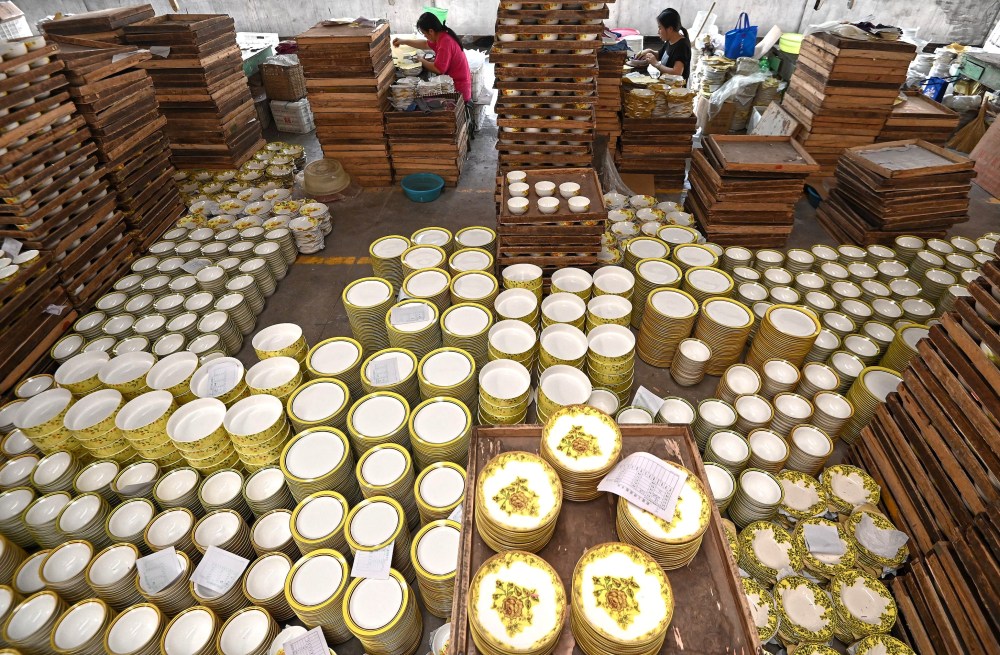
Huo Lihui, a National Bureau of Statistics chief statistician, attributed the weaker data in a statement to seasonal factors including the Lunar New Year holiday, which lasted for nine days in mid-February this year.
A separate private sector PMI survey by Chinese credit research and analysis company RatingDog also released Wednesday appeared more upbeat, with a February PMI reading of 52.1, up from 50.3 in January, remaining in the expansion territory and the sharpest expansion since December 2020. The private survey typically better reflect trends among smaller and more export-focused private companies.
Overseas demand has rebounded in February and was strong, said Yao Yu, founder of RatingDog, in a note, and new export orders have grown notably.
“The mixed bag of manufacturing PMI data suggests a similar trajectory to what we observed in 2025,” said Lynn Song, chief economist for Greater China at ING Bank, in a research note. “Resilient external demand (is) continuing to drive growth, while domestic demand has been disappointingly soft.”

The Supreme Court ruling last month against Trump’s reciprocal tariffs, which resulted in the reduction in U.S. tariffs globally including for China, is also likely to provide a “small boost” to exports and manufacturing activity over the coming months, said Zichun Huang, a China economist at Capital Economics, in a recent note.
U.S. President Donald Trump’s planned meeting with Chinese leader Xi Jinping in April, which could bring about an extended trade truce between the two countries, could also be positive news for Chinese manufacturers.
China’s domestic demand weakness, however, is likely expected to continue to be a problem, analysts said, as a prolonged real estate sector downturn dragged on consumption and investment.
This week, China is set to unveil its economic growth target at its annual national congress that begins Thursday, with economists expecting a growth target of 4.5% or above.
The congress, which lasts for around a week, will also approve Beijing’s five-year policy blueprint for 2026-2030, with an expected focus on areas such as boosting technological advancements and self-reliance.