Charity case

Brilliant new novel pillories philanthropy’s pitfalls with a rich cast of characters

Advertisement

Advertise with us

Sharon Bala’s much anticipated new novel Good Guys signals irony from the start. It follows the success of her 2018 debut, The Boat People, and is every bit worth the wait.

Read this article for free:


or

Already have an account? Log in here »

To continue reading, please subscribe:

Subscribe and receive a limited-edition Free Press branded hat or tote.

Digital Subscription

One year of digital access for only $205*

  • Enjoy unlimited reading on winnipegfreepress.com
  • Read the E-Edition, our digital replica newspaper
  • Access News Break, our award-winning app
  • Play interactive puzzles

*First annual payment billed as $205.00 + GST for one year. This annual subscription will automatically renew at $233.00 + GST every 52 weeks (10% off the regular annual price of $259.35). Offer available to new and qualified returning subscribers only. Cancel any time.

To continue reading, please subscribe:

Add Free Press access to your Brandon Sun subscription for only an additional

$1 for the first 4 weeks*

  • Enjoy unlimited reading on winnipegfreepress.com
  • Read the E-Edition, our digital replica newspaper
  • Access News Break, our award-winning app
  • Play interactive puzzles
Start now

*Your next Brandon Sun subscription payment will increase by $1.00 and you will be charged $17.95 plus GST for four weeks. After four weeks, your payment will increase to $24.95 plus GST every four weeks.

Hey there, time traveller!
This article was published 07/03/2026 (205 days ago), so information in it may no longer be current.

Sharon Bala’s much anticipated new novel Good Guys signals irony from the start. It follows the success of her 2018 debut, The Boat People, and is every bit worth the wait.

A CBC Canada Reads finalist, The Boat People was based on the real-life events of the MV Sun Sea ship told from the fictionalized perspectives of a Tamil passenger, his lawyer and the adjudicator of the case. It was translated into four languages and won the Newfoundland and Labrador Book Award and the Harper Lee Prize for Legal Fiction.

In that book, Bala made riveting the frustrations of the bureaucratic process and shone a light on the harsh realities for refugees in Canada. In Good Guys, the author turns a sharp eye to the complexities of philanthropy, interrogating the terrain of non-profits, charity and the politics of celebrity and international aid.
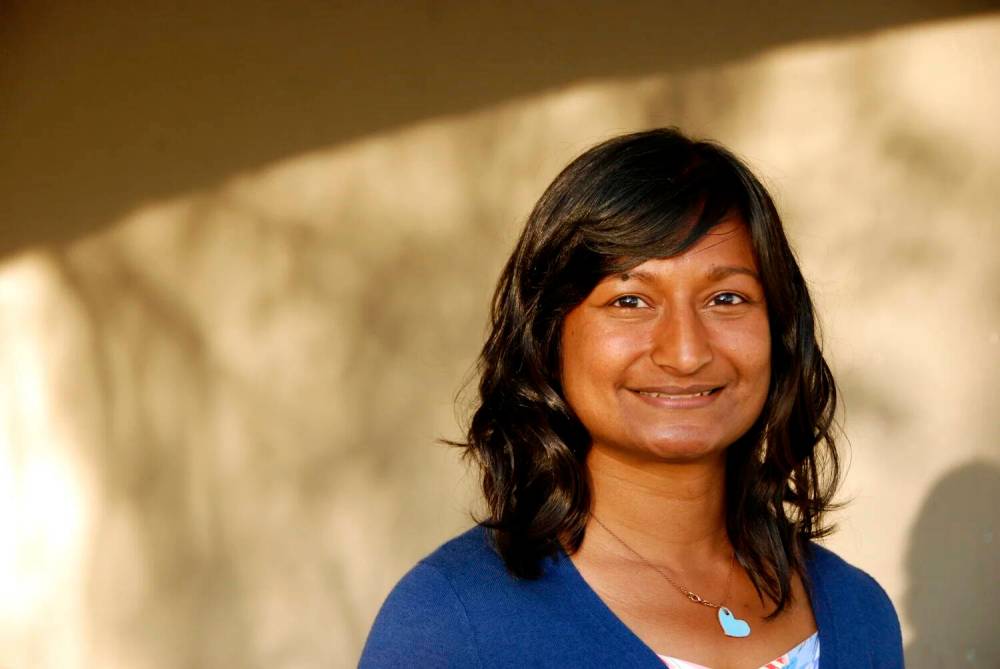
Nadra Ginting photo
                                Sharon Bala began writing Good Guys in 2012 as a longer short story, with numerous versions hitting the dustbin before the novel-length final product made it to publication.

Nadra Ginting photo

Sharon Bala began writing Good Guys in 2012 as a longer short story, with numerous versions hitting the dustbin before the novel-length final product made it to publication.

Born in Dubai, Bala immigrated to Canada with her Sri Lankan parents when she was seven. Raised in Pickering, Ont., she went on to earn university degrees in psychology and history before moving, at age 30, to St. John’s, N.L., where she joined the Port Authority writers’ group and embarked on her authorial career.

Good Guys began in 2012, Bala tells Bookspo podcast host Kerry Clare, as a long short story. Numerous manuscripts hit the dustbin before the final version made it to publication. Nothing came easy with this novel, she says.

The result of these efforts, however, produces a rich tapestry of characters whose backstories are fully realized if only glimpsed at, as in the case of main character Claire’s ex-husband Simon, or “the office joker,” who remains unnamed.

There are three perspectives from which we hear most often. Foremost is that of Claire, who has recently left a lucrative career in corporate reputation management to become a publicist for Children of the World, an international non-profit charity headquartered in Toronto and led by Crispin, a musician-turned-philanthropist, who gained fame and fortune in the ’90s.

When Claire responds to an A-list celebrity’s posting about the charity’s work in the fictional Central American country of Santa Rosa, she sets in motion a Hail Mary-series of events that appear to save at once the lives of children connected to the compound as well as the organization itself from financial ruin.

Multilingual Lucca is the charismatic country director of the charity’s flagship project in Santa Rosa. He has lived in numerous disaster zones, craving adventure and running from the pitfalls of his privileged youth. He has a knack for shirking responsibility with smooth talk and avoiding self-examination when the going gets tough.

And then there’s Emmanuelle, who shares with founder Crispin an evangelical upbringing and whose acute sense of ethics, astute observations and journalistic ambitions fuse together to expose a sinister crime at the core of Children of the World’s recent success.

Sharp with satire, Good Guys is a workplace dramedy that pinpoints in important and uncomfortable ways the self-righteous underpinnings of the non-profit world.

Bala’s novel puts into words the individual and collective discomforts around the notion of good intentions in a flawed system: non-profit lifer Anya uses the term “charitainment,” while Emmanuelle’s shrewd literary agent offers up the summarial gem “philanthrocapitalism.”

Good Guys

Good Guys

No character is let off the hook. The novel is deeply felt and thoughtful, and one need only scan a recent history of the news to see its relevance today: the WE Charity controversy, celebrity international adoptions and the fundraising efforts of U2’s Bono, to name a few.

Readers might already agree at the outset with the tattoo-sleeved, smartphone-toting skeptics that Claire overhears critiquing Children of the World and its systemic foibles. It is obvious to them that the charity model doesn’t work.

Recent examples in literature concur: the missionary project is misguided and has caused harm in the past, as Joan Thomas’s Five Wives lays bare; or look to Hernán Díaz’s Trust to consider the decayed roots of wealth accumulation and philanthropic lore.

So, are there any good guys in Good Guys, a novel that so vividly depicts our thought processes and lived reality as to show us to ourselves? The answer is unclear, and appropriately so; though most, if not all, would agree with the overheard Santa Rosa locals when they say, on more than one occasion, that nothing in this world is free.

Sara Harms is a Winnipeg editor.

Report Error Submit a Tip

More Stories

Discrediting independent media is the game plan

Editorial 4 minute read Preview

Discrediting independent media is the game plan

Editorial 4 minute read 2:00 AM CDT

United States President Donald Trump’s decision to bar several news organizations from White House briefings is, thanks to a court decision, teetering on the edge of collapse.

Will this defeat send the president into a rage? There is actually evidence that Trump knew this was going to be the outcome when he ordered the ban.

A federal court judge in Washington (and a Trump appointee, for the record) issued an injunction on Thursday arguing the swift decision to bar CNN, MS Now and Politico from the White House was likely unconstitutional. The judge ordered the White House to restore credentials to the three news organizations immediately.

Was this just the latest in a string of judicial defeats suffered by the Trump administration as it seeks to undermine, unravel and otherwise work around long-standing legal and administrative canons of the American government? No, not really.

Read
2:00 AM CDT

Province invests $3.8M in culinary arts training facility for francophone high school students

Kelly-Anne Riess 3 minute read Preview

Province invests $3.8M in culinary arts training facility for francophone high school students

Kelly-Anne Riess 3 minute read Yesterday at 12:10 PM CDT

A new dedicated culinary arts training facility will give francophone high school students a place to learn the trade in French.

The Manitoba government announced this week that it is providing $3.8 million toward the purchase of a property at 170 Marion St. and beginning design work for its renovation.

The facility will be the first dedicated vocational education site operated by Division scolaire franco-manitobaine, and the first fully French-language culinary arts program for Grade 11 and 12 students, preparing them for work in the restaurant and service sector.

“French-language education is a fundamental part of Manitoba’s identity and strength,” Education Minister Tracy Schmidt said in a news release. “It is an exciting step that will help strengthen both the francophone community and our skilled workforce.”

Read
Yesterday at 12:10 PM CDT

Is another goalie on Jets’ wish list?

Ken Wiebe 7 minute read Preview

Is another goalie on Jets’ wish list?

Ken Wiebe 7 minute read Yesterday at 6:59 PM CDT

Kevin Cheveldayoff and company are down to the short strokes.

With the opening-day roster due on Monday afternoon, the Winnipeg Jets took steps on the weekend to get down to the final number.

As it stood on Sunday, the Jets were down to 24 healthy players in training camp after centre Danny Zhilkin and defenceman Henry Thrun were placed on waivers.

With a maximum of 23 spots available, the only things left to determine are whether the Jets are interested in claiming a more experienced goalie to serve as the backup to Stuart Skinner and if centre Brayden Yager will break camp with the big club.

Read
Yesterday at 6:59 PM CDT

Four Jets clear waivers to join Moose

Ken Wiebe 3 minute read Preview

Four Jets clear waivers to join Moose

Ken Wiebe 3 minute read Saturday, Sep. 26, 2026

The Winnipeg Jets organizational depth has yet to take a hit on the waiver wire.

On Saturday afternoon, all four players exposed to waivers — defenceman Isaak Phillips and forwards Nikita Chibrikov, Noah Gregor and Parker Ford — cleared, which means they can be assigned to the Manitoba Moose of the American Hockey League.

Owing to injuries to captain Adam Lowry and winger Cole Perfetti, both Chibrikov and Ford started last season on the NHL roster but spent the bulk of last season with the Moose.

Chibrikov, chosen in the second round of the 2021 NHL Draft, has dealt with multiple lower-body injuries during the prior two seasons and is still working his way back to peak form.

Read
Saturday, Sep. 26, 2026

Letters, Sept. 28

7 minute read 2:00 AM CDT

Other options are closer

Every Winnipeg driver learns this lesson eventually: keep your eyes on the horizon too long and the pothole gets you. Manitoba’s energy debate has the same problem. We keep looking far down the road for the next big project and missing what’s close at hand.

Scott Forbes (Time for 21st-century leadership at MB Hydro, Think Tank, Sept. 24) makes a strong case for more wind and storage. But much of this debate is still measured in thousands of megawatts, generated far from where the power is used.

The more immediate opportunity is close to home.

Wab Kinew as ‘communicator in chief’

Paul G. Thomas 6 minute read Preview

Wab Kinew as ‘communicator in chief’

Paul G. Thomas 6 minute read 2:00 AM CDT

Premier Wab Kinew and his party have been riding high in the polls longer than normal for a government one year or less away from its first re-election contest. One reason is his ubiquitous, dominating communications presence as NDP leader and premier.

The argument here is that Kinew has supplemented his prerogatives as premier and party leader (such as appointing cabinet ministers and approving party nominations) with the skilful use of communications to advance his policy agenda, boost his personal popularity and maintain the competitive advantage of his party over the opposition Progressive Conservatives.

Communications has always been a significant part of politics and policy making. However, in the contemporary political and media environments, communications considerations have moved from the background to the foreground of decision-making by political parties, including when they are performing in the role of government. Campaigning and governing now overlap in what has been described as a permanent election campaign.

Political parties use communications strategies for several purposes: to establish an image of the leader which makes a positive emotional connection with voters; to promote a coherent message and to keep party members on message; and to gain favourable media coverage for its policies and other actions on almost a daily basis.

Read
2:00 AM CDT