Faith leaders push for access to ICE detention centers during Lent and Ramadan
Advertisement
Read this article for free:
or
Already have an account? Log in here »
To continue reading, please subscribe:
Digital Subscription
One year of digital access for only $1.44 a week*
- Enjoy unlimited reading on winnipegfreepress.com
- Read the E-Edition, our digital replica newspaper
- Access News Break, our award-winning app
- Play interactive puzzles
*Billed as $5.77 plus GST every four weeks. After 52 weeks, price increases to the regular rate of $19.95 plus GST every four weeks. Offer available to new and qualified returning subscribers only. Cancel any time.
To continue reading, please subscribe:
Add Free Press access to your Brandon Sun subscription for only an additional
$1 for the first 4 weeks*
- Enjoy unlimited reading on winnipegfreepress.com
- Read the E-Edition, our digital replica newspaper
- Access News Break, our award-winning app
- Play interactive puzzles
*Your next Brandon Sun subscription payment will increase by $1.00 and you will be charged $17.95 plus GST for four weeks. After four weeks, your payment will increase to $24.95 plus GST every four weeks.
Read unlimited articles for free today:
or
Already have an account? Log in here »
Hey there, time traveller!
This article was published 07/03/2026 (230 days ago), so information in it may no longer be current.
The long-held practice of faith leaders ministering to detained migrants has become far more contentious — and consequential — as detention numbers soar across the United States during the federal government’s immigration crackdown.
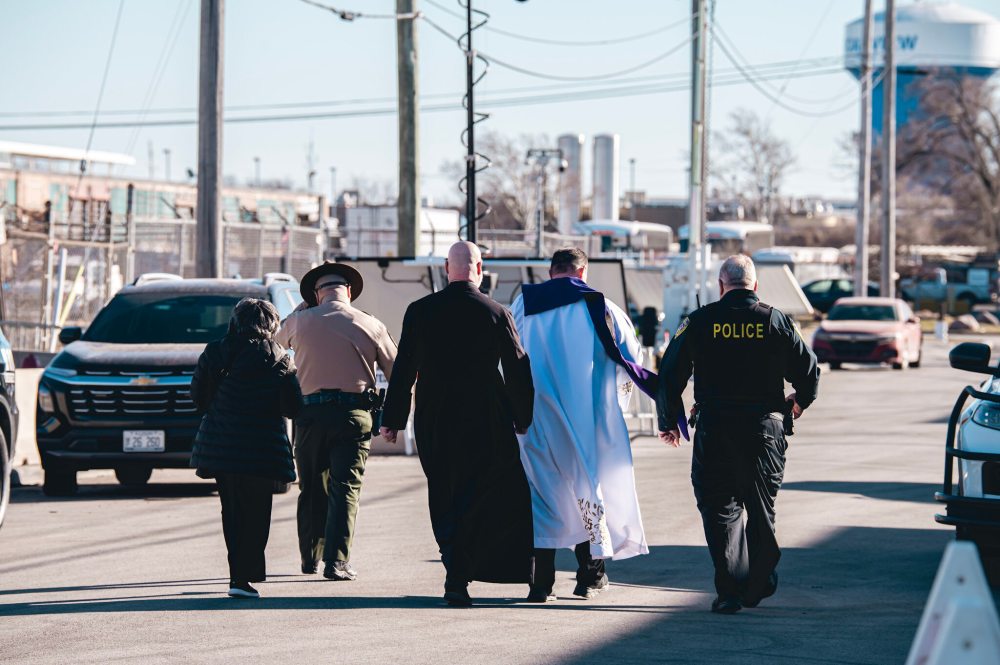
Clergy are pushing for more access at detention centers, especially during the ongoing holy seasons of Lent and Ramadan. After celebrating an Ash Wednesday service with four migrants who had just arrived at a detention center near Chicago, clergy there are working with immigration authorities to set up regular visits.
At the start of Ramadan, a Muslim chaplain was allowed to visit two women held for many months in immigration detention in the Dallas-Fort Worth area. She is hoping to return throughout the fasting month.
“In systems that are made to break them, it is very important that they not only get that care, but they also get adequate care with someone that can help them make meaning of their situation by bringing God,” chaplain Nosayba Mahmoud said.
After months of liaising with U.S. Immigration and Customs Enforcement’s Prairieland Detention Facility in Texas, she was allowed to bring the women dates to break the Ramadan fast as well as softcover Qurans.
But it took a lawsuit — one of two recently filed after clergy said they were denied access in Illinois and Minnesota — for a Catholic contingent to get into the ICE facility in the Chicago suburb of Broadview on Ash Wednesday.
“It’s an important victory,” said the Rev. David Inczauskis, a Jesuit priest and member of the Coalition for Spiritual and Public Leadership, which filed the Chicago lawsuit. “But also we recognize that it’s just one step along the way to migrant justice.”
ICE detention centers expand and draw scrutiny
Since President Donald Trump began his second term, the number of people detained by ICE has increased to as many as 75,000 from 40,000, spread across more than 225 sites as capacity expands. The largest site is Camp East Montana in El Paso, Texas, where an average of about 3,000 people have lived per day.
The Trump administration has repeatedly portrayed its mass deportation efforts as targeting immigrants who are a danger to society, but data from the Deportation Data Project shows that the percentage of people arrested by ICE with criminal histories has steadily decreased.
It’s not clear how Thursday’s ouster of Homeland Security Secretary Kristi Noem will affect detention centers, but the centers have come under mounting criticism, including from members of Congress, about living conditions and inconsistent access to legal representation.
ICE facilities that hold detainees for more than 72 hours are required to have a chaplain or “religious services coordinator,” as well as dedicated spaces for services, ICE told The Associated Press.
ICE policy requires advance notice and background checks for clergy and faith volunteers who want to provide pastoral visits, counseling and religious services, the agency added.
ICE detainees come from all over the world, but historically most were born in Christian-majority countries.
Clergy sue over access to detention centers
The two lawsuits center on access at federal buildings on the outskirts of Chicago and Minneapolis, where clergy said detainees were held for multiple days during the respective enforcement surges last fall and earlier this winter.
Both lawsuits claim the government violated religious freedom by not allowing the clergy to minister to migrants.
The Illinois case said faith leaders were barred from the Broadview center on some occasions starting last fall — a change since a nun and member of the coalition that filed this lawsuit in mid-November had been visiting for approved weekly prayers for a decade.
After a judge ordered ICE to allow the Ash Wednesday visit, faith leaders are “cautiously optimistic” that they might arrange a regular schedule to visit, offer prayers and bring items like rosaries and Bibles, Inczauskis said.
Such access also could benefit the federal agents — three of them asked to receive ashes alongside the migrants, he added.
In Minneapolis, the Rev. Chris Collins, also a Jesuit priest, was denied entry into a federal building where raucous protests occurred daily during the surge. With Minnesota branches of the Evangelical Lutheran Church in America and the United Church of Christ, Collins sued the government in February for being “categorically denied” the opportunity to provide pastoral care.
Faith leaders say access is inconsistent
Clergy and volunteers from different faiths have long ministered to immigration detainees.
For about 15 years, the U.S. branch of Jesuit Refugee Service has had a contract with the Department of Homeland Security to provide in-house chaplains at half a dozen centers, from near the Canadian border in New York to Cuba’s Guantanamo Bay, said the nonprofit’s spokesperson, Bridget Cusick.
Many of the clergy and volunteers involved say they are worried about inconsistent access. Yet they plan to keep up their ministry because they see it as vital to preserving the right to worship and reminding migrants of their humanity.
“I’m the only outside contact that they have,” said Simran Singh, who started visiting Indian detainees at the Mesa Verde ICE facility in Bakersfield, California, a decade ago. “Most of their relatives are not in America … so I am the only one who knows they exist, that they’re more than just a number.”
The Sikh volunteer added that on his weekly visits, detainees love the food from the gurdwara he brings — for some, it’s the only appropriate vegetarian food they have received while in custody.
Others are grateful he delivers the turbans that observant men wear, which are often taken away upon detention.
“That’s part of your identity. So not only are you stripped of your name, but you’re also stripped of who you are,” Singh said.
Similarly, Mahmoud, the Muslim chaplain in Texas, said she would like to provide prayer cloths, especially during Ramadan, but so far hasn’t been allowed to.
Catholic bishops demand more access
In a letter to Congress last week, the U.S. Conference of Catholic Bishops urged “consistent access to religious and pastoral services for all immigration detainees,” and asked for “clear guidelines and uniform processes.”
The bishops had already expressed concern about the lack of pastoral care in a fall statement strongly backed by Pope Leo XIV.
For four decades, the Catholic archbishop of Miami, Thomas Wenski, has been visiting migrants at the Krome Detention Center on the edge of the Everglades, where a weekly Mass is held.
He’s also celebrated Mass at Florida’s Alligator Alcatraz, an even more remote and controversial center. In his homily there last Christmas, he told the dozens of mostly Latino and Latin American men that his presence was proof that they hadn’t been forgotten.
“There are people outside that are praying for you,” Wenski recalled preaching. “God has not abandoned you.”
At the largest detention center, in El Paso, a Sunday Mass is regularly celebrated and priests also visit for confessions. But the access is “very limited” due to what the center’s management says is a shortage of staff and space, Bishop Mark Seitz said.
In Southern California, the Rev. Brian Nunes, auxiliary bishop of Los Angeles, celebrated two Masses recently at the large detention centers in Adelanto and California City, where many struggle with separation from family and their communities.
He, too, hopes to expand care.

“There’s also, on a very important level, this sense that … even when it’s difficult to serve them, that they were served,” Nunes said.
___
AP journalist Morgan Lee contributed from Santa Fe, New Mexico.
___
Associated Press religion coverage receives support through the AP’s collaboration with The Conversation US, with funding from Lilly Endowment Inc. The AP is solely responsible for this content.
The Free Press acknowledges the financial support it receives from members of the city’s faith community, which makes our coverage of religion possible.