

Inquest in The Pas examining 2018 death of train conductor in remote derailment

Advertisement
Read this article for free:
or
Already have an account? Log in here »
To continue reading, please subscribe:
Monthly Digital Subscription
$1 per week for 24 weeks*
- Enjoy unlimited reading on winnipegfreepress.com
- Read the E-Edition, our digital replica newspaper
- Access News Break, our award-winning app
- Play interactive puzzles
*Billed as $4.00 plus GST every four weeks. After 24 weeks, price increases to the regular rate of $19.95 plus GST every four weeks. Offer available to new and qualified returning subscribers only. Cancel any time.
Monthly Digital Subscription
$4.99/week*
- Enjoy unlimited reading on winnipegfreepress.com
- Read the E-Edition, our digital replica newspaper
- Access News Break, our award-winning app
- Play interactive puzzles
*Billed as $19.95 plus GST every four weeks. Cancel any time.
To continue reading, please subscribe:
Add Free Press access to your Brandon Sun subscription for only an additional
$1 for the first 4 weeks*
*Your next subscription payment will increase by $1.00 and you will be charged $16.99 plus GST for four weeks. After four weeks, your payment will increase to $23.99 plus GST every four weeks.
Read unlimited articles for free today:
or
Already have an account? Log in here »
All Chris Rushton could do was “scream” and “holler.”
Rushton, now 67, was trapped, along with 38-year-old conductor Kevin Anderson, pinned under wreckage in their engine car when the Hudson Bay Railway train they were operating derailed after it hit a washed-out section of rail in a remote area south of Thompson on Sept. 15, 2018.
Anderson died of internal bleeding, stuck under debris in the train’s engine car for nearly nine hours. Rushton, the train’s engineer, was seriously injured, but survived after he was pulled from the wreck, near Wabowden, and airlifted out.
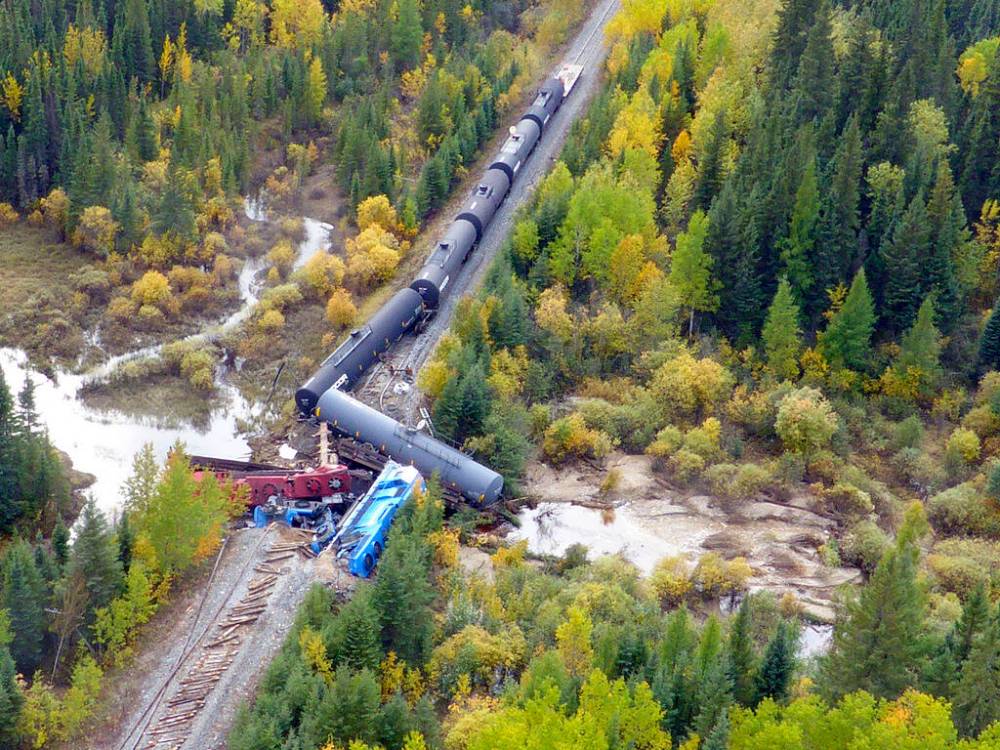
Aerial view of the train derailment that occurred in September 2018. (Transportation Safety Board of Canada photo)
The Transportation Safety Board found in 2020 that the rails and ties were in place, but were hanging over an empty space of about 15 metres long and five metres deep. The rails collapsed and the locomotive folded, pushing its main generator and electrical cabinet into the cab, pinning the two crew members inside.
Rushton testified at an inquest into Anderson’s death that began last week in The Pas in front of provincial court Judge Timothy Killeen.
“It all happened so fast, I didn’t even have time to panic, all I had time to do was throw my hands up in front of my face, that’s how fast it was. It was just ‘blam,’ like that,” said Rushton.
“Kevin and I both started screaming at each other to see if we were OK.”
The three-week inquest is meant to review the circumstances of Anderson’s death and examine the co-ordination of a multi-agency response to a serious incident in a remote area, inquest counsel Kerry Unruh said.
The men were unable to use their radios after the derailment, which occurred at about 4:30 p.m. that day.
“We started screaming back and forth and Kevin said that his arm was cut, and I said, ‘Well, you need to find something and wrap it around there and put pressure on it, like first aid,’” Rushton said.
“We’d taken first aid, we’d taken dangerous commodities (handling training), we knew what to do, but we were pinned and we couldn’t do nothing — other than scream, holler.”
A mining prospecting team, who happened to be flying in the area in a helicopter, came across the derailment and stopped down to check on the men, then flew out to alert emergency responders.
RCMP officers arrived at the derailment at about 7 p.m. Emergency medical responders also arrived, but decided to bar access to the site until trained and equipped personnel could assess the scene over concerns about propane and other fuel potentially leaking from cars.
Those trained responders, and emergency medical personnel, didn’t arrive until hours later, delaying treatment for the trapped and injured railroaders.
Dr. Rob Grierson, the chief medical officer of Shared Health’s emergency response services, testified at length at the inquest Thursday. He discussed the structure of the emergency medical and trauma medicine systems in Manitoba, particularly as it relates to rural areas, and changes made in the system since Anderson’s death in 2018.

He said any recommendations out of the inquest should be “meaningful” and “achievable” and should give certainty to emergency personnel in how to do their work.
The inquest has heard from the helicopter pilots who came across the scene, RCMP officers, Transport Canada and Transportation Safety Board officials, fire and health officials and paramedic responders.
It’s scheduled to continue until the end of next week.
The Transportation Safety Board found in its 2020 report that the section of track where the derailment occurred had been neglected, and condemned the railroad’s former owner, Omnitrax, saying that maintenance had been deferred in the months leading up to the derailment.
erik.pindera@freepress.mb.ca
Erik Pindera is a reporter for the Free Press, mostly focusing on crime and justice. The born-and-bred Winnipegger attended Red River College Polytechnic, wrote for the community newspaper in Kenora, Ont. and reported on television and radio in Winnipeg before joining the Free Press in 2020. Read more about Erik.
Every piece of reporting Erik produces is reviewed by an editing team before it is posted online or published in print — part of the Free Press‘s tradition, since 1872, of producing reliable independent journalism. Read more about Free Press’s history and mandate, and learn how our newsroom operates.
Our newsroom depends on a growing audience of readers to power our journalism. If you are not a paid reader, please consider becoming a subscriber.
Our newsroom depends on its audience of readers to power our journalism. Thank you for your support.
Erik Pindera is a reporter for the Free Press, mostly focusing on crime and justice. The born-and-bred Winnipegger attended Red River College Polytechnic, wrote for the community newspaper in Kenora, Ont. and reported on television and radio in Winnipeg before joining the Free Press in 2020. Read more about Erik.
Every piece of reporting Erik produces is reviewed by an editing team before it is posted online or published in print — part of the Free Press‘s tradition, since 1872, of producing reliable independent journalism. Read more about Free Press’s history and mandate, and learn how our newsroom operates.
Our newsroom depends on a growing audience of readers to power our journalism. If you are not a paid reader, please consider becoming a subscriber.
Our newsroom depends on its audience of readers to power our journalism. Thank you for your support.
Related Articles
Judge rules against family, union seeking all RCMP evidence at inquest into fatal 2018 train derailment




Advertisement Advertise With Us
Advertisement Advertise With Us
History
Updated on Friday, March 13, 2026 12:28 PM CDT: Minor copy edit
Updated on Monday, March 16, 2026 12:44 PM CDT: Corrects date to Sept. 15, 2018