

‘Equal representation’: cannabis advocates push for public pot zones

Advertisement
Read this article for free:
or
Already have an account? Log in here »
To continue reading, please subscribe:

Digital Subscription
One year of digital access for only $205*
- Enjoy unlimited reading on winnipegfreepress.com
- Read the E-Edition, our digital replica newspaper
- Access News Break, our award-winning app
- Play interactive puzzles
*First annual payment billed as $205.00 + GST for one year. This annual subscription will automatically renew at $233.00 + GST every 52 weeks (10% off the regular annual price of $259.35). Offer available to new and qualified returning subscribers only. Cancel any time.
To continue reading, please subscribe:
Add Free Press access to your Brandon Sun subscription for only an additional
$1 for the first 4 weeks*
- Enjoy unlimited reading on winnipegfreepress.com
- Read the E-Edition, our digital replica newspaper
- Access News Break, our award-winning app
- Play interactive puzzles
*Your next Brandon Sun subscription payment will increase by $1.00 and you will be charged $17.95 plus GST for four weeks. After four weeks, your payment will increase to $24.95 plus GST every four weeks.
Read unlimited articles for free today:
or
Already have an account? Log in here »
Hey there, time traveller!
This article was published 18/03/2026 (204 days ago), so information in it may no longer be current.
There are hookah lounges and smoking zones — and now, advocates are pushing the provincial government for public places to consume weed.
The Cannabis Business Association of Manitoba is calling on Premier Wab Kinew to green-light public cannabis consumption spaces.
Steven Stairs, the organization’s founder, has planned a rally outside the legislature on April 20. The association has few members but keeps in touch with owners of roughly 100 stores, Stairs said.
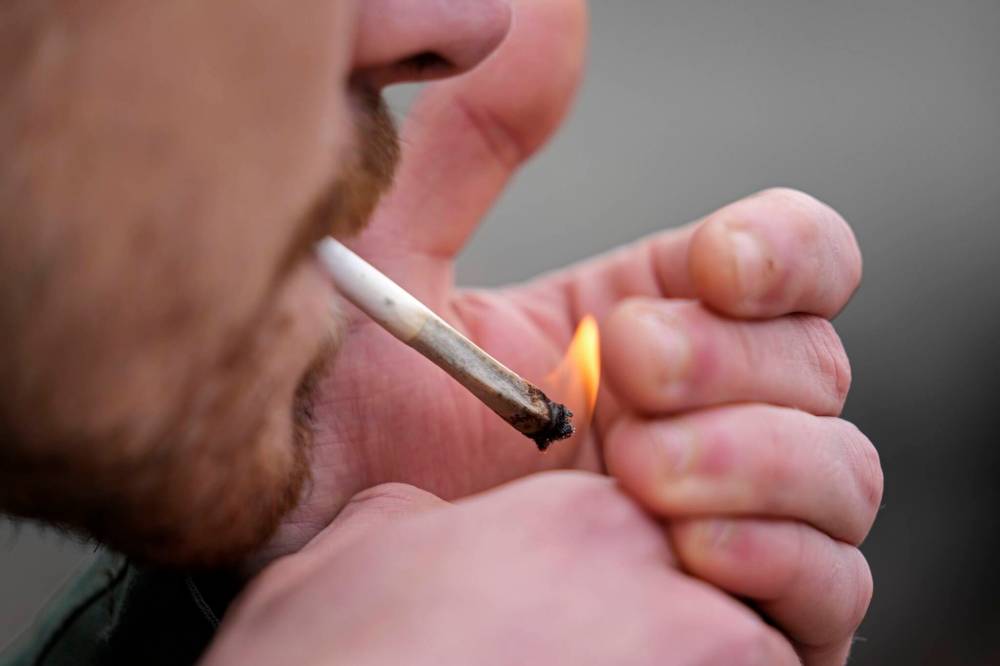
Martin Meissner / The Associated Press files
Manitoba had 249 licensed retail cannabis stores as of March 13. Cannabis revenue grew 10.7 per cent year-over-year in 2024-25, MLL says.
“We’re just looking for equal representation when it comes to access,” he said. “It’s about cannabis consumers being treated the same as an alcohol consumer.”
Alcohol is known for having health consequences, yet it’s widely accessible in public, Stairs said. He also pointed to hookah and cigar lounges, both of which exist in Manitoba.
“If (a public cannabis consumption space) means regulated buildings, cool. If that means … adults-only areas at specific, cordoned-off areas at public social gatherings, great.”
Stairs offered “baby steps,” such as allowing for edibles and cannabis drinks in public places before committing to smoking.
British Columbia has designated public spaces for smoking and vaping cannabis, including in non-specific smoking areas. Ontario allows use in some public places, such as parks and sidewalks.
Manitobans can use topical cannabis products in public. The Liquor, Gaming and Cannabis Authority of Manitoba isn’t aware of any move to broaden public consumption, a spokesperson wrote in a statement.
Justice Minister Matt Wiebe, who oversees the liquor, gaming and cannabis portfolio, said his office hasn’t received requests to amend consumption laws. Any decision would need to balance Manitobans’ health and social considerations, he wrote in a statement.
Christopher Pascoe, a University of Manitoba associate professor of physiology and pathophysiology, said cannabis should be treated like cigarettes in public for now.
“Second-hand cannabis smoke … we don’t have a lot of research in that area yet,” said Pascoe, who studies chronic respiratory diseases.
Research suggests people have higher respiratory symptoms — coughing, wheezing — when exposed, Pascoe said.
Cannabis and tobacco smoke have many of the same toxins, the federal government notes online.
The Manitoba Lung Association doesn’t approve of public cannabis use in any space, said president Juliette Mucha.
She called public consumption “not just a personal choice” — people nearby, including children and those with pre-existing health conditions, could be affected by second-hand smoke. Youth who see smoking modelled are more likely to pick up the habit, she noted.
Public cannabis consumption spaces could bolster the weed and hospitality sectors, Stairs said in a email to the premier last week.
“I think it’s something that’s needed very badly,” said Christopher Britton, owner of Black Tie Cannabis. “It’s really only the privilege of the homeowner that gets to have a space that they’re legally allowed to consume cannabis in.”
Manitoba law doesn’t regulate whether residents can smoke or vape in their apartment and condo units; it’s up to the property owner.
People already smoke weed in public, Britton said, adding this was happening before the drug was legalized in 2018. He “can’t imagine the demand would not be there” for public consumption zones.
Pot sales have been outpacing alcohol. Cannabis revenue grew 10.7 per cent year-over-year in 2024-25, compared to liquor operations’ growth of 1.6 per cent, Manitoba Liquor & Lotteries Corp. said in its fiscal report.
The volume of alcohol sales has declined since at least 2021.
Still, more spaces — such as restaurants — selling weed would mean greater competition in an already crowded market. Oversaturation is a problem in the industry, Britton and other pot sellers have said.
Manitoba had 249 licensed retail cannabis stores as of March 13. That’s a 68-store jump from the 181 licensed in March 2023, provincial numbers show.
Small businesses have closed while competing with larger brands, Stairs said.

Consolidation has happened among weed giants: Fika Company, for example, bought Fire & Flower and Delta 9; Delta 9 had acquired Garden Variety and Uncle Sam’s Cannabis.
Pascoe said if such zones are allowed by law, they should be kept away from entrances and people who aren’t interested in weed. Private buildings should have proper ventilation, and the negative health effects on staff should be considered, the professor said.
Cannabis smoke contains psychoactive compounds and people consuming second-hand smoke may feel those psychoactive effects, Pascoe said.
Eateries haven’t discussed offering weed zones much because of Canada’s tight laws, said Shaun Jeffrey, chief executive of the Manitoba Restaurant & Foodservices Association.
gabrielle.piche@winnipegfreepress.com
Gabrielle Piché reports on business for the Free Press. She interned at the Free Press and worked for its sister outlet, Canstar Community News, before entering the business beat in 2021. Read more about Gabrielle.
Every piece of reporting Gabrielle produces is reviewed by an editing team before it is posted online or published in print — part of the Free Press‘s tradition, since 1872, of producing reliable independent journalism. Read more about Free Press’s history and mandate, and learn how our newsroom operates.
Our newsroom depends on a growing audience of readers to power our journalism. If you are not a paid reader, please consider becoming a subscriber.
Our newsroom depends on its audience of readers to power our journalism. Thank you for your support.
Gabrielle Piché reports on business for the Free Press. She interned at the Free Press and worked for its sister outlet, Canstar Community News, before entering the business beat in 2021. Read more about Gabrielle.
Every piece of reporting Gabrielle produces is reviewed by an editing team before it is posted online or published in print — part of the Free Press‘s tradition, since 1872, of producing reliable independent journalism. Read more about Free Press’s history and mandate, and learn how our newsroom operates.
Our newsroom depends on a growing audience of readers to power our journalism. If you are not a paid reader, please consider becoming a subscriber.
Our newsroom depends on its audience of readers to power our journalism. Thank you for your support.
Advertisement Advertise With Us
Advertisement Advertise With Us