David Suzuki is turning 90. Environmentalists may have ‘lost, big time,’ but he still has hope

Advertisement

Advertise with us

David Suzuki admits defeat — at least in some respects.

Read this article for free:


or

Already have an account? Log in here »

To continue reading, please subscribe:

Subscribe and receive a limited-edition Free Press branded hat or tote.

Digital Subscription

One year of digital access for only $205*

  • Enjoy unlimited reading on winnipegfreepress.com
  • Read the E-Edition, our digital replica newspaper
  • Access News Break, our award-winning app
  • Play interactive puzzles

*First annual payment billed as $205.00 + GST for one year. This annual subscription will automatically renew at $233.00 + GST every 52 weeks (10% off the regular annual price of $259.35). Offer available to new and qualified returning subscribers only. Cancel any time.

To continue reading, please subscribe:

Add Free Press access to your Brandon Sun subscription for only an additional

$1 for the first 4 weeks*

  • Enjoy unlimited reading on winnipegfreepress.com
  • Read the E-Edition, our digital replica newspaper
  • Access News Break, our award-winning app
  • Play interactive puzzles
Start now

*Your next Brandon Sun subscription payment will increase by $1.00 and you will be charged $17.95 plus GST for four weeks. After four weeks, your payment will increase to $24.95 plus GST every four weeks.

Hey there, time traveller!
This article was published 18/03/2026 (207 days ago), so information in it may no longer be current.

David Suzuki admits defeat — at least in some respects.

The geneticist-turned-environmentalist, who is days away from his 90th birthday, reflected on his legacy as he prepared to release his latest book, “Lessons from a Lifetime,” which compiles photos and stories from his life, as well as testimonials written by those he inspired.

“To me, the important legacy that I want to tell my grandchildren is, look, I tried. I love you. I did the best I could for you. And I tried,” he said on a video call last month.
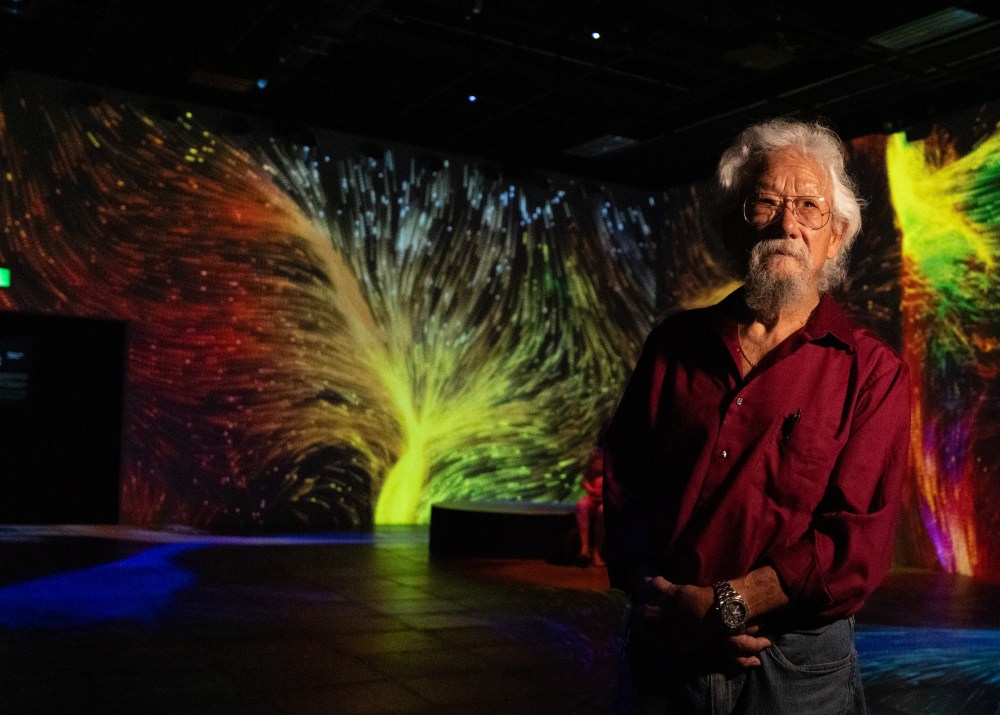
David Suzuki is pictured during an interview with The Canadian Press, in Montreal, Thursday, Sept. 19, 2024. The David Suzuki Foundation collaborated with a new immersive exhibit, called Root for Nature. THE CANADIAN PRESS/Christinne Muschi

“The measure of a person is not whether they succeeded — because we’ve lost, environmentalists have lost, big time — but that we tried.”

That failure can be quantified in two ways, he said: first, in the markers we’ve missed; the goals we’ve overshot.

The scientists warned, for example, that we couldn’t let temperatures rise 1.5 degrees above pre-industrial levels before 2100 — a threshold that passed last year.

“We won’t be able to go back and we have no idea what lies ahead,” he said.

But the failure can also be seen in how little we prioritize the environment, he said — which is tough to see, because he’s devoted his life to encouraging people to care more.

His new book, out now, borrows much of the text from “David Suzuki: The Autobiography,” published in 2006. It details his time as a geneticist studying fruit flies, how he parlayed his career as a professor into one as a science broadcaster on CBC, and the decades of environmental activism that took him all over the world.

“Lessons from a Lifetime” is, in some ways, a record of Suzuki’s legacy. In others, he said, the testimonials it contains make it feel like a premature memorial.

“With funerals, people give all these speeches about how nice the person was, but the guy’s dead,” he said, chuckling.

“I always said I’d like to have my funeral before I die. And in a way, the book is kind of like a funeral.”

In the book, his eldest daughter Tamiko Suzuki recalled how her father took her on tours of a nearby swamp as a kid; financier and Suzuki Foundation board member Stephen Bronfman said he sees the activist as a brother in the fight for Mother Earth; author Margaret Atwood called him “timeless.”

Former prime minister Justin Trudeau called Suzuki “a teacher, an inspiration, and a friend but also a critic, an antagonist, and a royal pain in the ass,” and actress-activist Jane Fonda recalled meeting him in the ’80s and “being struck by his handsome face, the lively twinkle in his eyes, and his strong body. (He was wearing shorts.)”

Though the book details Suzuki’s many victories, he said he feels governments have not taken his key message to heart.

“People forget that the word economics comes from the same word as ecology. Ecos is our household, our domain, where we live,” he said.

“Ecology is the study of our home. Economics is the management of our homes.”

Why, then, Suzuki asked, do world leaders consider short-term finances before the planet’s long-term fate?

“You would think that our economic system, our political system, our legal systems would all be based on that understanding that air, water, the soil that gives us our food, the plants that capture sunlight, the energy in sunlight, those are what keep us alive and healthy,” he said.

While he is still pushing for governments and corporations to change their priorities, the goal is no longer the prevention of climate catastrophe.

“I am saying: Look, the science is in. We’ve passed all of these tipping points and there’s nothing we can do about it,” he said. “We’re going into unknown territory, but at least we can try to minimize the effect of what’s coming.”

Part of that, he said, can be done by encouraging people to connect with one another.

Over the last several weeks, he and his wife Tara Cullis — cofounder of the David Suzuki Foundation — have embarked on a 16-date tour with their theatre production “What You Won’t Do For Love,” which sees the couple reflect on their 50-year partnership.

“Together, Tara and I showed what two people in love with each other and with the Earth can do,” Suzuki said.

Part of what he loves about the production is how it brings people together into one space, facilitating connections.

That, he said, is where individuals can make a difference when disasters strike.

“Who are the people on your block?” he said. “Are there people that can’t walk and they’re gonna need help? Do you know how to operate a chainsaw? Are you a pipe fitter that can get access to water? Does someone have a generator?”

If people forge relationships in times of relative calm, he said the crises will be much easier to manage.

To that end, the day after each performance, he held gatherings where community members who work in different fields — some in housing, others in public health, for example — could meet and talk.

“I think people will find it a joyous activity. It’s all there within the community,” he said.

This report by The Canadian Press was first published March 17, 2026.
Report Error Submit a Tip

More Stories

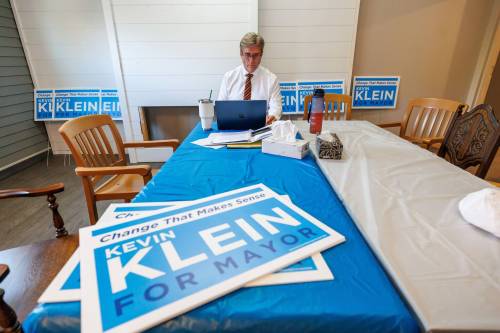
A Rocky day on the mayoral campaign trail for Kevin Klein

Malak Abas 12 minute read Preview

A Rocky day on the mayoral campaign trail for Kevin Klein

Malak Abas 12 minute read Friday, Oct. 9, 2026

Kevin Klein acknowledges it’s hard to foresee what he’ll wake up to each morning in the final weeks of a mayoral campaign.

But the seasoned politician, who has served as both a city councillor and a provincial cabinet minister, couldn’t have predicted the events — what he describes as “drama” — that unfolded last Sunday.

Fellow mayoral candidate Mike Vogiatzakis accused Klein’s campaign team of offering him a job to drop out of the race, while a guest writer’s column in the Winnipeg Sun that questioned the deaths of Indigenous children at residential schools, just days after the National Day for Truth and Reconciliation, sparked condemnation from a prominent Indigenous organization. (Klein is the CEO of the Klein Group, the company that owns the Sun. He has maintained he is not involved in its operations while running for mayor.)

The Free Press had already been scheduled to join Klein on the campaign trail Monday, intending to document a day in the life of the front-running candidate to unseat incumbent Scott Gillingham, before the controversies hit.

Read
Friday, Oct. 9, 2026

Chopped trees will leave a ‘blight’ on Windsor Park

Kelly-Anne Riess 3 minute read Preview

Chopped trees will leave a ‘blight’ on Windsor Park

Kelly-Anne Riess 3 minute read Friday, Oct. 9, 2026

Robert Gordon has watched the trees grow along a popular Windsor Park walking path for nearly six decades.

Now, as Manitoba Hydro cuts them down to protect nearby power lines, he says a familiar part of his childhood neighbourhood is disappearing.

Although he no longer lives in the area, Gordon regularly returns to walk or cycle along the tree-lined path, which runs parallel to Archibald Street.

He was concerned when he recently spotted crews clearing vegetation near the entrance to the path, but initially assumed they were removing brush. When he returned, he discovered the clearing had extended farther along the corridor.

Read
Friday, Oct. 9, 2026

Puppies, stocks — ‘zoomies’ abound

Andrew Froese 4 minute read Yesterday at 2:01 AM CDT

This spring, I adopted a three-month-old rescued German Shepherd mix. To say she is easily excitable is an understatement.

It is not really her fault. A puppy’s frontal cortex, the part of the brain that helps with decision-making and impulse control, is still developing. When an older dog, or a human, gets tired, we generally understand we should rest. Puppies have not quite figured that out. They often interpret tiredness as a signal something is wrong, which makes them more alert, more reactive and harder to settle.

That creates a feedback loop. The puppy gets tired, which makes her frantic, which makes her more tired, which makes her even more frantic. Eventually, this becomes what people call the “zoomies”: frantic sprinting, biting, jumping and general chaos.

From the outside, it looks like the puppy has too much energy. In reality, the opposite is true. The zoomies are not a sign of excess energy. They are a sign the puppy is overtired and does not know it yet.

Landlords will face fines for breaching confidentiality

Carol Sanders 4 minute read Preview

Landlords will face fines for breaching confidentiality

Carol Sanders 4 minute read Friday, Oct. 9, 2026

The province is amending legislation to allow landlords to be penalized if they breach the confidentiality of tenants who break their lease by obtaining a domestic violence certificate.

“Hopefully, now there’s going to be measures in place so that if this happens again, and God forbid it happens again to anyone else, that there would be penalties imposed on landlords who do that,” said one victim whose concerns were published on the front page of the Free Press last month.

Under current legislation, landlords must ensure that any information received from those tenants regarding the termination of the tenancy is kept confidential, but there are no penalties for landlords who violate that section of the act. After hearing from victims put at risk when landlords broke the law by violating their confidentiality, the government announced Monday that it is amending the Residential Tenancies Act to allow for penalties.

The young woman who spoke to the Free Press showed that her landlord copied her alleged abuser in email correspondence that included her personal email address and the domestic violence certificate she obtained in 2025 to end a tenancy agreement early and leave an abusive relationship.

Read
Friday, Oct. 9, 2026

Phoneless concert a beautiful chance to bask in moment

Jen Zoratti 5 minute read Preview

Phoneless concert a beautiful chance to bask in moment

Jen Zoratti 5 minute read Yesterday at 2:01 AM CDT

Outside the Scotiabank Arena in Toronto, digital billboards flashed fans their singular photo op for the night: “I took this photo before I saw Phoebe Bridgers: The Lost Tour 2026.”

It is, as it is for so many other people, my only documentation of a concert by one of my favourite artists. The American singer-songwriter — who I discovered at the Winnipeg Folk Festival in 2018 — has had a meteoric rise in the past few years, winning three Grammys in 2024 as one third of Boygenius, the indie-rock supergroup rounded out by Lucy Dacus and Julien Baker, and opening for Taylor Swift on select dates of her titanic Eras Tour.

Now, Bridgers is touring in support of Lost Weekend, her third album and first since 2020’s Punisher. It’s a feat of a record, a richly textured meditation on loss and grief, written in the aftermath of the death of her dad, with whom she had a complicated relationship.

So she is in a position to not only play multiple sold-out arena shows, but also insist that those shows be phone-free.

Read
Yesterday at 2:01 AM CDT

Person killed in workplace accident at Fairmont construction site

Morgan Modjeski 3 minute read Preview

Person killed in workplace accident at Fairmont construction site

Morgan Modjeski 3 minute read Friday, Oct. 9, 2026

Emergency responders were on scene and Manitoba Workplace Safety and Health is investigating after a worker died following an incident at a Winnipeg construction site Thursday.

Little information about the worker killed was provided, but the fatal incident happened at the Fairmont Winnipeg, located at 2 Lombard Place, with police responding around 5 p.m.

The hotel is currently closed and is an active construction site. The person killed has not been identified by name.

Information from a provincial spokesperson said the deceased was working for Kepsco Construction when they were fatally injured after a “portion of an overhead canopy collapsed during asbestos abatement work.”

Read
Friday, Oct. 9, 2026