

Highlights from Quebec budget for 2026-27 fiscal year
Advertisement
Read this article for free:
or
Already have an account? Log in here »
To continue reading, please subscribe:

Digital Subscription
One year of digital access for only $205*
- Enjoy unlimited reading on winnipegfreepress.com
- Read the E-Edition, our digital replica newspaper
- Access News Break, our award-winning app
- Play interactive puzzles
*First annual payment billed as $205.00 + GST for one year. This annual subscription will automatically renew at $233.00 + GST every 52 weeks (10% off the regular annual price of $259.35). Offer available to new and qualified returning subscribers only. Cancel any time.
To continue reading, please subscribe:
Add Free Press access to your Brandon Sun subscription for only an additional
$1 for the first 4 weeks*
- Enjoy unlimited reading on winnipegfreepress.com
- Read the E-Edition, our digital replica newspaper
- Access News Break, our award-winning app
- Play interactive puzzles
*Your next Brandon Sun subscription payment will increase by $1.00 and you will be charged $17.95 plus GST for four weeks. After four weeks, your payment will increase to $24.95 plus GST every four weeks.
Read unlimited articles for free today:
or
Already have an account? Log in here »
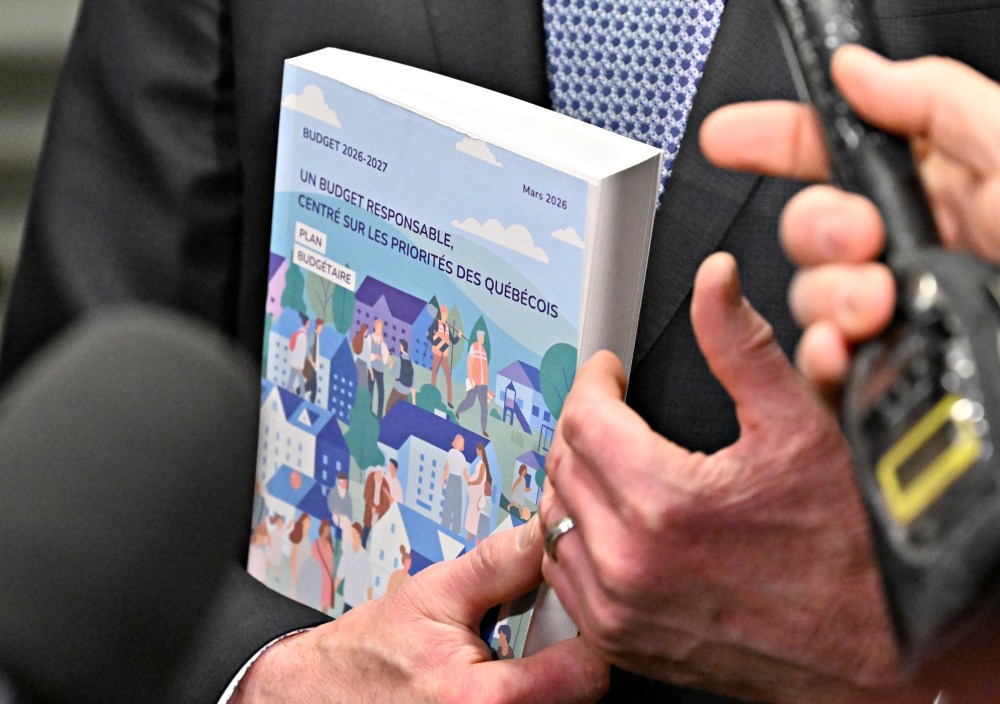
QUÉBEC – Quebec Finance Minister Eric Girard tabled his eighth and what will likely be his final budget ahead of the October general election. Here are some highlights from Quebec’s budget for the 2026-27 fiscal year.
— Revenues of $166.5 billion, a rise of 3.7 per cent.
— Operational deficit of $6.3 billion, which rises to $8.6 billion when legally required payments into a debt-repayment fund are included. That number also includes a $2-billion contingency fund.
— GDP grew by 0.8 per cent in 2025, and is expected to grow by 1.1 per cent in 2026 and 1.4 per cent in 2027.
— Inflation in Quebec expected to be 2.3 per cent in 2026, slightly higher than the 2.1 Canadian average.
— Health-care spending $68.7 billion, a rise of 4.1 per cent.
— Education spending $24.1 billion, a rise of 2.4 per cent; higher education $11.7 billion, a rise of 3.7 per cent.
— Debt service forecast to be $10.3 billion.
— A special $250-million fund that can be used at the discretion of the winner of the leadership race of the governing Coalition Avenir Québec. The winning candidate will replace François Legault as premier ahead of a general election campaign in the fall.
— Quebec’s share of federal equalization is $13.9 billion, a rise of 2.5 per cent.
— On March 31, 2026, Quebec’s net debt will be $250.3 billion, or 38.8 per cent of GDP, second only to Newfoundland and Labrador among the provinces.
— $1 billion into a new fund to support the critical and strategic mineral sector.

— $104.5 million over five years to eliminate one of the royalties paid to the government by the forestry sector.
— $40.2 million over five years for refundable tax credits for Quebec news media, which expands beyond print media and will now cover television, radio and news agencies.
— Quebec’s exports outside Canada fell by 2.9 per cent in 2025 compared to Canadian average drop of 1.7 per cent.
— The 2025-26 fiscal year will end with a $7.7-billion deficit, which is an improvement of almost $3.8 billion from the original estimate. This excludes the legally required payment into a fund to pay down the debt.
This report by The Canadian Press was first published March 18, 2026.