

Federal judge grants injunction allowing clergy visits at Minneapolis ICE holding facility
Advertisement
Read this article for free:
or
Already have an account? Log in here »
To continue reading, please subscribe:
Monthly Digital Subscription
$1 per week for 24 weeks*
- Enjoy unlimited reading on winnipegfreepress.com
- Read the E-Edition, our digital replica newspaper
- Access News Break, our award-winning app
- Play interactive puzzles
*Billed as $4.00 plus GST every four weeks. After 24 weeks, price increases to the regular rate of $19.95 plus GST every four weeks. Offer available to new and qualified returning subscribers only. Cancel any time.
Monthly Digital Subscription
$4.99/week*
- Enjoy unlimited reading on winnipegfreepress.com
- Read the E-Edition, our digital replica newspaper
- Access News Break, our award-winning app
- Play interactive puzzles
*Billed as $19.95 plus GST every four weeks. Cancel any time.
To continue reading, please subscribe:
Add Free Press access to your Brandon Sun subscription for only an additional
$1 for the first 4 weeks*
*Your next subscription payment will increase by $1.00 and you will be charged $16.99 plus GST for four weeks. After four weeks, your payment will increase to $23.99 plus GST every four weeks.
Read unlimited articles for free today:
or
Already have an account? Log in here »
ST. PAUL, Minn. (AP) — Clergy will be allowed to minister to immigrants in a holding facility at the headquarters of the Trump administration’s enforcement surge in Minnesota, a federal judge ruled Friday.
U.S. District Judge Jerry Blackwell granted an injunction requested by Minnesota branches of the Evangelical Lutheran Church in America, the United Church of Christ, and a Catholic priest who had sued the Department of Homeland Security.
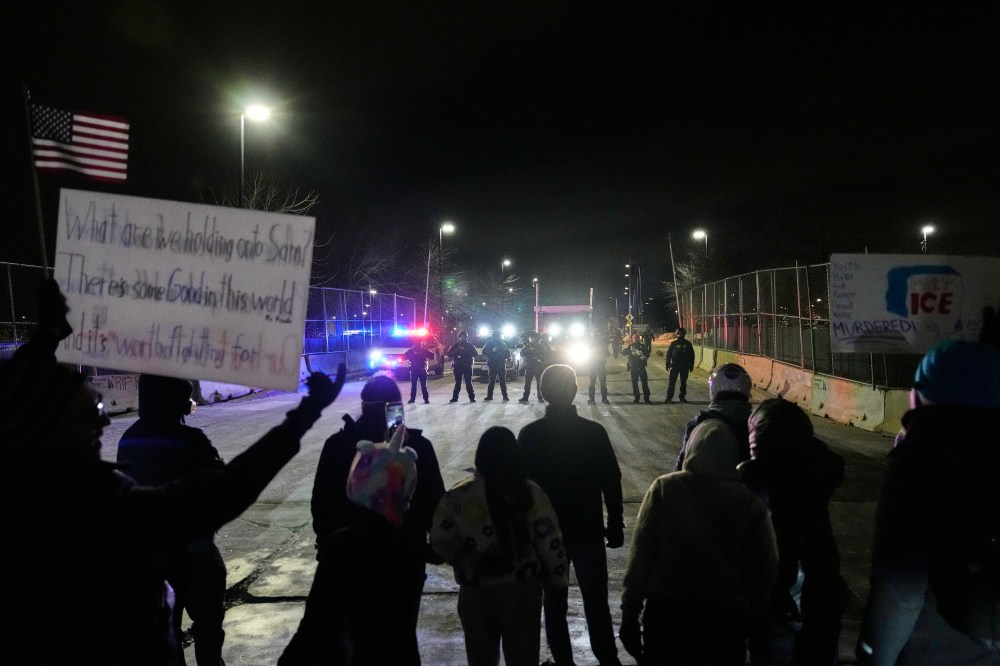
Under his ruling, clergy will be allowed in-person pastoral visits to all detainees at the Bishop Henry Whipple Federal Building in Minneapolis, the site of frequent protests over roughly the 3,000 federal officers who had surged into the state at the height of the crackdown.
Blackwell said the plaintiffs had met their burden of proving that they’re likely to succeed when the case reaches a final conclusion, and that restrictions on the religious freedom of clergy to minister to detainees constitutes “irreparable harm.”
He ordered both sides to meet within four business days to try to agree on details for how to provide access that takes into account the government’s legitimate security concerns, and then submit a plan within seven business days, or competing proposals if they can’t agree.
Bishop Jennifer Nagel, of the Minneapolis Synod of the Evangelical Lutheran Church in America, was turned away from Whipple when she tried to go to visit with detainees on Ash Wednesday. She told reporters after the hearing that serving people in crisis is fundamental in many religions.
“The trauma that families are going through, and individuals are going through, at these times is exorbitant. And so to be able to meet people in those needs, that’s very much at the core, the heart and soul of what we do as ministers of all different traditions,” Nagel said.
The lawsuit alleges the Whipple building, named for Minnesota’s first Episcopal bishop, a 19th-century advocate for human rights, “now stands in stark contrast to its namesake’s legacy.” It says the building has “become the epicenter of systematic deprivation of fundamental constitutional and legal rights by the federal government.”
Government attorneys noted that Operation Metro Surge officially ended on Feb. 12. They also said the number of new detentions has since subsided, so temporary restrictions on visitors have been eased, and clergy visits have been allowed for over two weeks.
But Blackwell agreed with attorneys for the plaintiffs who argued that the issue isn’t moot, because the government still doesn’t have a formal plan requiring access that sets out who decides the conditions under which clergy are admitted.
Catholic and Episcopal bishops in Minnesota, other Christian and Jewish clergy, and the Minnesota Council of Churches also formally supported the request. The courtroom was filled with Lutheran, United Church of Christ, Unitarian Universalist, Jewish and other clergy.
Clergy across the country have been pushing for more access to immigration detention facilities, especially during the holy seasons of Lent and Ramadan. It’s a longstanding practice for faith leaders to minister to detainees. but it has become far more contentious amid the current immigration crackdown.


It took a similar lawsuit for two Catholic priests and a nun to gain entry into an ICE facility in the Chicago suburb of Broadview on Ash Wednesday last month. And Muslim and Christian clergy in Texas have struggled to get into large Immigration and Customs Enforcement detention facilities there.
Tauria Rich, a senior local ICE official who oversees Whipple, said in a filing this week that visitors to Whipple are rare, and that any clergy requests are handled on a case-by-case basis. She said one clergy member had attempted to visit in early March, but left because no detainees were present. The visit would have been allowed if any detainees had been there, she said.
ICE calls the building a short-term holding facility, and not the kind of long-term detention center where clergy visits are normally allowed.
It’s not just clergy who’ve struggled to get in. Three members of Congress from Minnesota were turned away when they tried to inspect the facility. Once they did get in, they reported poor conditions.
Access has also been an issue for attorneys. Homeland Security was ordered by a different federal judge last month to give new detainees at Whipple immediate access to counsel before they’re taken elsewhere. That judge held a hearing this week to consider whether to convert her temporary order into a more permanent injunction. Her ruling is pending.
The Free Press acknowledges the financial support it receives from members of the city’s faith community, which makes our coverage of religion possible.