True North, strong and… Trump? More than 20 per cent of Manitobans think the U.S. could invade Canada in the next two years, poll conducted for the Free Press reveals
Read this article for free:
or
Already have an account? Log in here »
To continue reading, please subscribe:

Digital Subscription
One year of digital access for only $205*
- Enjoy unlimited reading on winnipegfreepress.com
- Read the E-Edition, our digital replica newspaper
- Access News Break, our award-winning app
- Play interactive puzzles
*First annual payment billed as $205.00 + GST for one year. This annual subscription will automatically renew at $233.00 + GST every 52 weeks (10% off the regular annual price of $259.35). Offer available to new and qualified returning subscribers only. Cancel any time.
To continue reading, please subscribe:
Add Free Press access to your Brandon Sun subscription for only an additional
$1 for the first 4 weeks*
- Enjoy unlimited reading on winnipegfreepress.com
- Read the E-Edition, our digital replica newspaper
- Access News Break, our award-winning app
- Play interactive puzzles
*Your next Brandon Sun subscription payment will increase by $1.00 and you will be charged $17.95 plus GST for four weeks. After four weeks, your payment will increase to $24.95 plus GST every four weeks.
Read unlimited articles for free today:
or
Already have an account? Log in here »
It has been more than two centuries since American troops crossed the international border in 1812 and invaded what was then the British colony of Canada — but that feeling of everlasting peace is fading.
Against the backdrop of the U.S. war with Iran, its forced removal of Venezuela’s president and President Donald Trump’s musing about annexing Greenland and making Canada the 51st state, some Manitobans are beginning to fear the spectre of armed conflict between this country and its neighbour to the south.
More than one out of five Manitobans believe an American invasion of Canada is possible in the next two years, according to a new Probe Research poll commissioned by the Free Press. Of those, 18 per cent of respondents said the prospect was somewhat likely, and four per cent felt it was very likely.

“The idea of the U.S. invading, for a long time, seemed preposterous. This certainly isn’t a question that we would’ve expected to ask people even a couple of years ago, but we wanted to understand with all of the things that have been happening in the last few months… if this is something that people think is a possibility,” said Curtis Brown, principal of Probe Research.
“Most people are skeptical, but a pretty significant share of the population certainly envisions that this could happen in relatively short order.”
Despite the growing anxiety, military experts say the notion of an invasion is far-fetched.
MIKE DEAL / FREE PRESS University of Manitoba Professor and Director of the Centre for Defence and Security Studies, Andrea Charron, is an expert on NORAD.
Andrea Charron, the director of the University of Manitoba’s Centre for Defence and Security Studies, described the idea as “alarmist” and urged the public to consider the many economic, military, familial and political connections between the allied countries.
“We are essential to the defence of the U.S., and vice-versa,” she said. “Despite the fact that Donald Trump is very mercurial, I don’t think his generals would see any merit or basis for an attack on Canada.”
Charron said she understands where the fear is coming from, noting Trump is “a very problematic president who tends to talk first and think later.” His unpredictability has left many people uncertain of how far he is willing to take his vision of American expansionism, she said.
Still, she cautioned the public against reading too far into the polling results, and to instead focus on the alliance that has tied Canada and the U.S. together for much of their respective histories.
“Polls can be helpful indicators, but they shouldn’t be taken as the end-all and be-all… They can also skew what’s actually going on,” she said. “When we have this sort of polarized view of our allies, this is exactly what our adversaries want.”
Winnipeg is home to the operational headquarters for the Royal Canadian Air Force and the North American Aerospace Defense Command, the latter of which is jointly staffed by U.S. and Canadian forces. Its commander is accountable to the governments of both countries and would likely be especially opposed to an attack, Charron said.
Peter Denton, an adjunct associate professor of history at the Royal Military College of Canada, agreed.
“We already have an American presence here, at the NORAD headquarters, and Canada is a buffer between the main population centres of the U.S. and Russia, in particular,” Denton said.
“Unless Canada were to elect a government hostile to the U.S., or be actively colluding with another power to bring armed forces to the American border, both of which are extremely improbable, there is no likelihood of an invasion by the American military — in two years or in 20.”
A more likely concern, although still improbable, he said, would involve a fracturing of the U.S. republic. In such a scenario, armed groups near the border could conduct raids against Canada for resources or to seize land, as happened back in 1837 when American militias accompanied Canadian rebels in an effort to liberate the colony from British rule.
THE BATTLE OF NEW ORLEANS / E. PERCY MORAN. UNITED STATES, CA. 1910. Retrieved from the Library of Congress, this illustration depicts the last major confrontation of the War of 1812, the Battle of New Orleans.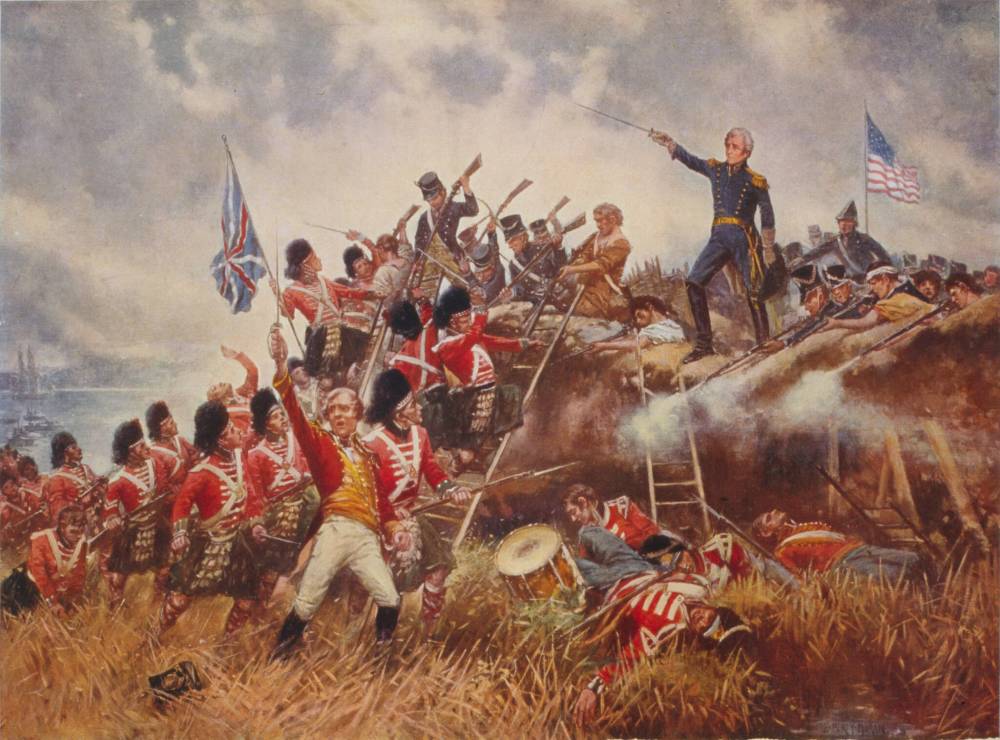
Overall, Manitoba is not a particularly appealing military target, he added.
“We have pretty much the same resource base as the bordering northern states, and colder weather.”
The poll found 87 per cent of Manitobans remain opposed to the idea of Canada becoming part of the U.S., which could be achieved willingly or through annexation. That number has remained unchanged since previous polling in March 2025.
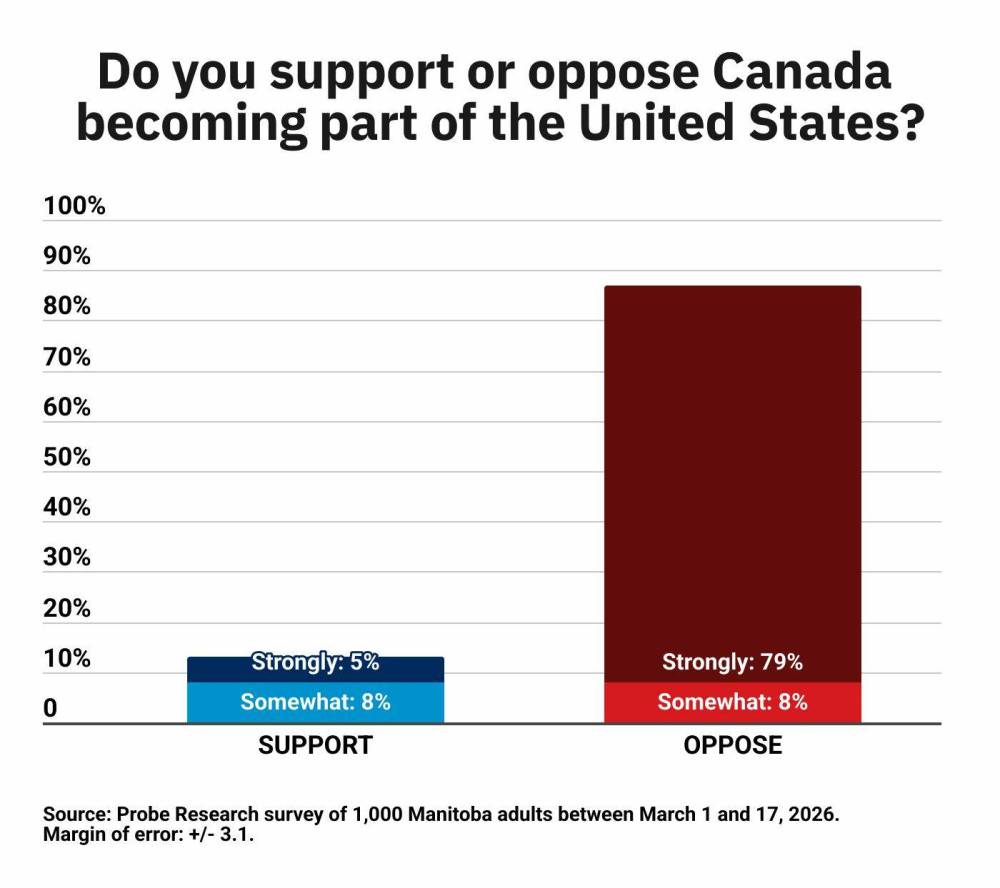
“By and large, the vast majority of people think that’s a bad idea,” Brown said. “But yet, at the same time, one of the things I’m thinking about and fascinated by is how there is such a partisan difference about this.”
According to the survey, willingness to join the U.S. is higher among people who support the federal Conservative party. Of the 13 per cent of respondents in favour of the idea, 27 per cent identified as Conservatives, compared to just three per cent who identified as Liberals.
Conservatives were also less likely to support the idea of Canada forming military alliances elsewhere in the world. While 71 per cent of respondents agreed Canada must form such relationships to protect itself from the U.S., just 48 per cent of them were Tories.

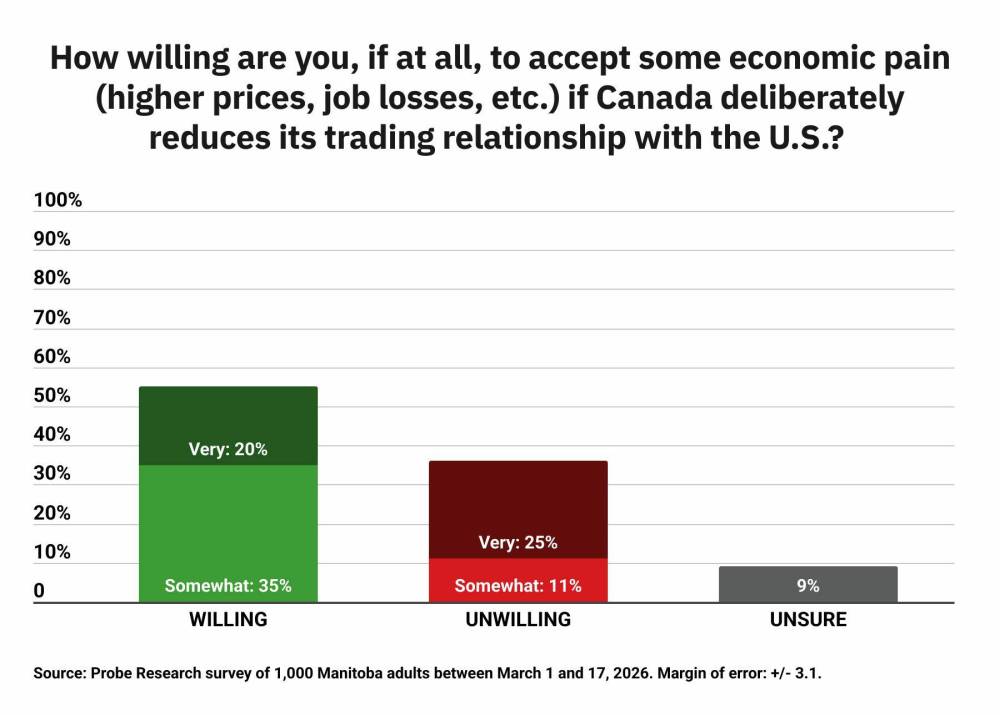
The partisan split extended to questions surrounding the economy. While 55 per cent of respondents said they are willing to endure higher prices, job losses and other fallout if Canada deliberately reduces its trading relationship with the U.S., only 32 per cent of them were Conservatives.
Blue-collar workers and people in the service industry are least willing to deal with negative economic outcomes, at just 45 per cent and 41 per cent, respectively. Meanwhile, 61 per cent of white-collar workers said they would accept some economic pain.
Despite the differences among political affiliations, 84 per cent of respondents supported the idea of Canada making major investments in its military.
Nearly all demographics — including both men and women, people older than 35, Winnipeg and rural Manitoba residents, Conservatives and Liberals — were united in the belief that Canada must shore up its military capability.
Charron said that comes as no surprise.
“It’s been a long time coming, and it’s essential that we have that public backing,” she said. The world is a more contested place, there are more adversaries. It’s really important that Canada be able to defend itself.”
The survey collected responses from Manitobans between March 1 and March 17. With a sample size of 1,000, one can say with 95 per cent certainty the results are within three percentage points of what they would be if the entire adult population of Manitoba were surveyed, Probe said.
tyler.searle@freepress.mb.ca


Tyler Searle is a multimedia producer who writes for the Free Press’s city desk. A graduate of Red River College Polytechnic’s creative communications program, he wrote for the Stonewall Teulon Tribune, Selkirk Record and Express Weekly News before joining the paper in 2022. Read more about Tyler.
Every piece of reporting Tyler produces is reviewed by an editing team before it is posted online or published in print — part of the Free Press‘s tradition, since 1872, of producing reliable independent journalism. Read more about Free Press’s history and mandate, and learn how our newsroom operates.
Our newsroom depends on a growing audience of readers to power our journalism. If you are not a paid reader, please consider becoming a subscriber.
Our newsroom depends on its audience of readers to power our journalism. Thank you for your support.