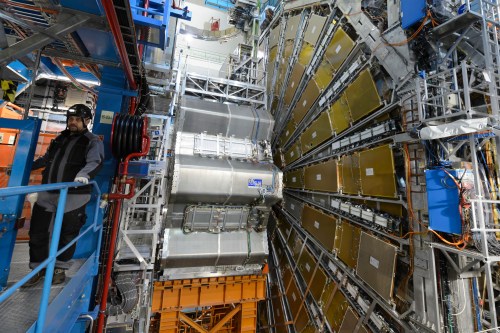
Geneva’s CERN hails delicate test on transporting antimatter as a scientific success
Advertisement
Read this article for free:
or
Already have an account? Log in here »
To continue reading, please subscribe:

Digital Subscription
One year of digital access for only $205*
- Enjoy unlimited reading on winnipegfreepress.com
- Read the E-Edition, our digital replica newspaper
- Access News Break, our award-winning app
- Play interactive puzzles
*First annual payment billed as $205.00 + GST for one year. This annual subscription will automatically renew at $233.00 + GST every 52 weeks (10% off the regular annual price of $259.35). Offer available to new and qualified returning subscribers only. Cancel any time.
To continue reading, please subscribe:
Add Free Press access to your Brandon Sun subscription for only an additional
$1 for the first 4 weeks*
- Enjoy unlimited reading on winnipegfreepress.com
- Read the E-Edition, our digital replica newspaper
- Access News Break, our award-winning app
- Play interactive puzzles
*Your next Brandon Sun subscription payment will increase by $1.00 and you will be charged $17.95 plus GST for four weeks. After four weeks, your payment will increase to $24.95 plus GST every four weeks.
Read unlimited articles for free today:
or
Already have an account? Log in here »
GENEVA (AP) — Scientists in Geneva took some antiprotons out for a spin — a very delicate one — in a truck, in a never-tried-before test drive that has been deemed a success.
If this so-called antimatter had come into contact with actual matter, even for a fraction of an instant, it would have been annihilated in a quick flash of energy. So experts at the European Organization for Nuclear Research, known as CERN, had to be extra careful when they took 92 antiprotons on the road for a short ride on Tuesday.
The antiprotons were suspended in a vacuum inside a specially designed box and held in place by supercooled magnets.
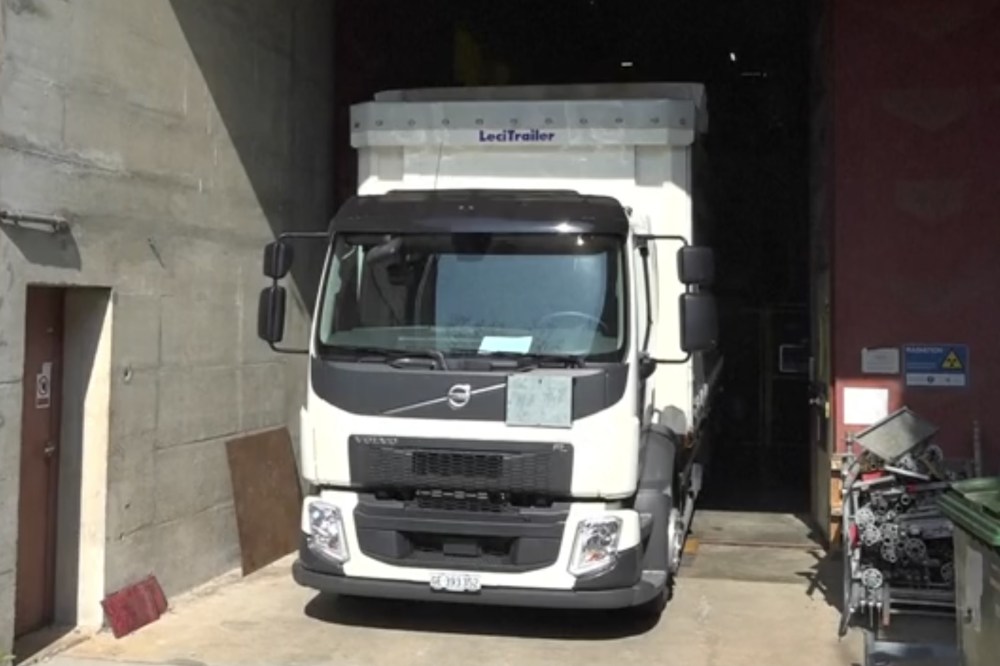
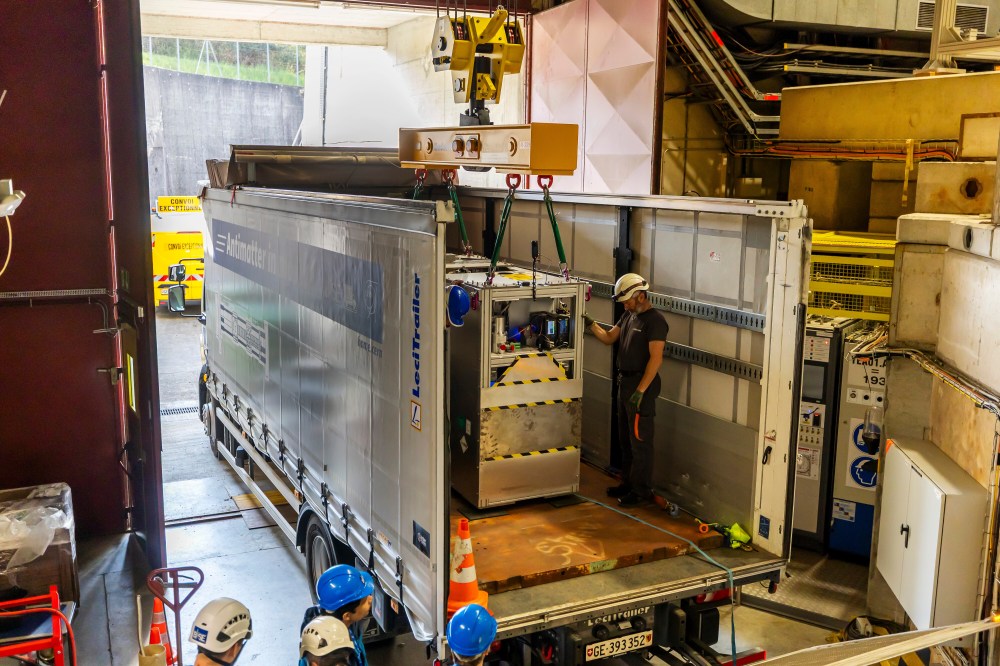
In methodical exercise over about three hours, the nearly 1,000-kilogram (2,200-pound) cryogenic box was craned up slowly and moved through a cavernous lab the onto the truck.
The drive on CERN’s campus itself lasted only about a half-hour to test how — if at all — the infinitesimal particles could be transported by road without seeping out.
The antiprotons were then placed back in their usual lab area, and the operation was concluded with applause, claims of success, and a bottle of Champagne.
“Transporting antimatter is a pioneering and ambitious project,” said Gautier Hamel de Monchenault, CERN’s director for research and computing. “We are at the beginning of an exciting scientific journey that will allow us to further deepen our understanding of antimatter.”
Taking the first step in a journey to Germany
Manipulating antimatter, like antiprotons, can be tricky business. As scientists understand the universe today, for every type of particle that exists, there is a corresponding antiparticle, exactly matching the particle but with an opposite charge.
If those opposites come into contact, they “annihilate” each other, setting off lots of energy, depending on the masses involved. Any bumps in the road on the test journey that aren’t compensated for by the specially-designed box could spoil the whole exercise.
“The motivation behind these experiments is to compare matter and antimatter with extremely high accuracy and watch for differences which we might have not seen yet,” said Stefan Ulmer, the leader and spokesperson for Tuesday’s test run.
The exercise was a first step toward making good on hopes, one day, to deliver CERN antiprotons to researchers abroad — such as at Heinrich Heine University in Düsseldorf, Germany, which is about eight hours away in normal driving conditions.
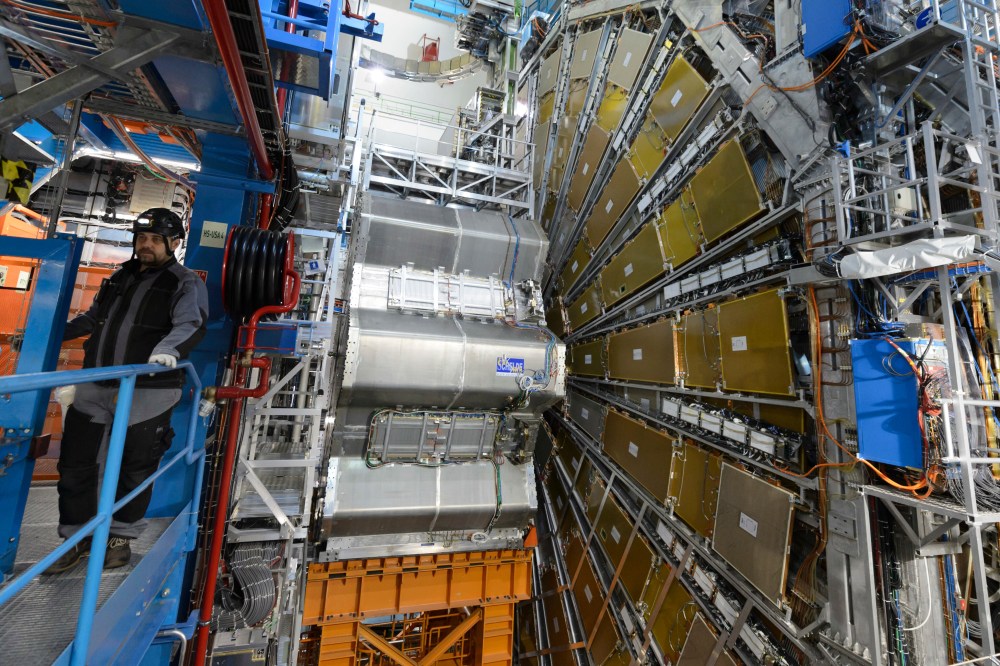
“We are scientists. We want to understand something about the fundamental symmetries of nature, and we know that if we do these experiments outside of this accelerator facility, we can measure 100 to 1,000 times better,” Ulmer said.
The antiprotons were encased in a “transportable antiproton trap” box that is compact enough to fit through ordinary laboratory doors and fit on a truck. It used superconducting magnets cooled to -269 degrees Celsius (-452 Fahrenheit) that allowed the antiprotons to be remain suspended in a vacuum — not touching the inner walls, which are made of … matter.
To put the amount into perspective:
The mass in Tuesday’s test — slightly less than that of about 100 hydrogen atoms — is so little, experts say, that the worst possible outcome was the loss of the antiprotons. Even if they did touch matter, any release of energy would be unnoticeable, only an oscilloscope, which picks up electrical signals, would be able to detect it.
To put the amount into perspective, Ulmer noted that a single grain of salt contains 10 to the 18th power — or a billion times a billion — of particles, and “we are transporting 100,” give or take.
The trap, said CERN press officer Sophie Tesauri, “is supposed to contain these antiprotons no matter what: If the truck stops, if it starts again, if it has to slam on the brakes — all that.” Work remains: The trap can contain the antiprotons on its own for only about four hours, and the drive to Düsseldorf is twice that.
The facts of the antimatter: Still being explored
Antimatter, says experimental particle physicist Tara Shears, is “one of the biggest mysteries that we have in science.” It is now rare, but when the universe was created, half of it was made of antimatter.
“We haven’t been able to study it very much,” said Shears, a professor at the University of Liverpool. “But it holds the keys to our understanding of what — literally — why the universe is like it is.”
Particle physicist Alan Barr said science has progressed enough that precise experiments are necessary to spot “rather subtle” differences between matter and antimatter.
“To do this, it’s useful to be able to take small amounts of antimatter from places where it is produced, like CERN, to other laboratories around Europe, where precise tests of it can be done,” said Barr, a professor at the University of Oxford.
CERN known for other successes
The Geneva-based center is best known for its Large Hadron Collider, a network of magnets that accelerates particles through a 27-kilometer (17-mile) underground tunnel and slams them together at velocities approaching the speed of light. Scientists then study the results of those collisions.
But the sprawling, buzzing complex of scientific experiment is more than just about smashing atoms together: The World Wide Web, for example, was invented here by Britain’s Tim Berners-Lee in 1989. Advances as varied as touch screens and tools to fight cancer have been worked on and developed at CERN.
Heinrich Heine University is seen as a better place to study antiprotons in-depth because CERN, with all its other activities, generates a lot of magnetic interference that can skew the study of antimatter.
The university is still working on a center that can take in such antiprotons, by 2029 at the earliest, Ulmer said.

CERN’s Antiproton Decelerator, where a proton beam gets fired into a block of metal, causes collisions that generate secondary particles, including lots of antiprotons. It’s billed as a unique machine that produces low-energy antiprotons for the study of antimatter.
The CERN “Antimatter Factory” is said to be the only place in the world where scientists can store and study antiprotons.
The center has been experimenting with antimatter for years, and has made breakthroughs on measurement, storage and interaction of antimatter. Two years ago, the team transported a “cloud” of about 70 protons — not antiprotons — across CERN’s campus.
___
AP video journalist Havovi Todd contributed from London.