

Move by Toronto police to ban protests in residential neighbourhood draws criticism
Advertisement
Read this article for free:
or
Already have an account? Log in here »
To continue reading, please subscribe:
Digital Subscription
One year of digital access for only $1.44 a week*
- Enjoy unlimited reading on winnipegfreepress.com
- Read the E-Edition, our digital replica newspaper
- Access News Break, our award-winning app
- Play interactive puzzles
*Billed as $5.77 plus GST every four weeks. After 52 weeks, price increases to the regular rate of $19.95 plus GST every four weeks. Offer available to new and qualified returning subscribers only. Cancel any time.
To continue reading, please subscribe:
Add Free Press access to your Brandon Sun subscription for only an additional
$1 for the first 4 weeks*
- Enjoy unlimited reading on winnipegfreepress.com
- Read the E-Edition, our digital replica newspaper
- Access News Break, our award-winning app
- Play interactive puzzles
*Your next Brandon Sun subscription payment will increase by $1.00 and you will be charged $17.95 plus GST for four weeks. After four weeks, your payment will increase to $24.95 plus GST every four weeks.
Read unlimited articles for free today:
or
Already have an account? Log in here »
TORONTO – Toronto police say their move to ban protests on residential streets of a predominantly Jewish neighbourhood in the city’s north end is a “reasonable limitation” to Charter-protected rights, amid criticism from civil liberties advocates.
Police said the decision was made in response to “increased volatility and heightened fear” in the area of Bathurst Street and Sheppard Avenue, where weekly pro-Palestinian demonstrations have been happening for more than two years.
Deputy Chief Frank Barredo said protesters can still gather along the main roads of Bathurst and Sheppard but will be arrested and charged with obstructing police if they disobey orders to stay away from residential streets in the area.
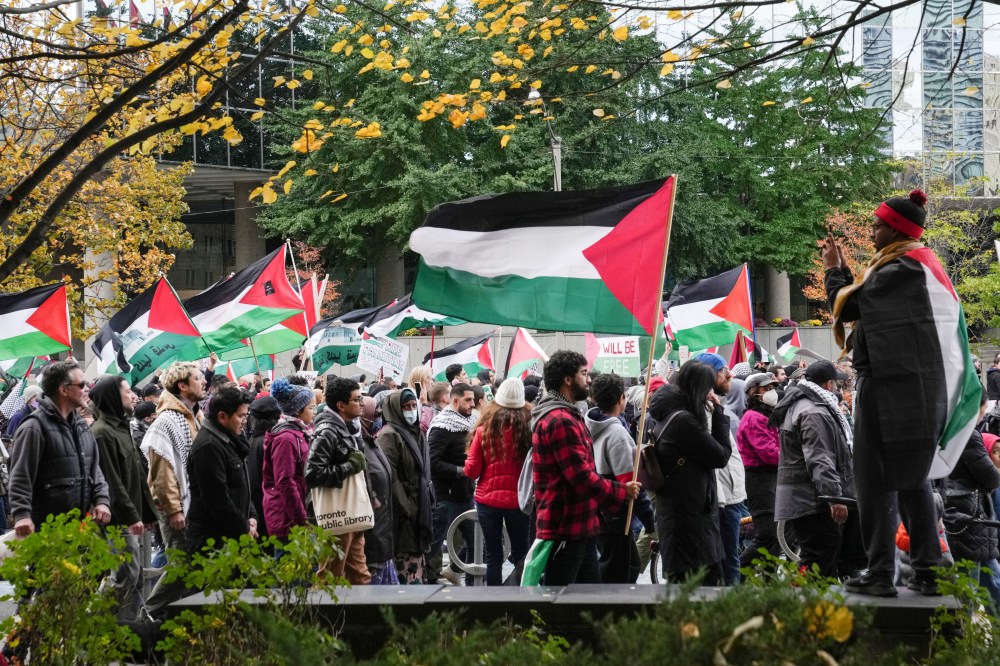
“The change is not so much about curtailing Charter rights any more than absolutely necessary,” Barredo said Tuesday.
“We understand (the Charter) allows for peaceful assembly, allows for expressions. So we take limitations on that very seriously,” he said, adding that police believe the Charter’s reasonable limits provision allows for localized restrictions on protests in this case.
But the Canadian Civil Liberties Association says banning pro-Palestinian protests from residential streets raises “serious concerns” about Charter violations.
Anaïs Bussières McNicoll, the association’s fundamental freedoms director, said in a statement Tuesday that police already have broad powers under the Criminal Code to protect people from harassment and intimidation, including at protests.
“What TPS is doing goes much further,” Bussières McNicoll said. “It creates protest-free zones on specific public streets, where any pro-Palestinian protester – regardless of how peacefully they express their message – can be arrested.
“This attack on freedom of expression and freedom of peaceful assembly is wrong.”
Speaking at an unrelated press conference about the launch of a new counterterrorism security unit and a task force to increase police visibility in Toronto, Barredo said the issue is “very localized to Bathurst and Shepherd.” At this time the residential area protest ban is “not necessarily a blanket direction” across the city, he said.
Police said there have been approximately 20 arrests in that area “specific to these protest groups,” and there is an ongoing investigation into antisemitic signs that were displayed at a protest last Sunday.
The new standalone counterterrorism unit police announced Tuesday will serve as a rapid response hub and work with the Royal Canadian Mounted Police and the Ontario Provincial Police to address terrorism threats, Chief Myron Demkiw said at the press conference.
Demkiw also said Task Force Guardian will deploy officers armed with tactical gear that includes patrol rifles, helmets and protective body armour to places of worship, tourist attractions and other locations in Toronto.
“If you see these officers … it does not mean there’s an imminent threat,” he said. “What it means is we are strategically positioning resources to protect our communities, and to be able to respond quickly if necessary.”
He said police need to take “proactive action” amid increasing geopolitical tensions and “polarization,” citing recent shootings at Toronto synagogues and the United States consulate.
This report by The Canadian Press was first published March 24, 2026.