Caspian owner’s son surprises inquiry with testimony about $4 million City’s beleagured police HQ project under microscope
Read this article for free:
or
Already have an account? Log in here »
To continue reading, please subscribe:

Digital Subscription
One year of digital access for only $205*
- Enjoy unlimited reading on winnipegfreepress.com
- Read the E-Edition, our digital replica newspaper
- Access News Break, our award-winning app
- Play interactive puzzles
*First annual payment billed as $205.00 + GST for one year. This annual subscription will automatically renew at $233.00 + GST every 52 weeks (10% off the regular annual price of $259.35). Offer available to new and qualified returning subscribers only. Cancel any time.
To continue reading, please subscribe:
Add Free Press access to your Brandon Sun subscription for only an additional
$1 for the first 4 weeks*
- Enjoy unlimited reading on winnipegfreepress.com
- Read the E-Edition, our digital replica newspaper
- Access News Break, our award-winning app
- Play interactive puzzles
*Your next Brandon Sun subscription payment will increase by $1.00 and you will be charged $17.95 plus GST for four weeks. After four weeks, your payment will increase to $24.95 plus GST every four weeks.
Read unlimited articles for free today:
or
Already have an account? Log in here »
Former mayor Sam Katz and the city’s former top bureaucrat requested $4 million in relation to the police headquarters, the main construction company’s son told the provincial inquiry into the project Thursday.
Shaun Babakhanians, a former project manager for Caspian Projects, was asked about a time his father Armik met with him shortly after speaking with former city chief administrative officer Phil Sheegl, then the deputy CAO, on Feb. 17, 2011.
On that date, Armik Babakhanians sent himself an email stating he expected Sheegl to get approval for the project, the inquiry previously heard.
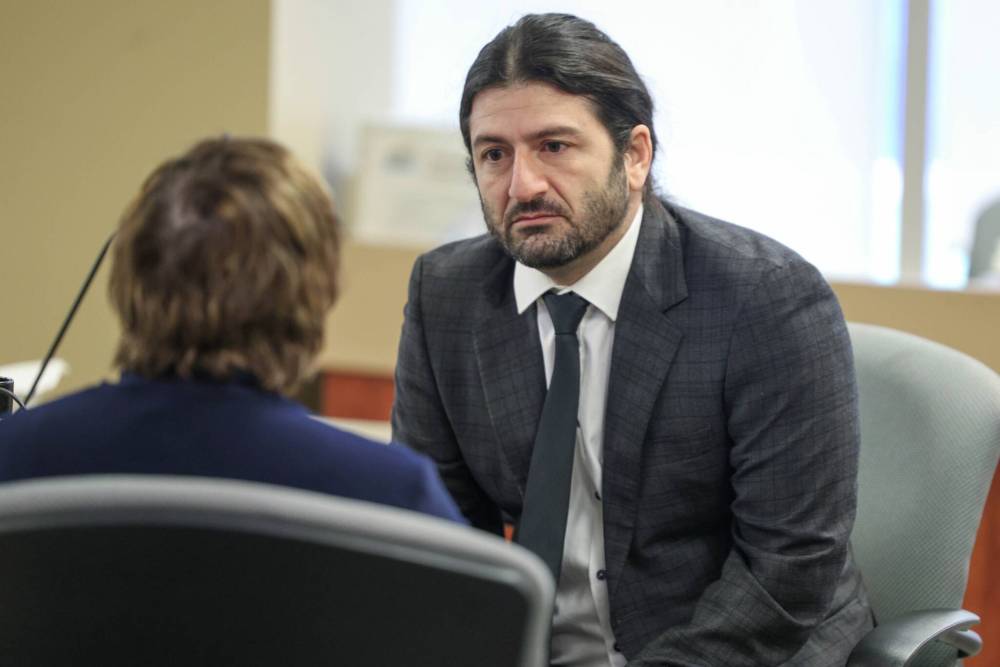
Ruth Bonneville / Free Press
Former Caspian Projects project manager Shaun Babakhanians testifies at the Winnipeg Police Service Headquarters Inquiry, Thursday.
“However, I think he wanted 2+2 for (former mayor) sam (Katz) and phil but the rest for us,” the email states.
It also notes “This will remain confidential for ever.”
On Thursday, Heather Leonoff, the legal counsel for the inquiry, asked Shaun Babakhanians about a conversation he had with his father the same day.
“He came to my house and told me that Sam and Phil wanted $4 million and I said no and he left,” answered Babakhanians.
“And did you ever hear anything more about this over the period of time the contract went on?” asked Leonoff.
“No, ma’am,” he answered.

Shortly after the statement, lawyer Evan Roitenberg, who is representing Sheegl at the inquiry, arrived at the hearing room and asked to cross-examine the witness.
Roitenberg noted Armik Babakhanians did not specify the word “millions” in the “2+2” part of the email and noted the company owner had testified he was not certain what was meant by “two and two.”
Under questioning, Shaun Babakhanians confirmed he made no notes of the conversation with his father, could not recall his exact words and was not part of the earlier conversation with Sheegl. He said he remembers the gist of the conversation with his father, though he clarified that his own response at the time included “f—k no,” and noted he did not want to swear at the inquiry.
“If, in fact, what had been sought had been money, and I’m certainly not suggesting that that’s what was being talked about… nothing about money had ever come up again to your knowledge?” asked Roitenberg.
“This will remain confidential for ever.”
“No mention of money ever came up again,” said Shaun Babakhanians, also noting no one ever approached him to ask for money.
Armik Babakhanians, Sheegl and former mayor Sam Katz all previously testified at the inquiry that no bribe took place in relation to the Winnipeg Police Services downtown headquarters project.
Sheegl testified he made no such request and Katz said he was not even aware of the conversation the email followed.
Danny Gunn, the lawyer representing Katz at the inquiry, declined comment Thursday.
Problems related to the headquarters at 245 Smith St. triggered multiple legal battles since it was completed in 2016. First expected to cost $135 million, the price soared to $214 million, including late flood damage and security upgrades.
In 2022, a court ruled Sheegl had accepted a $327,000 bribe from Caspian and ordered him to pay the city compensation. The city has since received a $1.15-million payment from Sheegl.
Earlier on Thursday, Shaun Babakhanians said his company and the city had opposing views on how costs should be billed for the project, which played a key role in the company’s decision to alter hundreds of invoices.
The city’s repeated requests for documents that back up subtrade costs were a source of frustration for Caspian, whose leaders believed a fixed price for the work made it unnecessary to share that level of detail, he said.
“On the city side, (the company’s view was) it’s none of your business. As in, what I pay my subtrade is irrelevant to you. You’ve negotiated a number with me overall,” said Shaun Babakhanians.
He noted he worked full time for the company from about 2005 to 2016.
“The optics of this are eventually what exploded all of it…. Why go that route, when you can go the more transparent route?”
Earlier in the inquiry, Armik Babakhanians testified that he submitted hundreds of false invoices but he denied overcharging the city for the work.
His son said Caspian initially believed it could bill the city for construction charges, plus his company’s profit and other costs. He said the city appears to have taken the view that only the cost of each step of work should be billed.
And he confirmed he helped inflate and alter price quotes, stating his father made the actual decisions to do so.
Inquiry commissioner Garth Smorang asked why the billing to the city didn’t spell out exactly what was being charged.
“You could have said, ‘Here was our cost for work already done … here’s our proposed markup,’ and then you could have negotiated with the city as to what a fair price would be, as opposed to leading the city or anyone reading those documents to believe that that was an actual quote, when in fact it wasn’t,” said Smorang.
“There’s no limit to the number of ways I’ve thought back on to how we could have done this better,” Shaun Babakhanians answered.
“The optics of this are eventually what exploded all of it…. Why go that route, when you can go the more transparent route?”
Smorang noted one bill to the city raised the amount from an original quote by $1 million.
“If you’re transparent, (they’re) going to see that and (they’re) going to say, ‘Hell no’… By being non-transparent, you (got) away with it,” he said.
Babakhanians suggested that, at the time, Caspian thought its main priority was to ensure the overall price was fair.
“If it appears fair, and ultimately, everything appears to be a fair price, what’s the harm?” he said.

BORIS MINKEVICH / FREE PRESS FILES
Former city CAO Phil Sheegl (left) with former mayor Sam Katz in 2012.
Babakhanians said he agrees now that the way invoices were handled was “unacceptable.”
“The ideal thing to do would have been to just pump the brakes on the project,” he said.
Leaving the project would have been very difficult, amid the need to provide police with a new building and pressure to complete the work before the next municipal election, he said.
At that time, the train has left the station … Everyone is pushing you from every (direction). Basically, it’s a full body vice to go,” said Babakhanians.
The inquiry will resume April 14.
joyanne.pursaga@freepress.mb.ca
X: @joyanne_pursaga

Joyanne is city hall reporter for the Winnipeg Free Press. A reporter since 2004, she began covering politics exclusively in 2012, writing on city hall and the Manitoba Legislature for the Winnipeg Sun before joining the Free Press in early 2020. Read more about Joyanne.
Every piece of reporting Joyanne produces is reviewed by an editing team before it is posted online or published in print — part of the Free Press‘s tradition, since 1872, of producing reliable independent journalism. Read more about Free Press’s history and mandate, and learn how our newsroom operates.
Our newsroom depends on a growing audience of readers to power our journalism. If you are not a paid reader, please consider becoming a subscriber.
Our newsroom depends on its audience of readers to power our journalism. Thank you for your support.
Related Articles
‘We could have done this better’: former Caspian manager testifies at police HQ inquiry






History
Updated on Thursday, March 26, 2026 7:22 PM CDT: Adds details