

Animal Justice loses case against horse farmer

Advertisement
Read this article for free:
or
Already have an account? Log in here »
To continue reading, please subscribe:

Digital Subscription
One year of digital access for only $205*
- Enjoy unlimited reading on winnipegfreepress.com
- Read the E-Edition, our digital replica newspaper
- Access News Break, our award-winning app
- Play interactive puzzles
*First annual payment billed as $205.00 + GST for one year. This annual subscription will automatically renew at $233.00 + GST every 52 weeks (10% off the regular annual price of $259.35). Offer available to new and qualified returning subscribers only. Cancel any time.
To continue reading, please subscribe:
Add Free Press access to your Brandon Sun subscription for only an additional
$1 for the first 4 weeks*
- Enjoy unlimited reading on winnipegfreepress.com
- Read the E-Edition, our digital replica newspaper
- Access News Break, our award-winning app
- Play interactive puzzles
*Your next Brandon Sun subscription payment will increase by $1.00 and you will be charged $17.95 plus GST for four weeks. After four weeks, your payment will increase to $24.95 plus GST every four weeks.
Read unlimited articles for free today:
or
Already have an account? Log in here »
Owners of a Swan River-area farm have been found not guilty of violating federal regulations in relation to a shipment of horses to Japan for slaughter in 2022.
An animal rights organization alleged the shipment violated animal transport law. At a trial in February, Animal Justice conducted a private prosecution against horse exporter Carolyle Farms over the Dec. 12, 2022, air shipment of 79 horses.
In Japan, the meat is sold raw and is considered a delicacy.

The prosecutor argued the company had failed to have a sufficient contingency plan, as required under the federal regulation, when the shipment had to be diverted from its refuelling stop in Alaska because of a snowstorm.
The farm argued it had a contingency plan in place for when it was in control of the horses, from Swan River until the animals were in the airplane; and that other groups involved in the shipment were responsible to have plans for their respective legs of the journey.
Provincial court Judge Sandra Chapman agreed with the farm and rendered a not guilty plea.
“It is clear here that the intent of the regulation is to ensure the health and safety … of animals in transport,” she said Friday.
“However, it is also clear that there is more than one party whose responsibility it is for the care of these animals during the course of each transport. This makes senses, given the difficulty of placing the full burden upon the seller, who loses control over the animals once those animals are handed over to the air carrier.”

The diversion resulted in the shipment exceeding the 28-hour limit in which it is acceptable for horses to go without feed, water and rest. A Canadian Food Inspection Agency official at the Winnipeg airport approved changes to the diversion plan — to have the plane refuel in Seattle instead because of the storm.
The arrangement had been worked out by the farm owner, the freight forwarder, the airline and Japanese purchaser .
In Chapman’s view of the regulation, each party is responsible to have a contingency plan for the animals while under their care, she said.
“The parties, in my view, are entitled to rely on the fact that each of these parties are federally regulated and if they have not fulfilled the requirement under the regulation, the transport would not be allowed to occur,” she said.
Chapman said to rule otherwise would place an impossible burden on each party involved in the shipments.
The farm had a plan approved by the CFIA for the period it was in control of the horses and at no point did the regulator say it was insufficient, said Chapman.
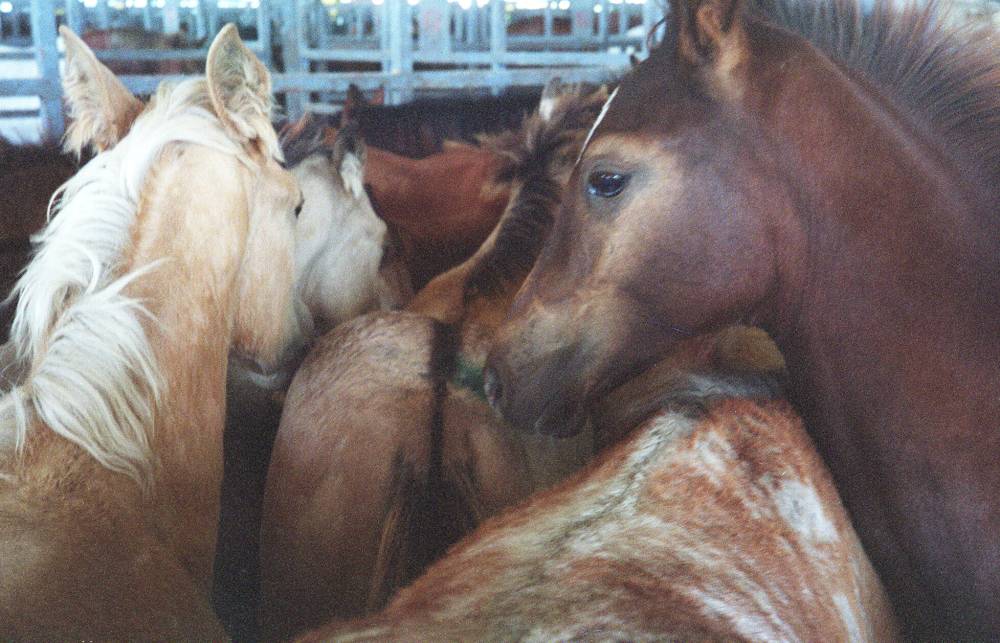
MIKE APORIUS / FREE PRESS FILES
In Japan, horse meat is sold raw and is considered a delicacy.
Animal Justice undertook the private prosecution, which required approval from another judge, after CFIA, the federal regulator, declined to take enforcement action over the shipment.
Animal Justice’s legal advocacy director, Kaitlyn Mitchell, said she’s “incredibly disappointed” by the ruling.
“Mostly, I’m concerned for what this means for animals. This case has always been about justice for these horses,” she said outside the Winnipeg courthouse.
“I know that no verdict today could have undone what these horses went through and the suffering that they endured, but we, obviously, we’re hoping for a different outcome.”
Mitchell said she’s most concerned about the time it takes to ship horses.
“Our laws are supposed to protect them for that entire journey, so by dividing things up artificially and letting… companies off the hook as soon as these horses are on the tarmac, really concerns me. I think it puts these animals at very serious risk during these incredibly long journeys,” she said.
She said the organization will look for potentially viable avenues of appeal.
erik.pindera@freepress.mb.ca
Erik Pindera is a reporter for the Free Press, mostly focusing on crime and justice. The born-and-bred Winnipegger attended Red River College Polytechnic, wrote for the community newspaper in Kenora, Ont. and reported on television and radio in Winnipeg before joining the Free Press in 2020. Read more about Erik.
Every piece of reporting Erik produces is reviewed by an editing team before it is posted online or published in print — part of the Free Press‘s tradition, since 1872, of producing reliable independent journalism. Read more about Free Press’s history and mandate, and learn how our newsroom operates.
Our newsroom depends on a growing audience of readers to power our journalism. If you are not a paid reader, please consider becoming a subscriber.
Our newsroom depends on its audience of readers to power our journalism. Thank you for your support.
Erik Pindera is a reporter for the Free Press, mostly focusing on crime and justice. The born-and-bred Winnipegger attended Red River College Polytechnic, wrote for the community newspaper in Kenora, Ont. and reported on television and radio in Winnipeg before joining the Free Press in 2020. Read more about Erik.
Every piece of reporting Erik produces is reviewed by an editing team before it is posted online or published in print — part of the Free Press‘s tradition, since 1872, of producing reliable independent journalism. Read more about Free Press’s history and mandate, and learn how our newsroom operates.
Our newsroom depends on a growing audience of readers to power our journalism. If you are not a paid reader, please consider becoming a subscriber.
Our newsroom depends on its audience of readers to power our journalism. Thank you for your support.
Related Articles
Animal Justice wants lawsuit by Manitoba farmer tossed out
Advertisement Advertise With Us
Advertisement Advertise With Us