

Prison overcrowding has no simple fix
Advertisement
Read this article for free:
or
Already have an account? Log in here »
To continue reading, please subscribe:

Digital Subscription
One year of digital access for only $205*
- Enjoy unlimited reading on winnipegfreepress.com
- Read the E-Edition, our digital replica newspaper
- Access News Break, our award-winning app
- Play interactive puzzles
*First annual payment billed as $205.00 + GST for one year. This annual subscription will automatically renew at $233.00 + GST every 52 weeks (10% off the regular annual price of $259.35). Offer available to new and qualified returning subscribers only. Cancel any time.
To continue reading, please subscribe:
Add Free Press access to your Brandon Sun subscription for only an additional
$1 for the first 4 weeks*
- Enjoy unlimited reading on winnipegfreepress.com
- Read the E-Edition, our digital replica newspaper
- Access News Break, our award-winning app
- Play interactive puzzles
*Your next Brandon Sun subscription payment will increase by $1.00 and you will be charged $17.95 plus GST for four weeks. After four weeks, your payment will increase to $24.95 plus GST every four weeks.
Read unlimited articles for free today:
or
Already have an account? Log in here »
Rarely, if ever, does government respond so quickly to a demand for more money.
On March 20, the Manitoba Government and General Employees’ Union said that overcrowding in provincial jails was causing mayhem and putting their members at risk. “When you put more people in and have less programming, less opportunities for recreation … the temperature rises within the facility,” union president Kyle Ross said.
It didn’t take long for government to respond. On the same day, Justice Minister Matt Wiebe gladly confirmed the NDP government was going to increase the budget for corrections by $14 million.
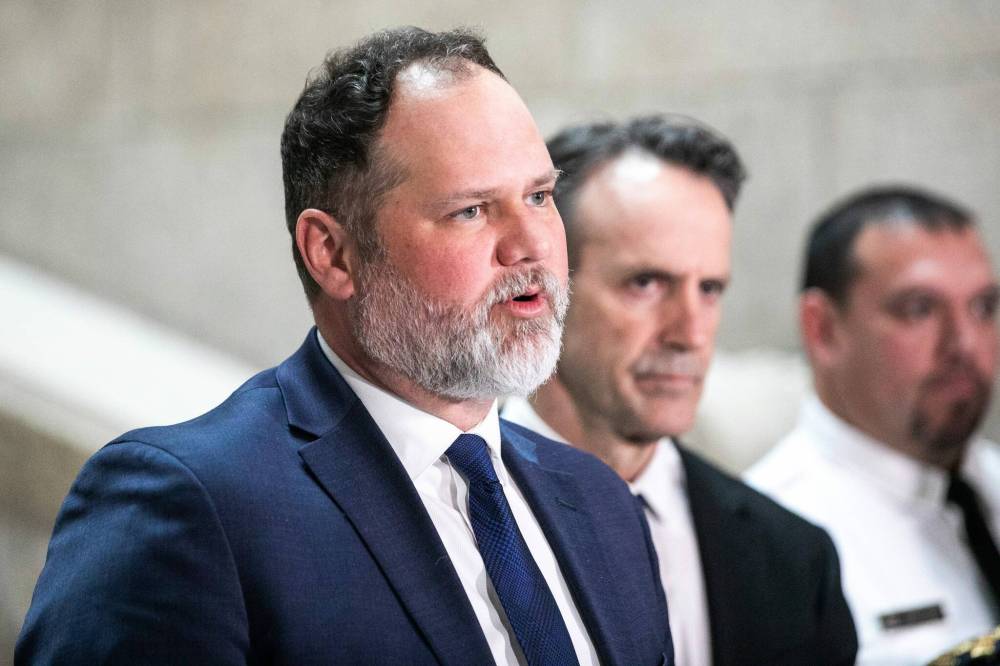
MIKAELA MACKENZIE / FREE PRESS FILES
Justice Minister Matt Wiebe
In case you were wondering, government does not normally provide same-day funding for outside demands or grievances. So, what prompted this expeditious pledge?
In this instance, Wiebe decided to reveal a detail from the March 24 budget a few days early to calm the union’s concerns. This not-unsubstantial sum of money allowed Wiebe to claim government was listening and responding to the union’s concerns. “We know (the new funding) is going to start to make a difference,” Wiebe said.
But will it make a difference? Since coming to power in 2023, the NDP government has hired an additional 150 corrections officers. Although the six provincial jails — Headingley Jail, Milner Ridge Correctional Centre, Brandon Correctional Centre, The Pas Correctional Centre, the Winnipeg Remand Centre and the Women’s Correctional Centre — could still use more, the additional hires do mark some progress. But that alone has not alleviated overcrowding.
Overcrowding is not caused by staffing shortages; it’s a byproduct of a justice system that is always finding new reasons to lock people up without adding resources to speed the administration of justice.
The justice system currently has too few judges and support staff to deal with criminal matters in a timely fashion. When it takes longer to dispose of a case, accused persons spend more time locked up in remand awaiting trial, bumping up the inmate population in jails and adding to the stress of corrections officers.
It should be noted that this is not just a Manitoba problem.
The most recent data from Statistics Canada, which captures up to the end of the 2023-24 government calendar year, show that just about every jail in every province and territory is over capacity and the problem is growing. The situation is most severe in the biggest provinces; many Ontario jails, for example, are running at 150 per cent capacity.
In the face of this kind of macro trend, what is the solution?

Many provincial judges have pointed out that a shortage of court clerks and judges is making it impossible to dispose of cases in a timely fashion. Trial dates are being pushed back, and the duration of remand incarceration is increasing. Across the country, roughly 75 per cent of the people in provincial and territorial jails are legally innocent — having not yet been convicted — and are awaiting trial. And because funding for legal aid has failed to keep up with demand, the vast majority of those in remand are poor, Indigenous and female.
And the problem can be expected to get worse. The premiers are demanding that Ottawa make it harder for anyone accused of a criminal offence to obtain bail. The “jail not bail” campaign has most definitely added to the crush of inmates in provincial jails.
It is not clear yet whether the just-tabled provincial budget will have increased support for more court administrative staff, more judges and alternatives to remand, like community courts.
However, until those demands are met, hiring more corrections officers is tantamount to putting more duct tape on a bursting-at-the-seams jail system.
The bursting will continue.