

On schedule: provincial minimum wage to rise to $16.40/hr in October

Advertisement
Read this article for free:
or
Already have an account? Log in here »
To continue reading, please subscribe:

Digital Subscription
One year of digital access for only $205*
- Enjoy unlimited reading on winnipegfreepress.com
- Read the E-Edition, our digital replica newspaper
- Access News Break, our award-winning app
- Play interactive puzzles
*First annual payment billed as $205.00 + GST for one year. This annual subscription will automatically renew at $233.00 + GST every 52 weeks (10% off the regular annual price of $259.35). Offer available to new and qualified returning subscribers only. Cancel any time.
To continue reading, please subscribe:
Add Free Press access to your Brandon Sun subscription for only an additional
$1 for the first 4 weeks*
- Enjoy unlimited reading on winnipegfreepress.com
- Read the E-Edition, our digital replica newspaper
- Access News Break, our award-winning app
- Play interactive puzzles
*Your next Brandon Sun subscription payment will increase by $1.00 and you will be charged $17.95 plus GST for four weeks. After four weeks, your payment will increase to $24.95 plus GST every four weeks.
Read unlimited articles for free today:
or
Already have an account? Log in here »
Hey there, time traveller!
This article was published 01/04/2026 (191 days ago), so information in it may no longer be current.
Manitoba’s minimum wage is set to rise 40 cents in October, leaving labour and business advocates split on the benefit of continuing to tie the baseline to the rate of inflation as the cost of living grows.
The minimum wage will rise to $16.40 per hour from $16/hr on Oct. 1. (The provincial government is required to announce the incoming minimum wage by April 1 each year.)
Provincial legislation ties the mark to inflation — the 40-cent increase is in line with Manitoba’s 2.7 per cent inflation rate in 2025 — and in 2022, the former Progressive Conservative government amended the rules to allow minimum wage be boosted beyond inflation, but only if inflation exceeds five per cent.
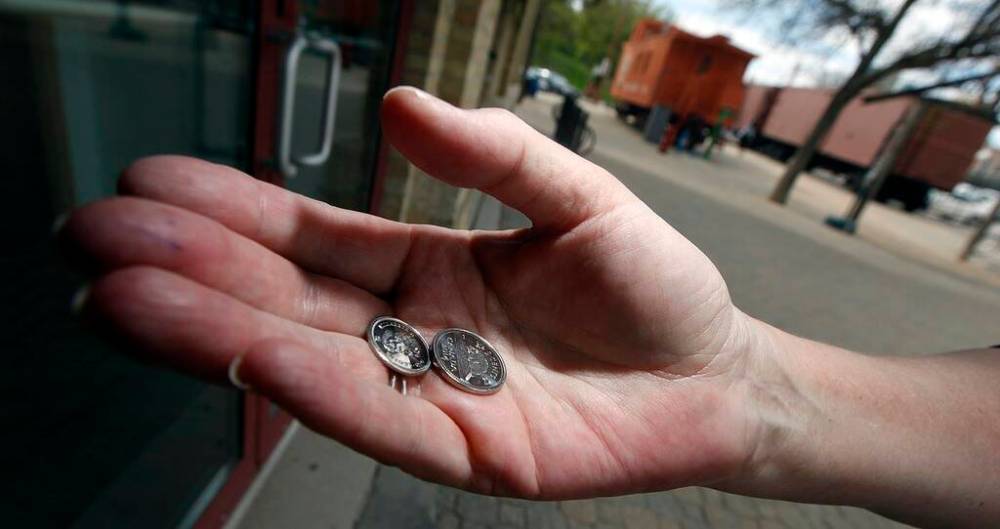
PHIL HOSSACK / FREE PRESS FILES
Manitoba’s minimum wage will rise to $16.40 per hour from $16/hr on Oct. 1.
However, that same legislation prevents the province from closing the gap between the minimum wage and the cost of living, said Manitoba Federation of Labour president Kevin Rebeck.
“Our government’s left the law in place and we think that starting point is way too low,” he said Wednesday.
More than 40,000 people in Manitoba work full time at minimum wage, Rebeck said, but many are stuck in a “poverty trap” that keeps them struggling paycheque to paycheque.
“I think we need to put working people first. I think people need to know that a job is a path out of poverty, they need to know they’re going to get compensated in a way that lets them participate in the economy,” he said.
“And I think business will be stronger for it, because what I think they really need, instead of just asking government for bailouts or handouts, is customers who can come and buy their products and services.”
Meanwhile, Winnipeg Chamber of Commerce president and CEO Loren Remillard said the business sector benefits from a model that “de-politicizes” minimum wage changes and allows businesses to adjust operations as needed.
“This is responsible,” he said. “It allows businesses to plan with confidence, it allows the wage (to rise with) costs without creating undue burden on businesses that are struggling.”
Remillard said Manitoba has had more businesses close than open in the last six quarters, and the provincial government has multiple other avenues to improve quality of life for workers.
“Why is it the default that it always has to be (passing) the cost of social pressures on to business? Business is trying to grow and employ more people,” Remillard said. “Government needs to take a hard look and say, what else can we do, if the consensus is that Manitobans are struggling? Minimum wage is not meant to be that tool.”
While he was the leader of the Opposition, NDP Premier Wab Kinew criticized the Progressive Conservatives for indexing minimum wage to inflation in 2022, and called on the province to adopt a “living wage” model, or wages tied to the amount a person would need to be paid to cover all their basic needs.
The Canadian Centre for Policy Alternatives suggests Winnipeg’s living wage was $19.77/hr in 2025, based on a calculation considering factors including rising food, transportation and rental costs.
Labour Minister Malaya Marcelino wouldn’t say if she’d consider bringing forward amendments to current minimum wage legislation, but pointed to changes made in the recently released budget, including axing provincial sales tax on some groceries and additional rent control measures, as ways the province is targeting the affordability crisis.
“We’re here to fight for workers, so this is the way that we’re doing it right now,” Marcelino said.

Manitoba’s $3.37/hr gap between the minimum wage and living wage is one of the lower ones in Canada — making it all the more achievable to close it, said Niall Harney, a senior researcher with the Canadian Centre for Policy Alternatives.
“We’d really like to see some kind of formula brought forward to raise the minimum wage that’s in line with some kind of living wage calculation.”
The CCPA’s living wage calculation has been stable in recent years, Harney said, attributable to an increase in federal transfers for low-income initiatives and the implementation of $10-a-day child care.
The living wage in Brandon and Thompson are calculated to be $16.22/hr and $17.89/hr, respectively.
malak.abas@freepress.mb.ca
Malak Abas is a city reporter at the Free Press. Born and raised in Winnipeg’s North End, she led the campus paper at the University of Manitoba before joining the Free Press in 2020. Read more about Malak.
Every piece of reporting Malak produces is reviewed by an editing team before it is posted online or published in print — part of the Free Press‘s tradition, since 1872, of producing reliable independent journalism. Read more about Free Press’s history and mandate, and learn how our newsroom operates.
Our newsroom depends on a growing audience of readers to power our journalism. If you are not a paid reader, please consider becoming a subscriber.
Our newsroom depends on its audience of readers to power our journalism. Thank you for your support.
Malak Abas is a city reporter at the Free Press. Born and raised in Winnipeg’s North End, she led the campus paper at the University of Manitoba before joining the Free Press in 2020. Read more about Malak.
Every piece of reporting Malak produces is reviewed by an editing team before it is posted online or published in print — part of the Free Press‘s tradition, since 1872, of producing reliable independent journalism. Read more about Free Press’s history and mandate, and learn how our newsroom operates.
Our newsroom depends on a growing audience of readers to power our journalism. If you are not a paid reader, please consider becoming a subscriber.
Our newsroom depends on its audience of readers to power our journalism. Thank you for your support.
Advertisement Advertise With Us
Advertisement Advertise With Us