
How a seabird native to Hawaii has adapted to life in Honolulu’s concrete jungle

Advertisement

Advertise with us

HONOLULU (AP) — Kaʻiulani Murphy is quick to spot white terns flapping their wings when she's guiding Polynesian voyaging canoes across the Pacific.

Read this article for free:


or

Already have an account? Log in here »

To continue reading, please subscribe:

Subscribe and receive a limited-edition Free Press branded hat or tote.

Digital Subscription

One year of digital access for only $205*

  • Enjoy unlimited reading on winnipegfreepress.com
  • Read the E-Edition, our digital replica newspaper
  • Access News Break, our award-winning app
  • Play interactive puzzles

*First annual payment billed as $205.00 + GST for one year. This annual subscription will automatically renew at $233.00 + GST every 52 weeks (10% off the regular annual price of $259.35). Offer available to new and qualified returning subscribers only. Cancel any time.

To continue reading, please subscribe:

Add Free Press access to your Brandon Sun subscription for only an additional

$1 for the first 4 weeks*

  • Enjoy unlimited reading on winnipegfreepress.com
  • Read the E-Edition, our digital replica newspaper
  • Access News Break, our award-winning app
  • Play interactive puzzles
Start now

*Your next Brandon Sun subscription payment will increase by $1.00 and you will be charged $17.95 plus GST for four weeks. After four weeks, your payment will increase to $24.95 plus GST every four weeks.

HONOLULU (AP) — Kaʻiulani Murphy is quick to spot white terns flapping their wings when she’s guiding Polynesian voyaging canoes across the Pacific.

The birds hunt for food at sea and lay eggs on land. So traditional navigators like her, who look to the stars, waves and other elements in nature to pilot across the ocean, see the bird’s presence as a sign that land is near.

These days voyagers returning to Honolulu have more white terns to track than at any other time in modern history. New data shows their numbers have jumped more than 50% in the past decade — evidence the seabirds are thriving amid the concrete towers, traffic-clogged roads and Waikiki hotels in the state’s largest metropolis.
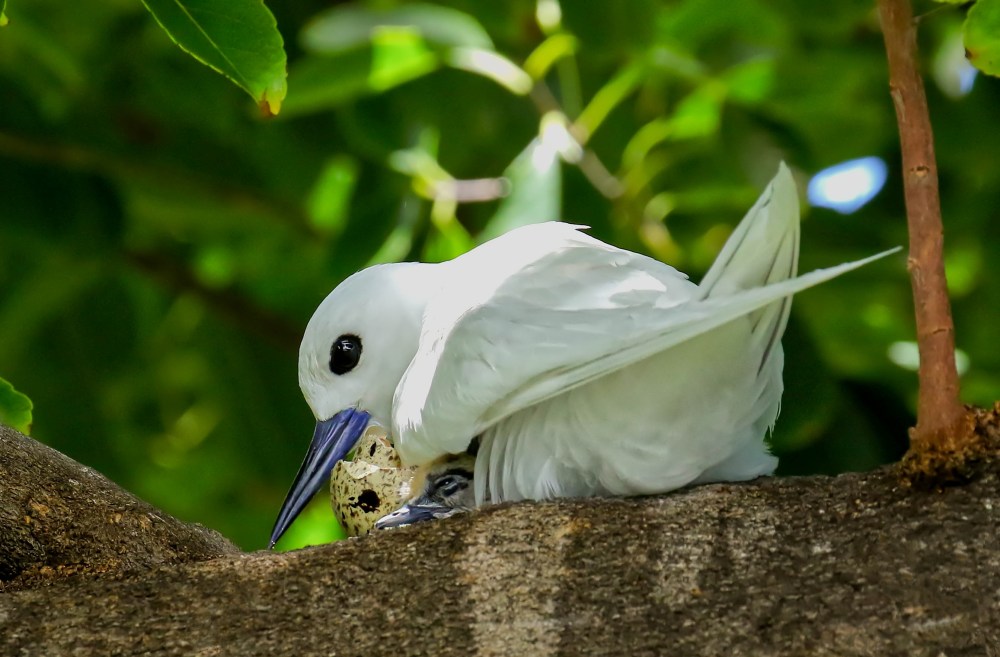
A white tern brooding a newly hatched chick while holding onto the last of the eggshell with her beak, Nov. 16, 2022, in Honolulu's Diamond Head area. (Melody Bentz via AP)

They’re defying the fate of many other native birds in Hawaii, where disease and predators that aren’t native to the islands have caused indigenous bird numbers to collapse.

“This is our big city,” said Murphy, who has navigated canoes to Tahiti, Japan and Rapa Nui. “It’s crazy to me that they’re getting to such a big population within Honolulu.”

There were 691 eggs and chicks in Honolulu trees as of this week, said Rich Downs, coordinator of the volunteer organization Hui Manu-o-Kū.

The group takes its moniker from the Hawaiian name for the white tern, which means “bird of Kū,” the god of war.

Manu-o-Kū can breed year round, but activity peaks from winter into early spring. They’re the only seabirds that don’t build nests, but instead lay their eggs on bare tree branches, cliff ledges or window sills. After hatching, the young sit on a branch until they can fly, their strong claws helping them hold on even in strong storms.

They’re found near islands in warm waters around the world, but in Hawaii they live mostly among remote, primarily uninhabited atolls in the northwest. The only place they’ve settled among the archipelago’s larger islands is Oahu, which is home to 1 million people.

Scientists aren’t sure why the birds are thriving in Honolulu. The city might be hospitable because humans have reduced the numbers of predators like rats and cats around restaurants and buildings. Busy roads can also deter predators. Barn owls and mongoose, other species that like to feed on terns, are rare in the urban core.

“All the lights and the noise, the commotion of people and traffic, and things like that, doesn’t seem to bother them,” said Eric VanderWerf, the executive director of Pacific Rim Conservation, a nonprofit that supports native birds in Hawaii and the Pacific.

Downtown trees offer favorable habitat. A cup created by the scar tissue of a trimmed tree branch is an ideal place for an egg, so well-maintained trees create plentiful homes.

The most recent population survey, conducted by Hui Manu-o-Kū in 2023 but unpublished until now, showed Oahu’s population of breeding adults jumped 1.5 times to 3,600 compared to 2016.

It offers a stark contrast with Hawaii’s other native birds. Since humans arrived in Hawaii, 71 of 113 bird species found only on the islands have gone extinct. Those remaining are often listed as threatened or endangered. Many are found in small numbers in higher elevation forests.

While native to the islands, manu-o-Kū were not observed breeding on Oahu until 1961, when scientists saw a pair of adults with a single egg.
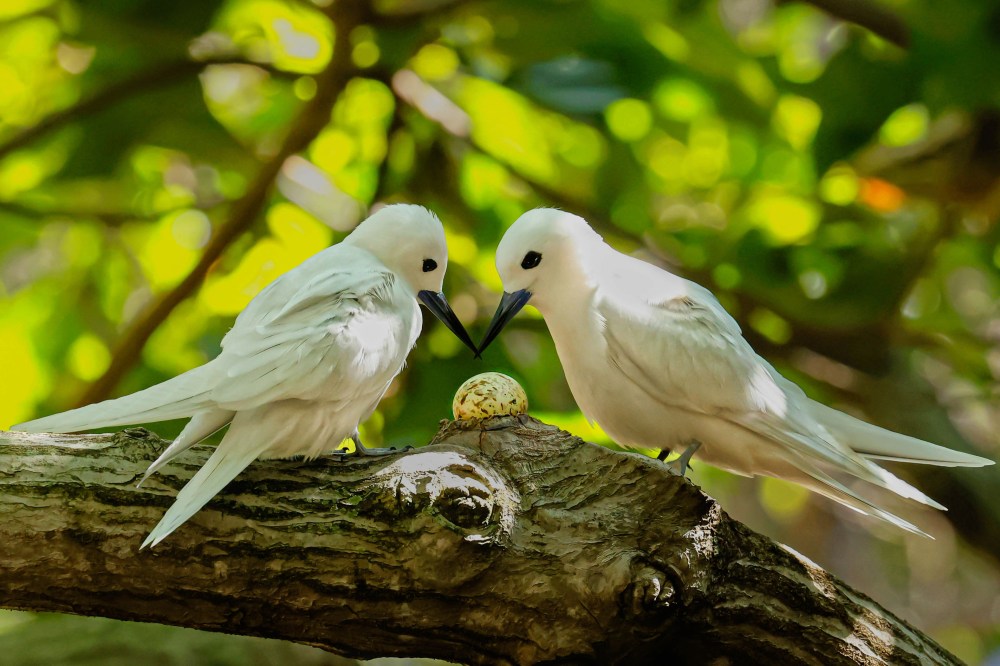
White tern parents looking at an egg holding their chick on the University of Hawaii at Manoa campus, Jan. 18, 2022, in Honolulu. (Melody Bentz via AP)

Decades later, as the bird’s population soared, Honolulu named manu-o-Kū its official bird in 2007. School children sing songs about the species. An annual festival celebrates them every May.

Hui Manu-o-Kū staff tie blue plastic ribbons around the trunks of trees hosting eggs and chicks to alert tree trimmers to stay clear. The ribbons also help bird-watchers keep track of the white terns, as does an online map.

For eight years, Joyce Hsieh’s been taking photos of the birds as they incubate their eggs, feed young birds and raise hatchlings. One of her preferred spots is a Target parking garage, because she can drive up to the third floor to reach the same level as the birds in nearby trees.

White terns have about the same body length as pigeons but a larger wingspan. They fly up to about 120 miles (193 kilometers) from land and feast on small fish and squid chased to the ocean surface by larger species like tuna.

Murphy, the traditional voyager, is Native Hawaiian. She sees parallels between Hawaii’s birds and her people.

Diseases introduced by the first Europeans killed Native Hawaiians in vast numbers in the 1800s. But Hawaiians — resilient and adaptive like manu-o-Kū — are still here, and their population is growing.

When she encounters the birds offshore en route to Oahu, she said it’s like seeing old friends.

“It’s just a special feeling,” she said.

Report Error Submit a Tip

More Stories

Artist’s inspired work brings Red River Métis story back to Portage and Main

Conrad Sweatman 8 minute read Preview

Artist’s inspired work brings Red River Métis story back to Portage and Main

Conrad Sweatman 8 minute read Updated: 2:47 PM CDT

Jennine Krauchi calls them the “grandmothers.” “They speak to you very silently. You never hear a word, but they speak,” Krauchi says, referring to the antique pieces of Métis needlework she’s carefully studied for years. But there are few precedents for her latest art project: a 85-foot-wide by 32-foot-high chain curtain of Métis needlework that drapes over the historic Bank of Montreal’s neoclassical facade.

Read
Updated: 2:47 PM CDT

Lone Manitoba 9/11 victim's legacy lives on helping Inuit students become nurses

Melissa Martin 13 minute read Preview

Lone Manitoba 9/11 victim's legacy lives on helping Inuit students become nurses

Melissa Martin 13 minute read Yesterday at 5:24 PM CDT

On the night before the morning that everyone remembers, Ellen Judd spoke to her partner, Christine Egan, several times on the phone. Egan was in New York, where she’d gone to look after her nephews so her beloved brother, Michael, and his wife, Anna, could treat themselves to an anniversary vacation.

Usually, Judd would have been there, too. The couple had been together for more than 15 years, and loved sharing all the good parts of life. But at the time, she was an anthropology professor at the University of Manitoba, and the school year was just starting; she had classes the next day. Staying connected by phone would have to suffice.

In their calls that night, Judd remembers, Egan was happy. Christmas was the main topic. They were planning to spend the holiday with Judd’s family in Ontario, and talked about when to book flights. Egan was looking forward to that visit; Judd’s family “loved her to bits,” the now-retired professor says, and the affection was mutual.

The next day, Egan said, she planned to go into Manhattan with Michael. He was an executive at Aon, a global risk, retirement and health services corporation, and had an office on the 105th floor of the World Trade Centre’s South Tower.

Read
Yesterday at 5:24 PM CDT

Mechanic Susie helps turn jockey standings around at Assiniboia Downs

George Williams 5 minute read Preview

Mechanic Susie helps turn jockey standings around at Assiniboia Downs

George Williams 5 minute read 9:51 PM CDT

Two champions got back up off the mat this week at Assiniboia Downs. One of them was a human.

Antonio Whitehall won four races on Wednesday evening to wrest back the lead in the jockey standings from surging former Hastings Park rider Kerron Khelawan, and he crossed the finish line first in the last five races on the card. Whitehall was disqualified from winning the seventh race aboard Tap the Parlay when that filly caused some unavoidable interference early in the race.

The winners that stood for Whitehall included Neighneigh ($5.50) in the fourth race for trainer Demetris Topouzis; Mechanic Susie ($3.90) in the fifth for trainer Elton Dickey; Betterlucknexttime ($3.80) in the sixth race for trainer Mike Nault; and a nail biter in the seventh aboard Weekendindelmar ($5.00) for trainer Robert Maybin.

No earth-shattering prices in the bunch, but the fact that the three-time ASD riding champion came back with a huge night after being outscored 2-0 by Khelawan and being knocked out of top spot in the standings the night before spoke volumes.

Read
9:51 PM CDT

Hip-hop artist ready to release meticulously constructed album

Conrad Sweatman 4 minute read Preview

Hip-hop artist ready to release meticulously constructed album

Conrad Sweatman 4 minute read 6:39 PM CDT

The techniques of digital music production today are finicky.

Dizzingly so: a little surgical EQ to make your hi-hats less shrill, the subtle boost in the 30-Hz range to get your kick drum thumping just so, drawing out a reverb swell with a visual artist’s meticulousness.

If the artist is visually impaired, the challenge might seem next to impossible.

“It’s so tough. Spending hours on a little piece of audio, or, like, I want the delay on the word ‘home’ exactly — not the syllable after or before,” says Winnipeg-based musician Matthew Monias, whose stage name is Mattmac.

Read
6:39 PM CDT

Rural venue lets artists shine on more intimate stage

Ben Waldman 4 minute read Preview

Rural venue lets artists shine on more intimate stage

Ben Waldman 4 minute read 6:31 PM CDT

With cooler temperatures on their way, Jocelyne Baribeau wants to break the linguistic ice between musicians with a new concert series at her home near Ste. Geneviève, about 30 minutes east of the Perimeter.

A onetime Western Canadian Music Award winner as best francophone artist, the St. Vital-raised Baribeau intends the Icebreakers series — which has its first concert this Sunday — to provide musicians with an intimate, rural setting to experiment and collaborate with peers with whom they might not otherwise share a bill.

“A goal for me to sort of erase a bit of that invisible line that we put. ‘It’s a French event,’ or ‘It’s an English event,’” says Baribeau, the vice-president of the Canadian Folk Music Awards.

“The more we can do that, the more opportunity there is for everyone. Music is music, and I don’t think it’s a language thing. You can feel a lot of things even when someone is singing in a language you don’t understand.”

Read
6:31 PM CDT

Puzzles Palace

1 minute read Monday, Jul. 27, 2026

To solve our puzzles, please subscribe with this special offer: |