New secularism law is looming over Way of the Cross marches on Good Friday in Quebec

Advertisement

Advertise with us

MONTREAL - Christians across Quebec are about to face a new legal landscape on Good Friday, only a day after the provincial legislature adopted a law that could crack down on their annual Way of the Cross processions.

Read this article for free:


By clicking the button above, an account will be created and you will begin to receive some of our recommended newsletters. You may opt out of any newsletter by visiting your Email and Communication Preferences page or by clicking "unsubscribe" at the bottom of any email.

or

Already have an account? Log in here »

To continue reading, please subscribe:

Digital Subscription

One year of digital access for only $1.44 a week*

  • Enjoy unlimited reading on winnipegfreepress.com
  • Read the E-Edition, our digital replica newspaper
  • Access News Break, our award-winning app
  • Play interactive puzzles

*Billed as $5.77 plus GST every four weeks. After 52 weeks, price increases to the regular rate of $19.95 plus GST every four weeks. Offer available to new and qualified returning subscribers only. Cancel any time.

To continue reading, please subscribe:

Add Free Press access to your Brandon Sun subscription for only an additional

$1 for the first 4 weeks*

  • Enjoy unlimited reading on winnipegfreepress.com
  • Read the E-Edition, our digital replica newspaper
  • Access News Break, our award-winning app
  • Play interactive puzzles
Start now

*Your next Brandon Sun subscription payment will increase by $1.00 and you will be charged $17.95 plus GST for four weeks. After four weeks, your payment will increase to $24.95 plus GST every four weeks.

Hey there, time traveller!
This article was published 03/04/2026 (207 days ago), so information in it may no longer be current.

MONTREAL – Christians across Quebec are about to face a new legal landscape on Good Friday, only a day after the provincial legislature adopted a law that could crack down on their annual Way of the Cross processions.

In Montreal, several hundred people joined Archbishop Christian Lépine in a march of “prayer, reflection and silence” that wound its way through the streets behind a large crucifix, stopping at several historic churches in a commemoration of Jesus’s journey to the cross.

But the Easter weekend tradition will likely become harder to organize in future years, now that the province has passed a law to ban public prayer.

People take part in a Way of the Cross procession in Montreal, Friday, March 29, 2024. THE CANADIAN PRESS/Graham Hughes

The Quebec government adopted legislation on Thursday, extending a ban on wearing religious symbols in public workplaces to daycare workers, prohibiting prayer rooms in public institutions, and banning public prayer without explicit municipal consent.

“No public road … or public park may be used for the purposes of collective religious practice unless a municipality authorizes, exceptionally and on a case-by-case basis, such a use in its public domain by resolution of the municipal council,” the text of the law reads. 

Martin Laliberté, the head of the Assembly of Quebec Catholic Bishops, believes the new law turns religious people into second-class citizens.

He notes that street closures and public demonstrations happen all the time, including for sporting events, protests and cultural events.

“If we do it for religious reasons, we don’t have the right,” he said Wednesday in an interview. “So people in society who are believers become second-class citizens who don’t have the right, like any other citizen, to demonstrate (when it’s) in the name of their faith.”

He said organizers of Way of the Cross and other marches have always co-ordinated with local officials and respected municipal rules, but never before had to seek express permission to hold their events. 

“It was a right, and now it’s not a right anymore,” he said. The new law, he said, leaves churches relying on the goodwill of city councils, who can decide whether or not to grant permits for the event.

Laliberté says senior Catholic leaders are concerned the new law goes far beyond the effect on ceremonial processions. He notes that the legislation invokes powers that allow the province to override some sections of the Charter and shield the secularism law from court challenges. 

“We have rights, according to the Charter, which say you have a right to express your faith publicly,” Laliberté said.

But with the new law, he said people don’t have this right anymore.

 “That’s a big shift for us.”

Laliberté said the Quebec Catholic bishops participated in consultations on the new law, where they expressed particular concern with the public prayer ban and the expansion of the religious symbol prohibition. He said politicians appeared to listen, but were unwilling to adopt the changes. 

He said he believes the new law has “no utility,” because the government already has all the tools it needs to protect secularism.
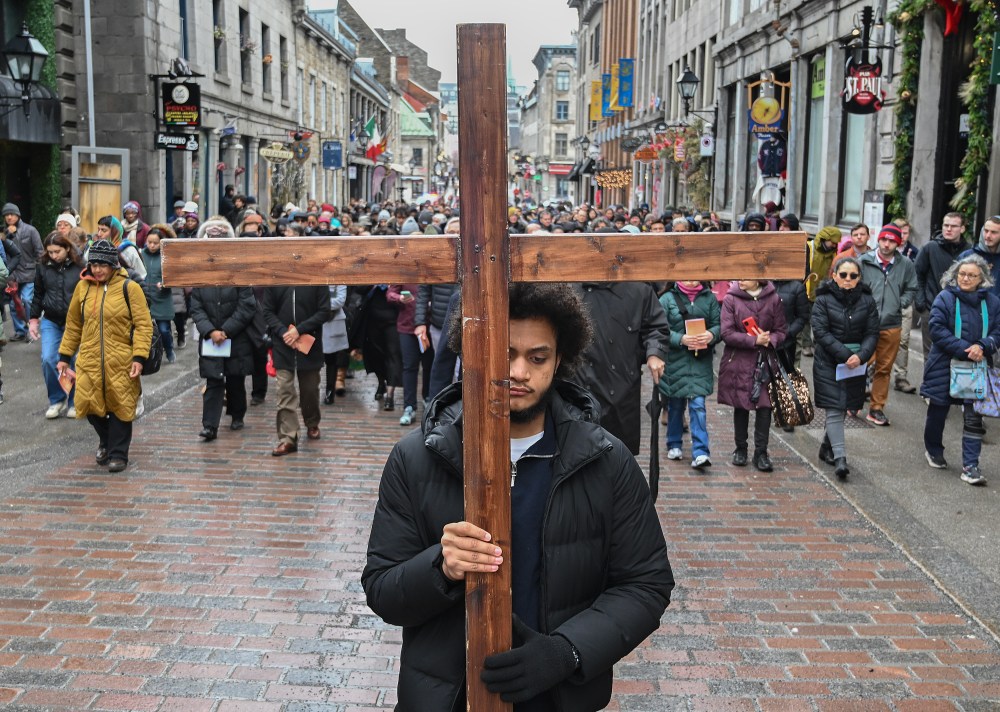
A man carries a cross during a Way of the Cross procession in Montreal, Friday, April 3, 2026. THE CANADIAN PRESS/Graham Hughes

The Quebec government did not respond to a request for comment by publication time.

John Zucchi, national director with Montreal Way of the Cross procession organizer Communion and Liberation Canada, says organizers always communicate with police about the event, but have been told in the past that it’s not necessary to inform the city.

He says the event last year drew nearly 1,000 people, who walk in silence behind a person carrying a crucifix to different churches, where there is singing, gospel readings and poems. 

Unlike many church events, he says attendance has gone up in recent years, and numbers have roughly doubled since the COVID-19 pandemic.

“I think people are struck by the soberness of the event, by the simplicity of it and by the quiet dignity that surrounds the event,” he said. “It’s not meant to be clamour or something loud. It’s a meditation from start to finish.”

Zucchi says he shares the views of religious leaders who are concerned about the law, but isn’t worrying yet about its impact on the march in Montreal. “We’ve only encountered goodwill with the city, with the police service … and count on that continued goodwill in the future,” he said.

He also questioned what events will count as “public prayer.” 

“With the case of a procession done in silence, what constitutes prayer?” he asks. 

This report by The Canadian Press was first published April 3, 2026. 

Report Error Submit a Tip

The Free Press acknowledges the financial support it receives from members of the city’s faith community, which makes our coverage of religion possible.

More Stories

Police probe weekend vandalism spree as dozens of school buses taken out of service

Chris Kitching 5 minute read Preview

Police probe weekend vandalism spree as dozens of school buses taken out of service

Chris Kitching 5 minute read Updated: Yesterday at 4:57 PM CDT

Vandals used fire extinguishers to damage dozens of Winnipeg School Division buses and an elementary school in a pair of weekend break-ins, disrupting transportation or lessons for potentially hundreds of students.

Several buses were taken out of service, resulting in cancellations or delays on some routes Monday, after 45 parked vehicles were damaged in a lot on Selkirk Avenue, west of Keewatin Street.

“We occasionally will have a fire extinguisher stolen or a little bit of damage, but this was certainly the largest-scale vandalism that we’ve seen in our (transportation) yard,” said Matt Henderson, superintendent of Manitoba’s largest school division.

“The result of that was a number of bus routes had to be cancelled (Monday), which is really problematic. There’s an added stress on families to get their children to school.”

Read
Updated: Yesterday at 4:57 PM CDT

Cabinet minister guilty of ethics violation may have buyer for family business two years after offering to sell

Carol Sanders 3 minute read Preview

Cabinet minister guilty of ethics violation may have buyer for family business two years after offering to sell

Carol Sanders 3 minute read Yesterday at 6:46 PM CDT

Natural Resources and Indigenous Futures Minister Ian Bushie has a potential buyer for Grandpa George’s gas and convenience store at Hollow Water First Nation after offering it to sell it two years ago when he was found guilty of an ethics violation.

“Grandpa George’s is currently in negotiations with a buyer and that process is ongoing,” Bushie’s press secretary Caedmon Malowany said in a prepared statement Monday.

Bushie held a news conference in 2024 to say he would voluntarily sell the business after he violated provincial ethics rules.

The MLA for Keewatinook, who was not available for an interview Monday, was not required to sell the gas bar after former ethics commissioner Jeffrey Schnoor ruled in September 2024 that Bushie inadvertently violated the new Conflict of Interest (Members and Ministers) Act.

Read
Yesterday at 6:46 PM CDT

Jets players glad to have Hellebuyck trade behind them

Mike McIntyre 6 minute read Preview

Jets players glad to have Hellebuyck trade behind them

Mike McIntyre 6 minute read Saturday, Oct. 24, 2026

Relief? Regret? Rage?

How are the Winnipeg Jets feeling following Friday’s Connor Hellebuyck trade — particularly those with deep roots and strong bonds with the franchise goaltender who now finds himself a member of the New Jersey Devils?

“It was a bit of a cloud hanging over our heads,” captain Adam Lowry admitted on Saturday. “It’s nice we can look forward now. We don’t have to keep talking about it. We’ve got guys that want to be here.”

That was a bit of a common theme around the room following an outdoor practice at Princess Auto Stadium ahead of Sunday’s Heritage Classic game against the Montreal Canadiens.

Read
Saturday, Oct. 24, 2026

Port of Churchill owners and Dubai-based DP World looking to boost trade route

Ian Bickis, The Canadian Press 2 minute read Preview

Port of Churchill owners and Dubai-based DP World looking to boost trade route

Ian Bickis, The Canadian Press 2 minute read Updated: Yesterday at 3:12 PM CDT

WINNIPEG - The owners of Manitoba's Port of Churchill say they're working with Dubai-based DP World Inc. to potentially boost traffic at the arctic port.

Indigenous-owned Arctic Gateway Group says the memorandum of understanding it has signed with DP World focuses on port operations and possibly creating a transportation corridor linking Manitoba to global markets.

The supply chain memorandum also includes the CentrePort Canada inland shipping hub based beside the Winnipeg airport, as well as the Hudson Bay Railway that links it to the Port of Churchill.

No dollar investment commitments were announced with the memorandum.

Read
Updated: Yesterday at 3:12 PM CDT

Connor Hellebuyck breaks silence after trade from Jets

Mike McIntyre 8 minute read Preview

Connor Hellebuyck breaks silence after trade from Jets

Mike McIntyre 8 minute read Saturday, Oct. 24, 2026

It took until the very end of his introductory news conference Saturday — right around the 15-minute mark — before Connor Hellebuyck was finally asked the question that hockey fans back in Winnipeg were likely waiting for.

“Is there anything you’d like to say to Jets fans?” a reporter who covers Hellebuyck’s new team, the New Jersey Devils, put to him during the session held inside the Prudential Center in Newark.

A short pause followed.

“I mean, there’s a lot. There’s a lot that I need to say,” Hellebuyck began, no doubt raising plenty of eyebrows around here and the hockey world in general.

Read
Saturday, Oct. 24, 2026

Letters, Oct. 27

7 minute read 2:01 AM CDT

Time for ranked ballots?

Re: Get out and exercise your franchise (Editorial, Oct. 24)

Declining turnout is indeed a threat to our democracy and, while I am grateful that the editorial mentioned proportional representation, the issue on the municipal level can be solved far more simply — using ranked-choice voting.

In the last Winnipeg municipal election, the mayor “won” the election with only 27 per cent of the vote. Multiply that by the turnout of 37.5 per cent and the mayor’s positive mandate — the portion of the electorate that voted for him as mayor — drops to a paltry 10 per cent. That number should shock us into an awareness that the single-mark ballot has failed us miserably.