Damaged RCMP vehicles recovered after First Nation protests in N.S., police say

Advertisement

Advertise with us

Police in Nova Scotia have launched investigations after RCMP vehicles were damaged and highways were blocked following a raid on a First Nations cannabis shop that a local leader says ruined years of building trust.

Read this article for free:


or

Already have an account? Log in here »

To continue reading, please subscribe:

Subscribe and receive a limited-edition Free Press branded hat or tote.

Digital Subscription

One year of digital access for only $205*

  • Enjoy unlimited reading on winnipegfreepress.com
  • Read the E-Edition, our digital replica newspaper
  • Access News Break, our award-winning app
  • Play interactive puzzles

*First annual payment billed as $205.00 + GST for one year. This annual subscription will automatically renew at $233.00 + GST every 52 weeks (10% off the regular annual price of $259.35). Offer available to new and qualified returning subscribers only. Cancel any time.

To continue reading, please subscribe:

Add Free Press access to your Brandon Sun subscription for only an additional

$1 for the first 4 weeks*

  • Enjoy unlimited reading on winnipegfreepress.com
  • Read the E-Edition, our digital replica newspaper
  • Access News Break, our award-winning app
  • Play interactive puzzles
Start now

*Your next Brandon Sun subscription payment will increase by $1.00 and you will be charged $17.95 plus GST for four weeks. After four weeks, your payment will increase to $24.95 plus GST every four weeks.

Police in Nova Scotia have launched investigations after RCMP vehicles were damaged and highways were blocked following a raid on a First Nations cannabis shop that a local leader says ruined years of building trust.

RCMP officers, with the help of Potlotek First Nation leaders, on Friday morning recovered seven police vehicles that were left behind during protests the day before and ended a partial blockade that remained, according to a news release. 

Photos of the recovered vehicles shared by the RCMP show an unmarked police car missing its wheels, while glass windows were shattered and tires slashed on several of the SUVs.
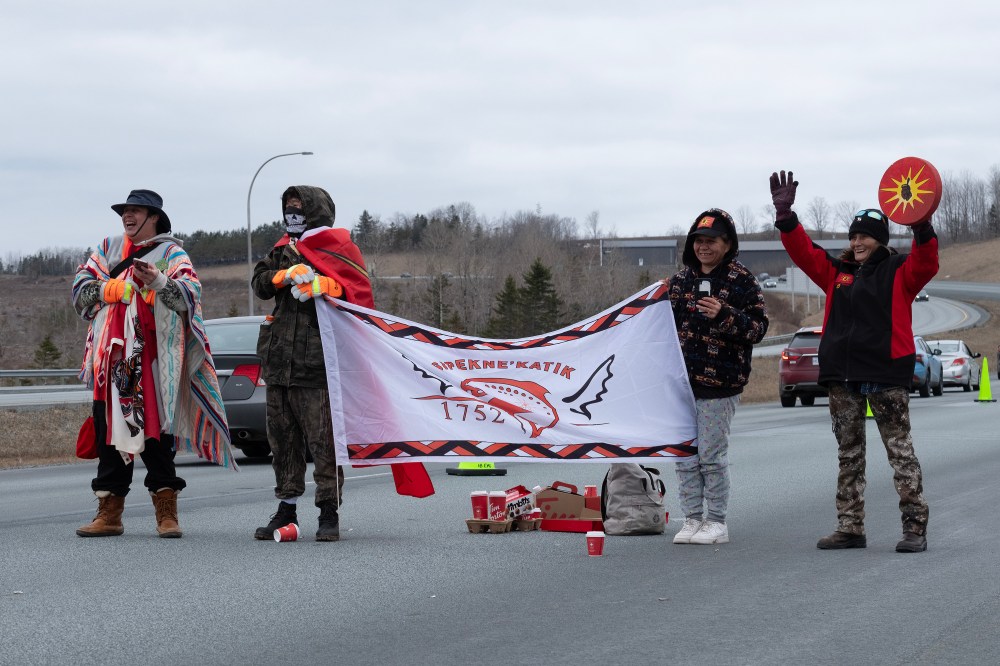
Sipekne'katik First Nation members protest along Highway 102 near Shubenacadie, N.S. on Thursday, April 2, 2026. THE CANADIAN PRESS/Ted Pritchard

An RCMP spokesperson confirmed all but one of the seven vehicles left behind Thursday were damaged. 

Isaiah Bernard, a Potlotek band councillor, said in a Friday interview that the damage wasn’t done by any Potlotek band members but instead by “outsiders who came here.”

“There are people who were just looking to cause a fight,” he said, adding it “wasn’t the Mi’kmaq  way” to cause harm to the vehicles.  

The protests were the latest events amid a crackdown by Nova Scotia on unregulated marijuana after the province’s attorney general in December directed police agencies to ramp-up illegal cannabis enforcement.

That call sparked a backlash from some Mi’kmaq leaders who say the sale of cannabis in their communities is protected by treaty rights and is therefore under their jurisdiction. 

On Thursday, Mounties entered a cannabis storefront in Potlotek and arrested two men while seizing products. Protesters then attempted to block Highway 4, including with heavy equipment, according to police and residents.

Officers cleared their vehicles of weapons and left on foot out of consideration for protester safety, according to an RCMP description of events. Meanwhile, related protests sprung up at various other locations in the province.

Many Potlotek community members went home around 9 p.m. on Thursday evening, according to Bernard. On Friday morning Chief Wilbert Marshall told any remaining protestors to shut a remaining partial blockade down. 

Bernard said the community plans to issue a public letter and contact provincial and federal representatives for support, and noted the raid has broken goodwill between the First Nation and the local RCMP.  

“We had great relationships with them over the last four years and we’ve been hosting events with them,” Bernard said.

“What happened yesterday broke a lot of that trust and it’s going to take a long time to build up to what it was. And it is unfortunate.”

Paul Service, a spokesperson for Nova Scotia RCMP, said the service “values our relationship with Potlotek First Nation.” 
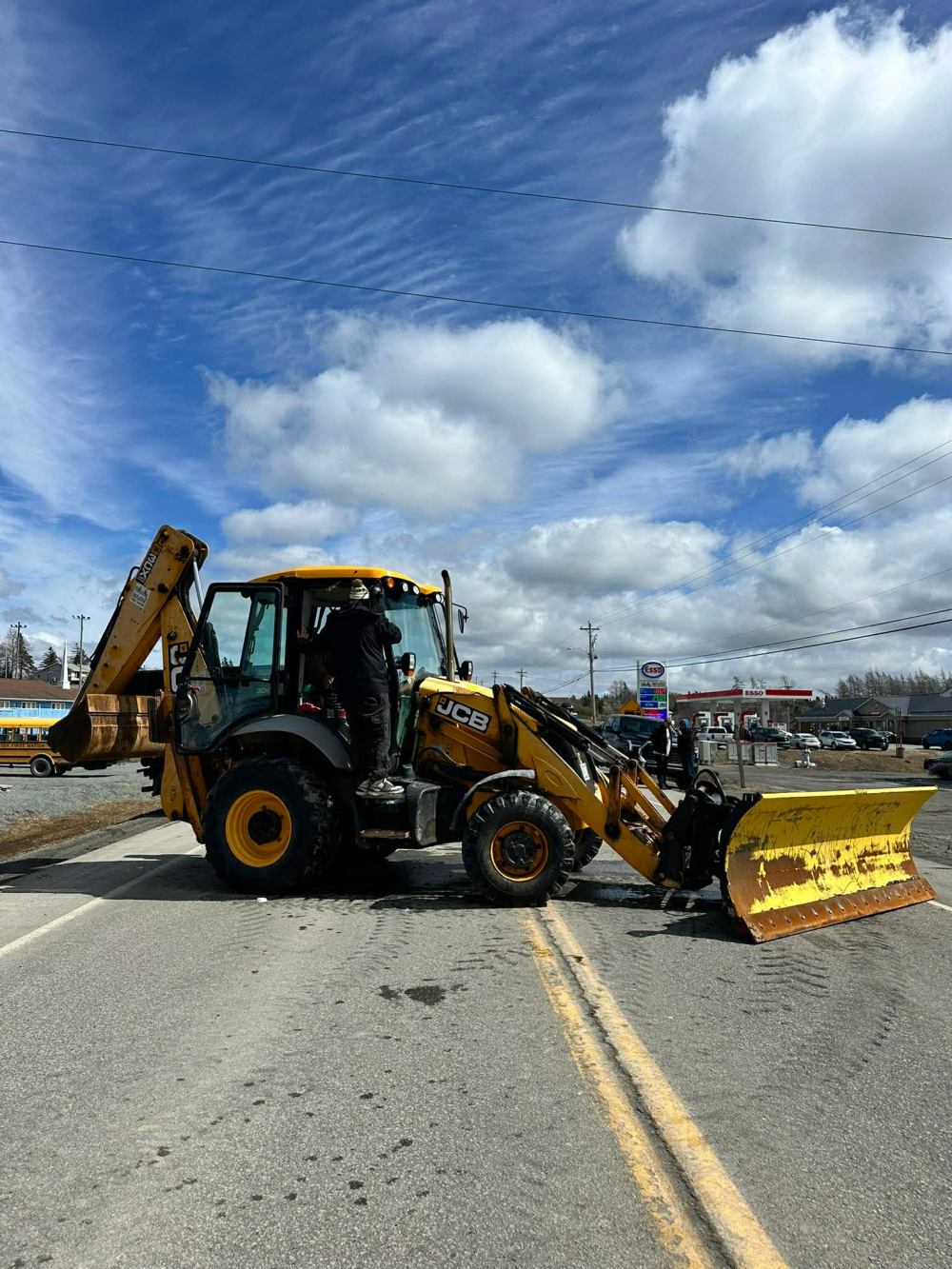
A tractor blocks Highway 4 in the Potlotek First Nation on Thursday, April 2, 2026. THE CANADIAN PRESS/Handout-Isaiah Bernard (Mandatory Credit)

“We also are an enforcement agency, and enforcement of laws preventing the illegal sale of alcohol and cannabis is part of supporting community safety.”

The Assembly of Nova Scotia Mi’kmaw Chiefs said in March the cannabis shop raids have undermined the positive work that had been done to build relationships between First Nations, police and the province.

“The Mi’kmaw assert their Right to self-government, which includes jurisdiction over economic development, community safety and the regulation of what happens on our lands,” a statement from the organization said in early March.

Meanwhile, the RCMP said investigations into the sale of cannabis, blockade of Highway 4 and “related criminal offences” will continue. 

Bernard said some of the blame can be attributed to the government — and that resistance to its policies from First Nations goes behind just cannabis.

“I hope that our province will just leave us alone, we’re a sovereign nation,” he added.

— with files from Lyndsay Armstrong

This report by The Canadian Press was first published April 3, 2026.

Report Error Submit a Tip

More Stories

Today’s horoscope

Georgia Nicols 4 minute read Preview

Today’s horoscope

Georgia Nicols 4 minute read Yesterday at 2:01 AM CDT

MOON ALERT: After 12:15 a.m., there are no restrictions to shopping or important decisions today. The moon is in Capricorn.

ARIES (March 21-April 19)

This is a tricky day. Don’t be too ambitious. It’s totally OK to kick back and relax. But be aware that communications with parents and authority figures might be confused, vague or subject to misunderstandings. Nevertheless, romance is sweet and cosy!

TAURUS (April 20-May 20)

Read
Yesterday at 2:01 AM CDT

Near-future U.S. the setting for surreal dual-world storyline

Reviewed by Morley Walker 4 minute read Preview

Near-future U.S. the setting for surreal dual-world storyline

Reviewed by Morley Walker 4 minute read Yesterday at 2:01 AM CDT

It’s not every day you encounter a seriously intended literary novel that attempts to dramatize a mind-bending physics theory like quantum entanglement.

But then the B.C.-born-and-raised Emily St. John Mandel is not your everyday Canadian literary writer.

In her late 40s, she has lived in the U.S. for her entire writing career. She is best known for her 2014 dystopian novel Station Eleven, about a Shakespearean acting troupe navigating a pandemic-ravaged America.

Her new outing, her seventh, Exit Party, shares DNA with detective and sci-fi genres more than with conventional literary fiction.

Read
Yesterday at 2:01 AM CDT

New Jets show promise despite loss to experienced Oilers

Mike McIntyre 8 minute read Preview

New Jets show promise despite loss to experienced Oilers

Mike McIntyre 8 minute read Updated: 9:34 AM CDT

Preseason hockey games are always more about the process than the result, and that’s especially true when the opposing rosters appear to be a major mismatch on paper.

So a 5-2 loss by an inexperienced group of Winnipeg Jets skaters against a star-studded Edmonton Oilers squad on Saturday night in the Alberta capital was neither surprising nor alarming.

There was, however, plenty to like from the visitors’ perspective despite the outcome.

Let’s break it down.

Read
Updated: 9:34 AM CDT

Not falling back means time loop remains unclosed

Jen Zoratti 4 minute read Yesterday at 2:01 AM CDT

I demand restitution. Where’s my hour?

In the traditional fall-back, spring-forward time change set up — you know, ol’ trusty that’s been effect for lo these 63 years — we lost an hour in the spring that we got back in the fall.

That was the social contract: you commit to feeling like you’re on cold medication for a week in March because you know a glorious extra hour of sleep will be returned to you in November. (Unless, of course, you have little kids, but look: we all make our choices.)

Well, that transaction, flawed as it was, isn’t happening this year. That hour you sacrificed to the sun gods in the spring? Gone. Not coming back. We’ve sprung forward and we shan’t be falling back — not in November, and (possibly) not ever. The scale shall remain unbalanced and the loop shall remain unclosed as Manitoba has adopted permanent daylight time.

Winnipeg Jets at Edmonton Oilers

1 minute read Yesterday at 3:22 PM CDT

Family account spiced with magic realism, geopolitical intrigue and a ghost story

Reviewed by Zilla Jones 4 minute read Preview

Family account spiced with magic realism, geopolitical intrigue and a ghost story

Reviewed by Zilla Jones 4 minute read Yesterday at 2:01 AM CDT

Tom Lin’s second novel Babylon, South Dakota moves beyond a historical account of an immigrant family’s struggle, delightfully blending and bending genres.

Lin is a Chinese-born novelist whose family emigrated to the U.S. when he was four years old. His debut novel, The Thousand Crimes of Ming Tsu, won the 2022 Andrew Carnegie Medal for Excellence in Fiction, making him the youngest ever recipient of that award. He earned a PhD in English from the University of California Davis and is currently an assistant professor of English and creative writing at the University of Iowa.

Babylon, South Dakota takes place in an unspecified time period that can be understood to be during the Mao era — likely the 1950s or ’60s. A young Chinese couple, the Hsuis, immigrate to the rural community that gives the book its title. They take the names Saul and Mei and settle on a 160-acre homestead left to them by a distant relative.

Saul’s dream is to breed and sell chrysanthemums from seeds he brought from China, while Mei wants to raise livestock. They speak no English, know nothing of life in the United States, are unprepared for the harshness of winter and the isolation of the farm and bring nothing with them except some gold, which Mei hides around the house for emergencies. Their only link to the outside world is a discarded and marginally functioning TV set, which Saul rescues and rigs up.

Read
Yesterday at 2:01 AM CDT