

Rent control killing jobs: landlords
Millions in capital on hold as proposed bill would delay recovering costs, companies say

Advertisement
Read this article for free:
or
Already have an account? Log in here »
To continue reading, please subscribe:

Digital Subscription
One year of digital access for only $205*
- Enjoy unlimited reading on winnipegfreepress.com
- Read the E-Edition, our digital replica newspaper
- Access News Break, our award-winning app
- Play interactive puzzles
*First annual payment billed as $205.00 + GST for one year. This annual subscription will automatically renew at $233.00 + GST every 52 weeks (10% off the regular annual price of $259.35). Offer available to new and qualified returning subscribers only. Cancel any time.
To continue reading, please subscribe:
Add Free Press access to your Brandon Sun subscription for only an additional
$1 for the first 4 weeks*
- Enjoy unlimited reading on winnipegfreepress.com
- Read the E-Edition, our digital replica newspaper
- Access News Break, our award-winning app
- Play interactive puzzles
*Your next Brandon Sun subscription payment will increase by $1.00 and you will be charged $17.95 plus GST for four weeks. After four weeks, your payment will increase to $24.95 plus GST every four weeks.
Read unlimited articles for free today:
or
Already have an account? Log in here »
Hey there, time traveller!
This article was published 07/04/2026 (187 days ago), so information in it may no longer be current.
Companies are laying off staff and pausing major investments ahead of changes to Manitoba’s rental market.
One Manitoba company that works primarily on apartment buildings has had four projects put on hold and had to lay off roughly a dozen staff.
“That’s been a common theme with my peers… They’re all having to do the same,” said Con-Restor Technologies owner Stephane Phaneuf.

MIKAELA MACKENZIE / FREE PRESS
Neil Kraemer, a member of the West Broadway Tenant Committee, is a renter who’s seen above-guideline rent increases over the past three years.
The Manitoba government plans to change how rental property managers can apply for above-guideline increases this spring. If implemented, landlords won’t recoup renovation costs through rent as quickly.
It could take twice as long to cover costs, industry experts say.
That’s put a chill on work for contractors, Phaneuf said, noting his Sunnyside firm has had two balcony jobs at residential towers put on hold, as well as two parkade contracts.
“People who the government’s trying to protect with these (changes) will be the ones affected the most, because they’re going to be out of work,” Phaneuf said, adding most of his staff live in apartments. “And the downstream effects will eventually hurt the end user.”
Ron Penner, chief operating officer of Globe Property Management, said the changes are devastating.
The firm, which oversees roughly 5,500 rental units in Manitoba, has put $10 million of capital spending on hold. Most of its sites are more than 20 years old and subject to rent control, which is set at a 1.8 per cent increase this year.
That doesn’t cover the cost of maintenance and repairs, Penner said.
The government’s proposal to cap the portion of capital expenditures landlords can claim — by 50 per cent — will result in “negative returns,” Penner said, as property managers spend money on renovations before applying for above-guideline rent increases.
“If you’re not getting a return on your investment, you can’t spend the money,” Penner said. “It’s going to have to make us (as an industry) look at pushing things beyond the reasonable limits, and there’ll be more deferred maintenance.”
Under the current formula, companies see an average of five per cent profit from renovations, said Avrom Charach, spokesman for the Professional Property Managers Association.
The association expects landlords to lose 1.5 to two per cent under the new model. Charach said it will be hard for businesses to pitch their projects for bank loans.
“It’s going to degrade the… housing stock in this province significantly because you can’t make a living doing these kinds of repairs,” he said.
“The misnomer that government has out there is ‘landlords just keep increasing profits’… What we’re trying to do is keep pace.”
Charach cited higher taxes and an average seven per cent operating cost increase within the industry. By the time a project, like fridge replacements, is paid off, an identical project or replacement will need to start, he said.
“In every single case, the tenant will pay 100 per cent of that cost,” said Yutaka Dirks, spokesperson for the Right to Housing Coalition.
“We are happy that the government is moving the capital expenses… it will make a real difference in tenants’ rent increases.”
Still, the coalition believes renovation costs should be broken down by a repair’s expected lifetime and added to tenants’ rents during that span. It’d be a smaller and temporary expense, Dirks said.
“The way (the system is) currently designed produces these much higher rent increases than other provinces,” Dirks said, highlighting Ontario, which ends rent increases with project lifespans.
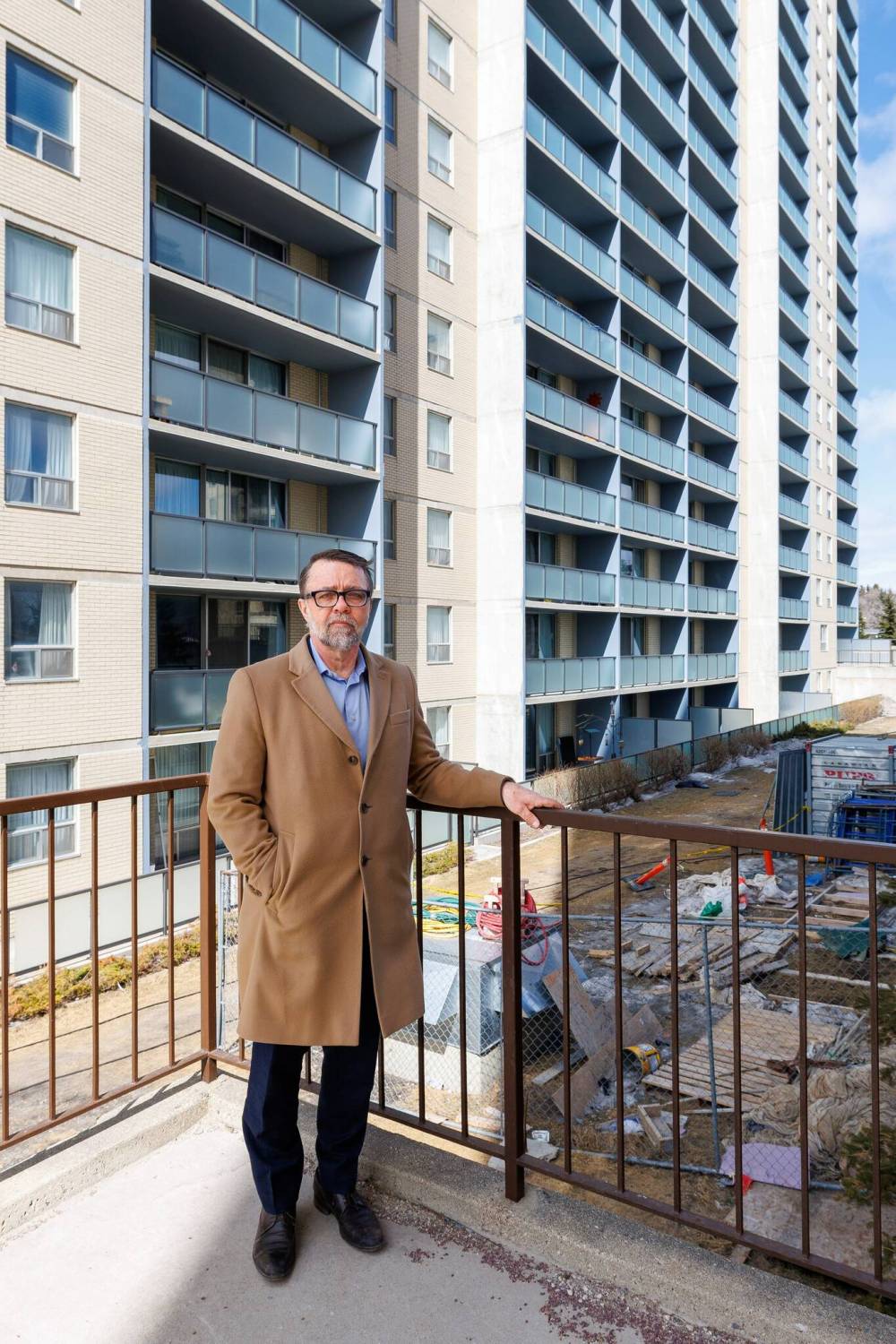
MIKE DEAL / FREE PRESS
Ron Penner, chief operating officer of Globe Property Management, outside one of the apartment towers at Courts of St. James.
A helpful model would include passing the cost of a suite’s renovation to the future renter instead of splitting the money between the entire block, Charach said.
The Manitoba government introduced legislation this year to increase the number of rent-controlled units. Currently, exemptions begin for units charging $1,670 or more. If passed, the floor will be $2,000.
Buildings less than 20 years old are exempt.
“The changes are good,” said Neil Kraemer, a renter and member of the West Broadway Tenants Committee. “(But) they don’t quite go far enough.”
He lives at 645 Westminster Ave., a building that went without heat for weeks this winter. Kraemer’s rent has increased from $941 per month in 2019 to $1,341 through a series of above-guideline rent increases. He said many of the renovations weren’t necessary.
“There’s no requirement for the landlord to prove that any of these renovations were necessary,” Kraemer said. “Everything’s gotten more expensive.”
He’d like to see rent discounts eliminated as the advertised price of a unit sometimes doesn’t last, leaving the renter with much heftier bills than they’d signed up for, he said.
“The landlord is choosing not to make as much profit because the market won’t bear it,” Charach said of discounts, adding the government approved a higher rent.
Landlords remove discounts to pay their bills, Charach continued, saying “we’re facing exactly what our tenants are facing (with affordability).”
He said nationally, the average profit in the industry doesn’t exceed five per cent. Statistics Canada reported an industry profit margin of 36.9 per cent in 2023, up from 36.2 per cent in 2022, which doesn’t factor many expenses, such as income tax and salaries.

Public Service Delivery Minister Mintu Sandhu said he was reasonable and would continue listening to both renters and property managers.
“Right now is the largest expansion to the rent control in decades,” Sandhu said.
The rules will be reviewed every five years, he added.
The median Manitoba two-bedroom apartment rent was $1,518 last October, according to the Canada Mortgage and Housing Corporation.
gabrielle.piche@winnipegfreepress.com
Gabrielle Piché reports on business for the Free Press. She interned at the Free Press and worked for its sister outlet, Canstar Community News, before entering the business beat in 2021. Read more about Gabrielle.
Every piece of reporting Gabrielle produces is reviewed by an editing team before it is posted online or published in print — part of the Free Press‘s tradition, since 1872, of producing reliable independent journalism. Read more about Free Press’s history and mandate, and learn how our newsroom operates.
Our newsroom depends on a growing audience of readers to power our journalism. If you are not a paid reader, please consider becoming a subscriber.
Our newsroom depends on its audience of readers to power our journalism. Thank you for your support.
Gabrielle Piché reports on business for the Free Press. She interned at the Free Press and worked for its sister outlet, Canstar Community News, before entering the business beat in 2021. Read more about Gabrielle.
Every piece of reporting Gabrielle produces is reviewed by an editing team before it is posted online or published in print — part of the Free Press‘s tradition, since 1872, of producing reliable independent journalism. Read more about Free Press’s history and mandate, and learn how our newsroom operates.
Our newsroom depends on a growing audience of readers to power our journalism. If you are not a paid reader, please consider becoming a subscriber.
Our newsroom depends on its audience of readers to power our journalism. Thank you for your support.
Related Articles
NDP bill aims to strengthen renters’ protection


Advertisement Advertise With Us
Advertisement Advertise With Us
History
Updated on Tuesday, April 7, 2026 9:43 AM CDT: Adds clarification