Russia’s internet crackdown leads to a spring of growing discontent
Advertisement
Read this article for free:
or
Already have an account? Log in here »
To continue reading, please subscribe:

Digital Subscription
One year of digital access for only $205*
- Enjoy unlimited reading on winnipegfreepress.com
- Read the E-Edition, our digital replica newspaper
- Access News Break, our award-winning app
- Play interactive puzzles
*First annual payment billed as $205.00 + GST for one year. This annual subscription will automatically renew at $233.00 + GST every 52 weeks (10% off the regular annual price of $259.35). Offer available to new and qualified returning subscribers only. Cancel any time.
To continue reading, please subscribe:
Add Free Press access to your Brandon Sun subscription for only an additional
$1 for the first 4 weeks*
- Enjoy unlimited reading on winnipegfreepress.com
- Read the E-Edition, our digital replica newspaper
- Access News Break, our award-winning app
- Play interactive puzzles
*Your next Brandon Sun subscription payment will increase by $1.00 and you will be charged $17.95 plus GST for four weeks. After four weeks, your payment will increase to $24.95 plus GST every four weeks.
Read unlimited articles for free today:
or
Already have an account? Log in here »
Several dozen people lined up outside a presidential administration building on a sunny spring weekend in central Moscow as police stood nearby and watched them closely.
The people were lodging complaints about the government’s intensifying crackdown on the internet that has seen regular shutdowns of cellphone internet connections, blocked popular messaging apps and cut access to thousands of other websites and digital services.
It was the latest sign of the growing anger and frustration over the restrictions that have disrupted the daily lives of Russians, hurt businesses and drawn criticism even from Kremlin supporters.
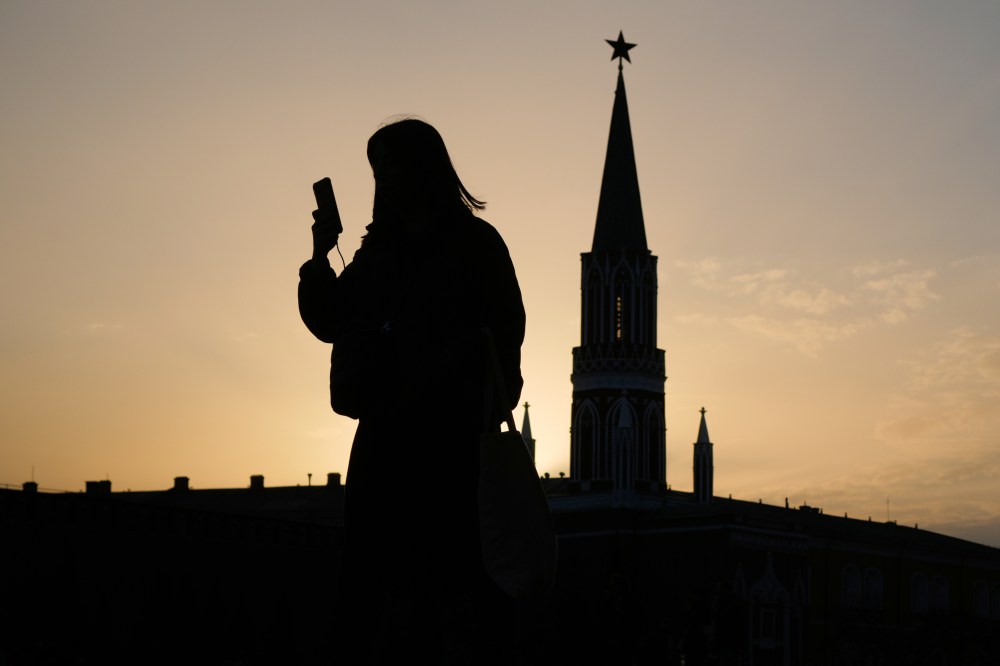
Knowing that any unauthorized demonstrations are harshly suppressed, activists have tried to organize authorized rallies, plastered posters on walls and notice boards, and filed lawsuits. Industry leaders pleaded with authorities to repeal the measures.
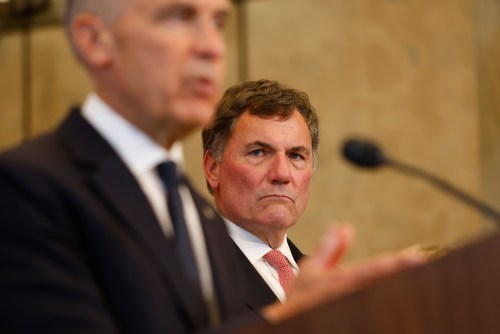
Even the leader of Armenia delivered a not-so-veiled barb at Russia during a televised meeting with President Vladimir Putin on April 1. Prime Minister Nikol Pashinyan noted that in Armenia, “our social media, for example, is 100% free. There are no restrictions whatsoever.”
An unsmiling Putin stared at Pashinyan with slightly raised eyebrows.
The clampdown not only serves to control what websites Russians can see, but also has thrown digital life into disarray, making it difficult to order taxis and deliveries, pay for goods and services electronically, and stay in touch with friends and family.
Politician and Kremlin critic Boris Nadezhdin spoke for many Russians who are upset about the internet clampdown when he said in an interview with The Associated Press: “This infuriates a huge number of people.”
Moves toward internet control
For years, Russia has sought to take the internet under total government control and potentially cut it off from the rest of the world, blocking tens of thousands of websites, messaging apps and social media platforms that refuse to cooperate with the authorities.
Internet users have gotten used to circumventing the restrictions by using virtual private networks, or VPNs, even as the government has been actively blocking those, too.
But last year, the restrictions reached a whole new level: sweeping shutdowns of cellphone internet connections -– and sometimes broadband, too -– leaving only a handful of websites and apps on government-approved “white lists.”
Officials claimed the drastic measures were needed to thwart Ukrainian drones relying on Russian cellphone internet for navigation as Kyiv tries to strike back during Moscow’s 4-year-old full-scale invasion.
But the shutdowns hit remote regions that have never been targeted by Ukraine’s drones, with ordinary people and businesses decrying the measures as detrimental.
The Kremlin has gone after the country’s two most popular messaging apps — WhatsApp and Telegram — while simultaneously promoting a state-backed “national” app called MAX, widely seen as a surveillance tool.
At first, voice and video calls on WhatsApp and Telegram were blocked. Then, sending messages became effectively impossible, too, without using a VPN.
Last week, Digital and Communications Minister Maksut Shadayev said his ministry received orders to further decrease the use of VPNs. Unconfirmed media reports said his ministry proposed a flurry of new measures against VPNs. The ministry did not respond to a request for comment sent by AP.
Lawyer Sarkis Darbinyan, co-founder of the RKS Global digital rights group, told AP the goal of the authorities is to drive internet users into a “digital ghetto” of Russian, government-controlled apps and platforms.
“The internet is no longer this universal digital good,” he said.
Business leaders seek moderation
In recent weeks, a growing number of business leaders in Russia have voiced concern about the sweeping restrictions and urged authorities to take a more moderate approach.
Alexander Shokhin, head of the Russian Union of Industrialists and Entrepreneurs, told Putin at a recent forum of the group that cellphone internet shutdowns “made life difficult for both businesses and citizens.”
“Given the high level of mobile technology penetration in our lives, we hope that a systemic, balanced solution will be found,” said Shokhin, a government minister in the 1990s and a member of the ruling United Russia party since the 2000s.
Putin was onstage with Shokhin and spoke immediately after him but didn’t address the issue.
A similar plea came from CEOs of two of Russia’s four cellphone operators at a telecommunications conference last week. Sergei Anokhin of Beeline and Khachatur Pombukhchan of Megafon said that instead of cellphone internet shutdowns, operators could just identify suspicious users and restrict them, the Russian news agency Interfax reported.
“This would make life significantly easier for people, for clients,” Pombukhchan said.
Prominent IT entrepreneur Natalya Kasperskaya lambasted Roskomnadzor, blaming its intensifying efforts to block VPNs for a brief outage last weekend of banking and other services.
“There’s no technical way to block VPNs without disrupting the entire internet,” she wrote in a post on Telegram. “So, comrades, take screenshots of interesting websites, withdraw as much cash as possible, and get ready to listen to radio reports about foreign enemies who have blocked our once-beloved RuNet,” — referring to the Russian internet.
Roskomnadzor denied involvement, and Kasperskaya later apologized in a separate post, but she called for dialogue between the authorities and the IT sector, stressing that “technical decisions sometimes cause downright shock and a desire to at least get an explanation.”
Cautious steps toward protest
Activists from Moscow to Vladivostok in the Far East have tried to organize rallies against internet restrictions since late February.
Knowing that unauthorized demonstrations are harshly suppressed and government critics are routinely jailed, they acted cautiously and sought authorization for the gatherings in accordance with strict protest laws. In most cases, those were rejected, and some activists were even arrested on various charges.
But people managed to hold small pickets in a few cities. In others, activists plastered flyers and banners on walls and public notice boards decrying the restrictions.

Opposition politician Nadezhdin, his supporters and other activist groups have filed for permission to hold rallies in dozens of cities on April 12, when Russia marks Cosmonautics Day, honoring the 1961 flight of Yuri Gagarin, the first human in space.
“We’re filing for authorization (and saying) we’re marking Cosmonautics Day,” Nadezhdin says with a subtle smile. “Our slogans will be (about the fact that) cosmonautics is impossible without science, technology and progress, and progress, science and technology development is impossible without connectivity, without communication, without the internet.”
Nadezhdin says he is determined to increase pressure on authorities despite the crackdown. Public frustration over the restrictions is “enormous,” and people are ready to take part in protests that are authorized and safe, he added.
Moscow-based opposition politician Yulia Galyamina echoed his sentiment in a video she recorded last weekend near the presidential administration, where she and others filed their formal complaints, saying the discontent “is truly widespread.”
“The more there is public outcry over the blocking of the internet, Telegram in particular, and depriving us of the possibility to communicate with each other, interact, express our political position, the bigger the effect will be,” she said.