

Survey reveals widespread support in province for LGBTTQ+ community’s rights

Advertisement
Read this article for free:
or
Already have an account? Log in here »
To continue reading, please subscribe:
Digital Subscription
One year of digital access for only $1.44 a week*
- Enjoy unlimited reading on winnipegfreepress.com
- Read the E-Edition, our digital replica newspaper
- Access News Break, our award-winning app
- Play interactive puzzles
*Billed as $5.77 plus GST every four weeks. After 52 weeks, price increases to the regular rate of $19.95 plus GST every four weeks. Offer available to new and qualified returning subscribers only. Cancel any time.
To continue reading, please subscribe:
Add Free Press access to your Brandon Sun subscription for only an additional
$1 for the first 4 weeks*
- Enjoy unlimited reading on winnipegfreepress.com
- Read the E-Edition, our digital replica newspaper
- Access News Break, our award-winning app
- Play interactive puzzles
*Your next Brandon Sun subscription payment will increase by $1.00 and you will be charged $17.95 plus GST for four weeks. After four weeks, your payment will increase to $24.95 plus GST every four weeks.
Read unlimited articles for free today:
or
Already have an account? Log in here »
Hey there, time traveller!
This article was published 09/04/2026 (191 days ago), so information in it may no longer be current.
More than seven out of 10 Manitobans believe the rights of people in the province’s LGBTTQ+ community should be protected by law, new poll results reveal.
A Probe Research survey of 1,000 Manitobans, including 400 outside of Winnipeg, found that while half of the participants said they had no close relationships with an LGBTTQ+ person, 71 per cent believe the rights of people who identify as a member of that community should have the protection of strong rights laws.
While 67 per cent of the LGBTTQ+ people surveyed said their community had not yet reached full equality, the majority said they felt their life was headed in a good direction, they had access to the income they needed and considered their access to work and income to be good.
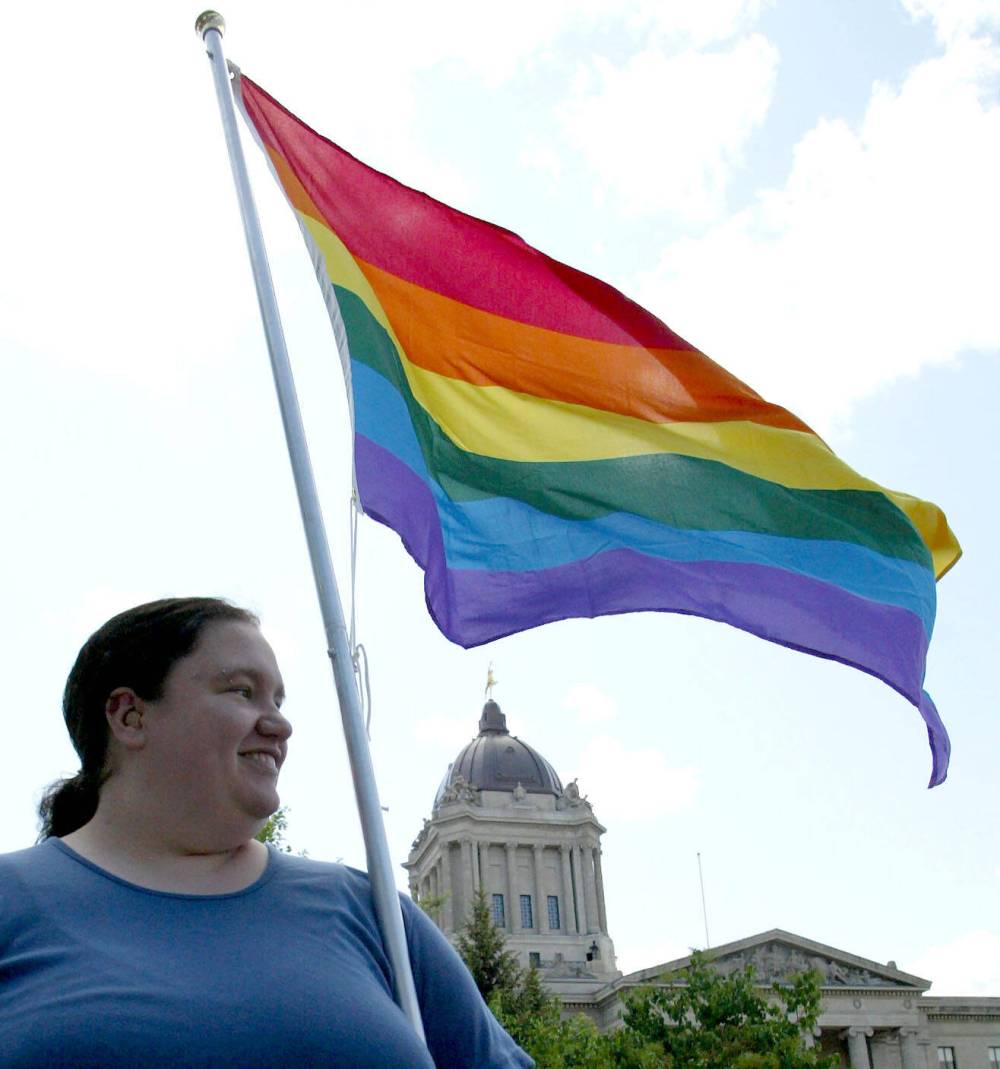
JOE BRYKSA / FREE PRESS FILES
A Probe Research survey of 1,000 Manitobans found 71 per cent of the participants believe the rights of people who identify as a member of the LGBTTQ+ community should have the protection of strong rights laws.
Those results are especially heartening for community non-profit Rainbow Resource Centre executive director Noreen Mian, as the people she serves watch legislation affecting transgender youth passed in Alberta, and the U.S. administration under President Donald Trump walks back supports for transgender people.
“I think Manitobans, in general, we’ve always existed as kind of an island, and we’ve always taken care of ourselves,” Mian said Thursday. “And I think that strong sense of community is what sort of sets us apart.”
The data was presented at a Winnipeg Chamber of Commerce event Thursday focused on LGBTTQ+ Manitobans in the workplace. The full report from Probe Research will be released next month.
Not all of the numbers painted a positive picture. LGBTTQ+ Manitobans said they were more likely to feel lonely, undervalued by society or not included. People who did not have any close relationships with LGBTTQ+ people were less likely to describe it as a “normal and natural thing.”
When asked ideological questions that have been points of contention in recent years, there was more of a split. Out of those surveyed, 54 per cent said they believed “gender ideology” had gone too far, 61 per cent said parents should be notified if a child changes pronouns at school, and just over one in four said they believe drag performers indoctrinate or groom children.
Those numbers are largely driven by young men, dispelling a oft-held belief that young people inherently have more progressive values, said Probe Research principal Mary Agnes Welch.
“I think as we think about crafting (diversity, equity and inclusion) programs and training in workplaces, I think traditionally, perhaps some of those have been kind of focused on middle-aged folks, women, even older men,” said Welch.
“And that’s not the problem…. We see this in every survey we do about climate change, about views on encampments, about views on immigration, there is an increasing cohort of young men, less educated, who are not being reached by the entire discussion of equity and inclusion and diversity. And for me, this is just one little example of how those folks are falling through the cracks.”
Welch said the data suggested having an LGBTTQ+ person in your life — be it in the workplace, friendships, relatives or otherwise — has a huge impact on a person’s internal belief system.

“The important thing about this, and this was maybe a surprise to us in this project, is that having those relationships a family member, a close friend, a cousin, it drives views,” she said.
Mian said anti-LGBTTQ+ sentiment persists in Manitoba, pointing to comments made by Opposition Leader Obby Khan, who was criticized by Manitoba’s Speaker this week after he said Khan told Health Minister Uzoma Asagwara, who is non-binary, “You are a terrible person, whatever you are.”
“It’s affecting. People are feeling more emboldened than I think they did five years ago,” Mian said.
There are over 270,000 Manitobans who either identify as part of the LGBTTQ+ community or have a member of the community in their immediate family, according to Rainbow Resource Centre.
malak.abas@freepress.mb.ca
Malak Abas is a city reporter at the Free Press. Born and raised in Winnipeg’s North End, she led the campus paper at the University of Manitoba before joining the Free Press in 2020. Read more about Malak.
Every piece of reporting Malak produces is reviewed by an editing team before it is posted online or published in print — part of the Free Press‘s tradition, since 1872, of producing reliable independent journalism. Read more about Free Press’s history and mandate, and learn how our newsroom operates.
Our newsroom depends on a growing audience of readers to power our journalism. If you are not a paid reader, please consider becoming a subscriber.
Our newsroom depends on its audience of readers to power our journalism. Thank you for your support.
Malak Abas is a city reporter at the Free Press. Born and raised in Winnipeg’s North End, she led the campus paper at the University of Manitoba before joining the Free Press in 2020. Read more about Malak.
Every piece of reporting Malak produces is reviewed by an editing team before it is posted online or published in print — part of the Free Press‘s tradition, since 1872, of producing reliable independent journalism. Read more about Free Press’s history and mandate, and learn how our newsroom operates.
Our newsroom depends on a growing audience of readers to power our journalism. If you are not a paid reader, please consider becoming a subscriber.
Our newsroom depends on its audience of readers to power our journalism. Thank you for your support.
Related Articles
Winnipeg-based Probe Research acquired by Abacus Data
Advertisement Advertise With Us
Advertisement Advertise With Us