

Oblivious Conservatives fiddling while Poilievre burns

Advertisement
Read this article for free:
or
Already have an account? Log in here »
To continue reading, please subscribe:

Digital Subscription
One year of digital access for only $205*
- Enjoy unlimited reading on winnipegfreepress.com
- Read the E-Edition, our digital replica newspaper
- Access News Break, our award-winning app
- Play interactive puzzles
*First annual payment billed as $205.00 + GST for one year. This annual subscription will automatically renew at $233.00 + GST every 52 weeks (10% off the regular annual price of $259.35). Offer available to new and qualified returning subscribers only. Cancel any time.
To continue reading, please subscribe:
Add Free Press access to your Brandon Sun subscription for only an additional
$1 for the first 4 weeks*
- Enjoy unlimited reading on winnipegfreepress.com
- Read the E-Edition, our digital replica newspaper
- Access News Break, our award-winning app
- Play interactive puzzles
*Your next Brandon Sun subscription payment will increase by $1.00 and you will be charged $17.95 plus GST for four weeks. After four weeks, your payment will increase to $24.95 plus GST every four weeks.
Read unlimited articles for free today:
or
Already have an account? Log in here »
The warning signs for the federal Conservatives are no longer subtle — they’re sitting in plain view on the government benches.
Another one of their own just got up and walked across the aisle.
Ontario MP Marilyn Gladu’s decision to bolt the Conservative caucus and join Prime Minister Mark Carney’s Liberals is not an isolated incident. She is the fifth opposition MP to do so in a matter of months — and the fourth to abandon the Conservatives. That’s not bad luck. That’s a pattern.
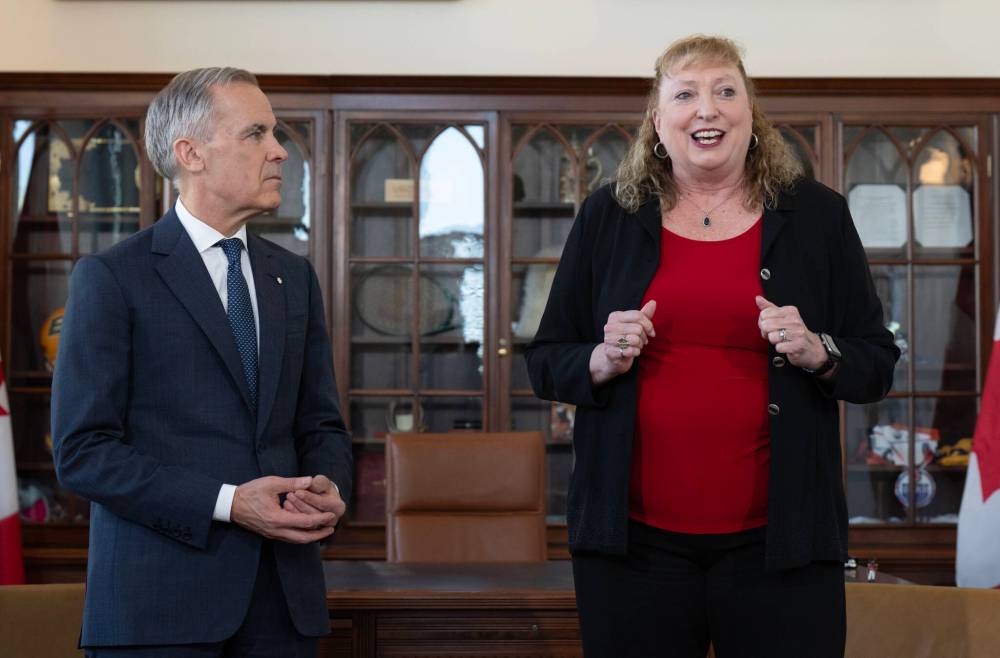
Prime Minister Mark Carney looks on as MP for Sarnia-Lambton-Bkejwanong Marilyn Gladu speaks in Ottawa, Wednesday. (Adrian Wyld / The Canadian Press)
At some point, patterns demand explanation.
And yet, the Conservatives under Pierre Poilievre don’t appear remotely interested in asking the obvious question: why?
Why are sitting MPs — people who have campaigned under the Conservative banner, knocked on doors, raised money and defended the party publicly — deciding they’d rather sit with the Liberals?
The easy answer — the one Poilievre himself defaults to — is to blame everyone else. In Gladu’s case, he accused the prime minister of engineering a “backroom deal” to “seize” a majority voters didn’t grant him. He also took a shot at Gladu, suggesting she should resign and run again under her new political colours.
That may play well with the party’s base. But it avoids the harder truth.
MPs don’t cross the floor in growing numbers because they’re all part of some grand conspiracy. They cross because something isn’t working where they are.
Gladu, notably, framed her decision in terms that should set off alarm bells in Conservative headquarters. She talked about the need for “serious leadership” in the face of economic uncertainty, about nation-building projects, trade diversification and strengthening defence — all issues the Conservatives claim to care about.
But in her view, it’s the Liberals under Carney who are delivering a credible agenda on those fronts.
That should sting.
Because for the better part of a decade, the Conservatives have tried to position themselves as the party of economic competence and pragmatic governance. Now, one of their own is effectively saying the other team is doing it better.
And she’s not alone.
Public opinion polls have been telling a similar story for months. The Liberals hold a solid, often double-digit lead nationally.
Poilievre has built his political identity around a combative, populist style that thrives on grievance and sharp-edged attacks. It energizes a segment of the electorate — there’s no question about that. His rallies are loud, his social media presence is aggressive and his messaging is relentlessly focused on what’s broken.
But elections aren’t won by energizing a segment. They’re won by persuading a broad range of voters to buy into a political party’s brand.
And right now, the Conservative brand under Poilievre isn’t persuading enough Canadians that it’s ready to govern.
There’s a difference between criticizing the government and convincing voters you can replace it. The former is easy. The latter requires discipline, credibility and — perhaps most important — a tone that signals stability rather than perpetual outrage.
That’s where Poilievre continues to fall short.
Meanwhile, Carney has positioned himself — at least so far — as the adult in the room. His focus on economic stewardship, trade diversification and large-scale infrastructure projects speaks to a country looking for stability in uncertain times.
You can debate the substance of his policies, but politically, the contrast is working.
Even more telling is what the Conservatives haven’t done.
Despite months of unfavourable polling and a steady drip of caucus defections, there has been no meaningful recalibration, no softening of tone and no effort to broaden the party’s appeal beyond its core supporters.
Instead, it’s been more of the same.
That may be a deliberate strategy. Poilievre and his team may believe that doubling down will eventually break through — that Canadians will come around as economic pressures persist.
But that’s a gamble.
Because the longer the Conservatives stick to a strategy that isn’t producing results, the more they risk entrenching the very perceptions that are holding them back.
Politics has a way of hardening impressions over time. A leader seen as abrasive today is unlikely to be seen as unifying tomorrow without a conscious effort to change course.
And if MPs continue to drift away — if the trickle becomes a steady stream — it won’t just be a perception problem, it will be an organizational one.
Caucus unity matters. So does morale. So does the ability to present a credible, cohesive alternative government.

Right now, the Conservatives are struggling on all three fronts.
Losing MPs to your primary opponent, trailing badly in the polls and failing to connect with a broad swath of the electorate aren’t external problems, they’re internal ones.
At some point, the question isn’t whether something needs to change, it’s whether the party is willing to change it.
So far, there’s little evidence that kind of soul searching is occurring within the Conservative Party of Canada.
tom.brodbeck@freepress.mb.ca
Tom Brodbeck is an award-winning author and columnist with over 30 years experience in print media. He joined the Free Press in 2019. Born and raised in Montreal, Tom graduated from the University of Manitoba in 1993 with a Bachelor of Arts degree in economics and commerce. Read more about Tom.
Tom provides commentary and analysis on political and related issues at the municipal, provincial and federal level. His columns are built on research and coverage of local events. The Free Press’s editing team reviews Tom’s columns before they are posted online or published in print – part of the Free Press’s tradition, since 1872, of producing reliable independent journalism. Read more about Free Press’s history and mandate, and learn how our newsroom operates.
Our newsroom depends on a growing audience of readers to power our journalism. If you are not a paid reader, please consider becoming a subscriber.
Our newsroom depends on its audience of readers to power our journalism. Thank you for your support.
Tom Brodbeck is an award-winning author and columnist with over 30 years experience in print media. He joined the Free Press in 2019. Born and raised in Montreal, Tom graduated from the University of Manitoba in 1993 with a Bachelor of Arts degree in economics and commerce. Read more about Tom.
Tom provides commentary and analysis on political and related issues at the municipal, provincial and federal level. His columns are built on research and coverage of local events. The Free Press’s editing team reviews Tom’s columns before they are posted online or published in print – part of the Free Press’s tradition, since 1872, of producing reliable independent journalism. Read more about Free Press’s history and mandate, and learn how our newsroom operates.
Our newsroom depends on a growing audience of readers to power our journalism. If you are not a paid reader, please consider becoming a subscriber.
Our newsroom depends on its audience of readers to power our journalism. Thank you for your support.
Related Articles
Ontario MP Marilyn Gladu says she's joining Carney's Liberal government








Advertisement Advertise With Us
Advertisement Advertise With Us